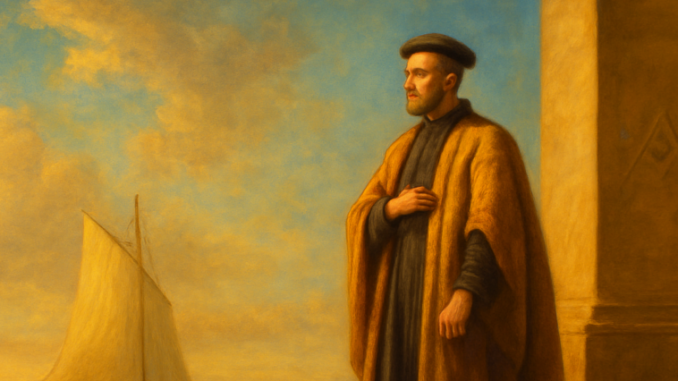
Every morning we choose what to put on. It seems like the simplest of acts — routine, unremarkable, hardly worth a second thought. Yet behind this daily ritual lies a world of meaning. Michel de Montaigne, the sixteenth-century philosopher who essentially invented the personal essay as a tool of self-examination, turned his penetrating gaze on this very subject. In his brief but provocative essay ‘On the Custom of Wearing Clothes,’ he asks why human beings clothe themselves at all — and what this seemingly trivial question reveals about our nature, our habits, and the layers we place between ourselves and the world.
The Core Question: Why Do We Dress at All?
Montaigne opens with a question so elementary that most of us never bother to ask it: is clothing truly a natural necessity, or merely a learned habit? He observes that many peoples around the world live perfectly well without garments, even in climates that we would consider far too harsh for bare skin. We are born naked, he reminds us, and could presumably survive without textiles if custom allowed it.
This is not a manifesto for nudism. It is a philosophical exercise — a deliberate provocation designed to wake us up to the immense power of habituation. What we regard as absolutely essential often turns out to be nothing more than the product of tradition and upbringing. The clothing we wear is not simply protection from the elements; it is a symbol of the cultural layers we have draped over our original nature.
Evidence from Distant Lands and Ancient Times
Montaigne was an avid collector of stories and testimonies. In this essay, he draws on accounts of peoples who live unclothed in frigid regions, soldiers who marched barefoot through snow, and ancient philosophers who deliberately embraced austerity. He references the reports of explorers who encountered indigenous populations in the New World, where nakedness was the norm despite conditions that Europeans would consider brutal.
These examples are not meant to romanticize other cultures. Their purpose is to highlight the relativity of our own customs. If others can live without clothing, what does that say about the supposed indispensability of our wardrobes? Montaigne invites us to look past our assumptions and ask a fundamental question: what is truly natural, and what is merely acquired?
Clothing as a Mirror of the Mind
Beneath the surface of Montaigne’s observations lies a deeper message. Clothing functions as a metaphor for all the layers we wrap around our true selves. The fabrics we wear are no different from the masks we put on, the roles we perform, the conventions to which we conform. In a very real sense, Montaigne is asking: who are we when all these layers are stripped away?
Clothing covers the body, but habit covers the mind — and both conceal what is original and authentic within us.
This thought resonates deeply with the broader project of the Essays: the systematic examination of assumptions in pursuit of genuine self-understanding. Montaigne does not claim to possess absolute truths. Instead, he cultivates the awareness that much of what we consider fixed and certain is, in reality, fluid and contingent.
The Symbolism of Concealment and Revelation
From a symbolic perspective, clothing is one of the most fundamental expressions of the human condition. We cover ourselves because we are vulnerable, because we belong to a community with its own codes, because we wish to present ourselves in a particular way. Yet every act of covering is simultaneously an act of revelation — what we choose to hide tells as much about us as what we choose to display.
In this light, Montaigne’s essay takes on a universal dimension. It is not merely about fabric and fashion; it is about the tension between inner and outer, between essence and appearance. The garments we wear become symbols of the conventions we accept and the boundaries we draw between ourselves and the world around us. For those who walk a path of self-knowledge — in Masonic tradition or otherwise — this tension between concealment and revelation is a familiar and fertile subject for contemplation.
Habit as Second Nature
A recurring theme throughout Montaigne’s work is the extraordinary power of habit. He regards it as a second nature — one so potent that it often completely overshadows the first. Clothing serves as the perfect illustration: we are so accustomed to wearing garments that we cannot imagine living without them. And yet other cultures and historical periods prove that this is no absolute necessity.
This observation carries practical implications for anyone engaged in the work of self-knowledge. If habit governs our thinking and behaviour so thoroughly, then genuine self-examination requires more than introspection alone. It demands that we identify the learned patterns steering us from within — the reflexes, the assumptions, the automatisms we take for granted. Montaigne encourages us to examine our own ‘clothing’: the beliefs we have inherited, the opinions we have never questioned, the habits of mind we mistake for truths.
For Freemasons, this resonates with the imperative to work the rough ashlar — to chip away at the unexamined habits and inherited prejudices that prevent us from becoming our truest selves. The apron, the glove, the regalia: these too are garments, chosen deliberately, rich with symbolism. They remind us that what we wear — literally and figuratively — should be a conscious choice, not a sleepwalker’s reflex.
The Enduring Relevance of Montaigne’s Reflection
Montaigne’s meditation on clothing remains strikingly relevant in an age dominated by outward appearance and personal branding. The question of what we conceal and what we reveal is arguably more urgent than ever. Fashion, identity, authenticity — all of these concepts connect directly to the themes Montaigne explores in this short essay.
His writing invites contemplation about the layers we wrap around ourselves, both literally and figuratively. It poses the question: are we willing to set some of those layers aside — not to stand exposed, but to see more clearly what lies beneath? In this sense, even a brief essay on such an everyday subject becomes a profound meditation on self-knowledge and the courage it takes to pursue it honestly.
Montaigne’s essay on clothing is short, but its implications are vast. It reminds us that even our most taken-for-granted habits are products of culture and conditioning, not immutable laws of nature. Behind the fabric we wear lies the deeper question of who we truly are when every layer has been removed. It is an invitation to look not only into our wardrobes but into all the wrappings we have placed around our minds and hearts — and to ask honestly which of those serve us and which merely hold us back from the light of authentic self-understanding.
Copyright text & image: devrijmetselaar.nl
Texts are based on the ideas and content of the author of devrijmetselaar.nl, reviewed, corrected, and supplemented with the assistance of OpenAI. Images are created based on the ideas of the author of devrijmetselaar.nl using OpenAI/DALL-E.
Frequently Asked Questions
What is Montaigne's main argument about why humans wear clothes?
Montaigne argues that clothing is not a natural necessity but rather a learned habit and cultural custom. He observes that many peoples around the world live without garments even in harsh climates, and notes that humans are born naked. His point is not to promote nudism, but to demonstrate how habituation and tradition have convinced us that clothing is essential when it may actually be a cultural layer we have placed over our original nature.
What evidence does Montaigne use to support his philosophy on clothing?
Montaigne draws on accounts from explorers and historical sources, including stories of peoples living unclothed in frigid regions, soldiers marching barefoot through snow, ancient philosophers who embraced austerity, and indigenous populations encountered in the New World. These examples are intended to highlight the relativity of cultural customs and to challenge the assumption that Western clothing practices are universal necessities.
How does Montaigne use clothing as a philosophical tool?
Montaigne uses clothing as a metaphor and philosophical exercise to examine the power of habituation and custom in human life. By questioning something as mundane and routine as getting dressed each morning, he awakens readers to recognize that what we regard as absolutely essential often turns out to be nothing more than the product of tradition and upbringing, serving as a symbol of the cultural layers we place between ourselves and the world.


Be the first to comment