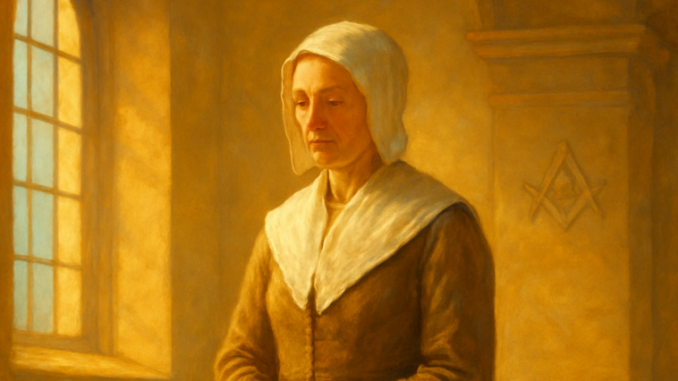
Two spiritual traditions that seem to have little in common reveal surprising points of convergence when examined side by side. The Quakers, born in seventeenth-century England, articulated five core principles they call “testimonies.” Freemasons, whose modern organizational form took shape in that very same era, developed their own system of values designed to guide daily conduct. How do these two traditions relate to each other? And what does a comparison reveal about the universal human quest for spiritual depth?
The Quaker Way: Life as Testimony
The Quakers, formally known as the Religious Society of Friends, developed their five testimonies as practical expressions of inward faith. These testimonies are: simplicity, peace, integrity, community, and equality. Unlike rigid doctrines, they function as compass points for everyday life. George Fox, the founder of the Quaker movement, insisted that true spirituality does not reside in outward forms but in the direct experience of the Inner Light.
For the Quaker, every action is a potential testimony. The choice to wear plain clothing was not a fashion statement — it was a stand against vanity. The refusal to swear oaths in court was not civil disobedience — it was a testimony of integrity, an insistence that one’s word should always be truthful, making oaths redundant. Words and deeds form a single whole in this tradition.
The Masonic Way: Building Character
Freemasonry approaches spiritual growth along a different path. Where Quakers draw their principles directly from inner revelation, the Freemason works with rituals, symbols, and degrees. The core values of brotherhood, love of truth, tolerance, and moral self-improvement are not so much proclaimed as they are experienced within an initiatic context.
The rituals in the lodge serve as both mirror and workshop. A Freemason is not born — he is made through labor on the rough ashlar of his own character. This process unfolds in silence and discretion, sheltered from the outside world. Where the Quaker makes his testimony visible in society, the Freemason often guards his inner journey for himself and his brethren.
Five Testimonies Alongside Five Building Stones
When we place the five Quaker testimonies alongside Masonic values, a fascinating pattern of correspondence and contrast emerges:
Simplicity finds its echo in the Masonic aversion to outward display and the emphasis on inner worth over material status. In the lodge, titles and social standing are set aside. What matters is the quality of the man within.
Peace resonates with the Masonic obligation to maintain brotherly harmony and to avoid religious and political disputes within the lodge. Both traditions recognize that genuine community requires the deliberate cultivation of peace.
Integrity is a cornerstone for both. The Quaker prohibition on falsehood finds its Masonic equivalent in the demand for sincerity and honest dealing. A Mason is expected to be truthful in all his transactions, just as the Quaker strives to let every word be trustworthy.
Community manifests among Quakers in the caring meeting, where members support one another spiritually and materially. Among Freemasons, it takes form in the chain of brotherhood that transcends borders, cultures, and social classes.
Equality is, for Quakers, a theological given — every person carries the Inner Light. For Freemasons, equality is ritually affirmed each time brethren meet on the level, regardless of their station in the outside world.
Where the Paths Diverge
The parallels are striking, but the differences are equally significant. Quakers operate in complete openness; their meetings are accessible to all, their principles public. Freemasons, by contrast, cherish privacy as a precondition for genuine self-reflection. This difference is not a deficiency — it is a deliberate choice rooted in different understandings of how spiritual growth best flourishes.
A more fundamental distinction concerns the relationship to faith. Quakers are explicitly Christian in origin, even though modern Quaker communities have broadened considerably. Freemasonry requires no specific creed — only the acknowledgment of a higher reality that each Mason may define for himself. This openness makes the lodge a meeting place for men of vastly different religious backgrounds, a space where shared values matter more than shared theology.
Both Quakers and Freemasons seek to connect inner conviction with outward action, but the Quaker testifies in the full light of day while the Freemason builds in the shelter of the temple.
What Both Traditions Share
Beneath all the differences lies a shared conviction: that spirituality only becomes meaningful when it is made flesh in daily life. Neither the Quaker nor the Freemason is satisfied with abstract professions of belief. What matters is the translation of principles into concrete deeds — acting justly, speaking truthfully, forming communities that transcend individual self-interest.
Both traditions emerged during a period of intense religious upheaval and sought a way beyond dogmatic conflict. The Quakers did this by rejecting all outward religion in favor of the Inner Light. The Freemasons created a space where men of different faiths could come together as brothers. Both responses testify to the same hunger for authentic spirituality — a spirituality rooted not in creed but in conduct.
Lessons for the Seeking Mind
The comparison between Quakers and Freemasons teaches us that spiritual traditions need not be in competition. They are different answers to universal questions. The five testimonies of the Quakers and the core values of Freemasonry are like two maps of the same landscape, each with its own scale and legend, but pointing toward the same human longings: for truth, for community, for a life that amounts to more than the accumulation of possessions and status.
For anyone who studies both traditions, it becomes clear that the path to inner growth can take many forms. Some find their way in the expectant silence of a Quaker meeting; others discover it in the ritual work of the lodge. What matters is not the form, but the sincerity of the search.
The five testimonies of the Quakers and the values of Freemasonry together bear witness to a profound human striving — the desire to live with purpose, integrity, and genuine connection to others. Though their methods differ, both traditions remind us that the measure of any spiritual path lies not in what we profess, but in how we live. For seekers willing to look beyond surface differences, these two venerable traditions offer complementary wisdom for the journey toward a more meaningful life.
Copyright text & image: devrijmetselaar.nl
Texts are based on the ideas and content of the author of devrijmetselaar.nl, reviewed, corrected, and supplemented with the assistance of OpenAI. Images are created based on the ideas of the author of devrijmetselaar.nl using OpenAI/DALL-E.

Be the first to comment