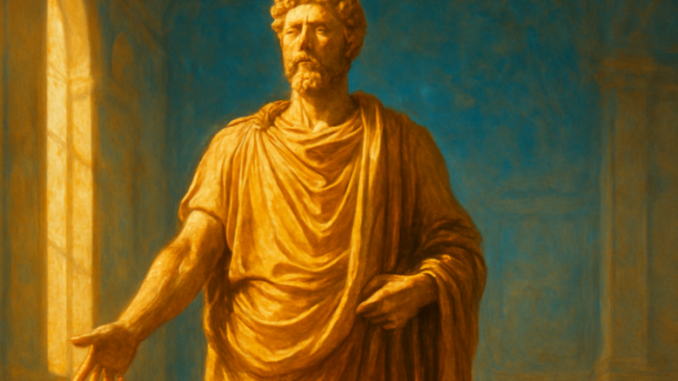
In 172 AD, Emperor Marcus Aurelius sat along the Danube frontier, surrounded by war and personal loss, and wrote some of the most penetrating observations ever recorded about the human capacity to transform adversity. His fifth book of the Meditations contains a core insight that still resonates in Masonic lodges around the world nearly two thousand years later: the obstacle becomes the way. This philosophical legacy connects the ancient Stoic tradition with the ongoing pursuit of moral perfection that lies at the heart of Freemasonry.
The Historical Context of Book V
Marcus Aurelius never intended his Meditations for publication. They were private notes — a journal of self-examination written during one of the most turbulent periods of his reign. Book V emerged during the Marcomannic Wars, a grueling campaign against Germanic tribes that kept the emperor far from Rome, surrounded by death and hardship. And yet, amid all of it, he turned his gaze inward. He asked himself a deceptively simple question: how do I remain a good man when the world around me descends into chaos?
This was no rhetorical exercise. Marcus Aurelius buried children, lost trusted advisors, and watched soldiers fall around him. His own health was failing. Still, he refused to see himself as a victim. In Book V, he articulates the principle that every setback offers an opportunity for virtue. The obstacle blocking the path becomes the path itself. This paradox lies at the core of Stoic practice — and would find a powerful echo, centuries later, in the rituals and symbols of Freemasonry.
The Rough Ashlar: Obstacle and Opportunity
In Freemasonry, the rough ashlar symbolizes the individual at the beginning of his journey — unrefined, full of imperfections, yet brimming with potential. This stone must be shaped into a perfect cube, fit for the building of the temple of humanity. What Marcus Aurelius describes as overcoming obstacles, the Freemason understands as working on his own rough stone. Every obstacle is a blow of the gavel; every setback is a chance to smooth away another imperfection.
The obstacle is not what holds us back — it is what shapes us. Once we understand this, every adversity becomes a building block for the growth of character.
Marcus Aurelius would have recognized this symbolism instantly. He wrote about fire purifying gold: the hotter the flame, the purer the metal. The Freemason who works on self-improvement in the lodge applies the same alchemy. The adversities of life — conflict, loss, disappointment — are not to be fled from but embraced as necessary elements of inner transformation. The rough stone does not become a perfect ashlar without the chisel’s bite.
Brotherhood as a Pillar Against Adversity
One crucial difference between the solitary meditations of Marcus Aurelius and the Masonic tradition lies in the role of community. The emperor wrote in isolation, even when surrounded by his legions. The Freemason, by contrast, works within a brotherhood. This distinction matters profoundly. Where the Stoic must overcome his obstacles alone through sheer inner strength, the Freemason finds support in the chain of brethren linked arm to arm.
And yet, Marcus Aurelius himself acknowledged the value of human connection. In Book V, he reflects on his duty to the community and his role as part of the greater human whole. He writes that a hand cannot claim to exist independently of the body. In the same way, no person can truly claim to be separate from his fellow human beings. This thought finds a direct parallel in the Masonic principle of brotherhood: we are all stones in the same temple, all links in the same chain. The individual journey of self-improvement does not happen in a vacuum — it unfolds within the supportive framework of the lodge.
Self-Reflection as a Daily Discipline
Marcus Aurelius began many of his entries with a call to self-reflection upon waking. In Book V, he writes about the necessity of reminding yourself each morning that you will encounter difficult people throughout the day — the ungrateful, the dishonest, the hostile. By accepting this in advance, you prepare yourself to respond with patience rather than anger. This is not cynicism; it is realism in service of virtue.
The Masonic lodge cultivates similar rituals of contemplation. The Chamber of Reflection, the quiet moments before and after labor, the symbolic journey from darkness into light — all of these invite introspection. The brother is encouraged to examine his actions, question his motives, and acknowledge his shortcomings. Just as Marcus Aurelius committed his thoughts to writing to keep himself sharp and accountable, the Freemason uses the symbolism of the Craft to continually build upon his own character.
This daily discipline of looking inward is perhaps the most practical takeaway from both traditions. Grand philosophical principles mean little without consistent application. The Stoic philosopher and the Masonic brother both understand that self-knowledge is not a destination but a practice — one that must be renewed each day.
From Obstacle to Illuminated Path
The central lesson of Book V remains strikingly relevant. Marcus Aurelius teaches us that external circumstances can never determine our inner well-being — unless we allow them to. The obstacle that seems insurmountable reveals itself, upon closer examination, to be a school. The Freemason recognizes in this the quest for light: not the absence of darkness, but the ability to navigate through darkness and draw meaning from it.
Consider the key principles that emerge when Stoic philosophy meets Masonic practice:
- Every setback reveals an unworked part of your own stone.
- Brotherhood provides support where individual strength falls short.
- Self-reflection transforms reaction into conscious, deliberate response.
- The obstacle itself becomes the path toward moral growth.
What Marcus Aurelius wrote in solitude along the Danube finds a home in the symbolic space of the lodge. Stoic wisdom and the Masonic tradition speak the same language, though with different accents. Both recognize that a person is not defined by what happens to him, but by how he responds. Both see in the obstacle not a blockade, but an invitation to transformation.
The Meditations of Marcus Aurelius — and Book V in particular — offer a timeless guide for anyone grappling with the inevitable setbacks of existence. For the Freemason, this Stoic heritage provides a philosophical foundation for the symbolic work of the lodge. The rough ashlar is not shaped by comfort and ease; it is shaped by the very resistance it encounters. In learning to see every obstacle as raw material for growth, both the Stoic philosopher and the Masonic brother discover the same enduring truth: the impediment to action advances action, and what stands in the way becomes the way.
Copyright text & image: devrijmetselaar.nl
Texts are based on the ideas and content of the author of devrijmetselaar.nl, reviewed, corrected, and supplemented with the assistance of OpenAI. Images are created based on the ideas of the author of devrijmetselaar.nl using OpenAI/DALL-E.
Frequently Asked Questions
What is the main connection between Marcus Aurelius's philosophy and Freemasonry?
Both traditions share the core principle that obstacles are opportunities for personal growth and virtue. Marcus Aurelius taught that adversity can be transformed into a path for moral improvement, while Freemasonry uses the symbol of the rough ashlar to represent this same journey of self-refinement and character development through overcoming challenges.
Under what circumstances did Marcus Aurelius write Book V of his Meditations?
Marcus Aurelius wrote Book V during the Marcomannic Wars (around 172 AD) while stationed at the Danube frontier. He was surrounded by conflict, personal loss, and hardship, including the death of children and trusted advisors. Despite these circumstances, he used this journal as a tool for self-examination, asking how to remain virtuous amid chaos.
What does the rough ashlar symbolize in Freemasonry, and how does it relate to Marcus Aurelius's teachings?
The rough ashlar represents an individual at the beginning of their journey—unrefined yet full of potential. It must be shaped into a perfect cube through work and refinement. This Masonic symbol directly parallels Marcus Aurelius's teaching that obstacles are the means by which we develop virtue and character, with each setback functioning as another tool that shapes us toward perfection.

Be the first to comment