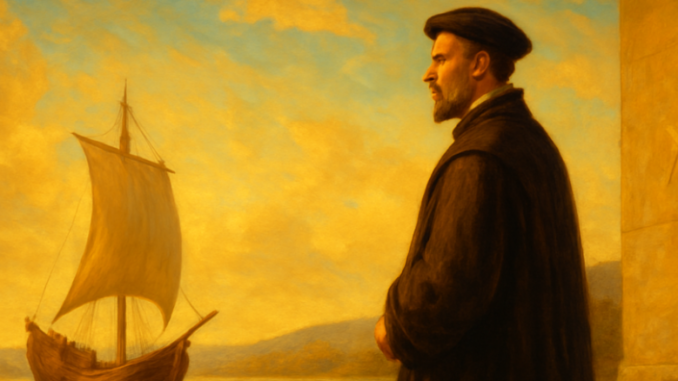
A broken sword on a battlefield. It lies half-buried in the mud, its hilt still warm from the hand that gripped it. At first glance, it is nothing more than the debris of war — a remnant of violence. But for Michel de Montaigne, such an image became the starting point for a far deeper question: what do we actually know for certain about what really happened? In his brief essay on the Battle of Dreux, an entire philosophical landscape unfolds — one rooted in ancient traditions of doubt, self-examination, and intellectual humility. Those same traditions continue to resonate today in the rituals and thinking of Freemasonry.
The Battle Nobody Fully Witnessed
In December 1562, Catholic and Huguenot armies clashed near the northern French town of Dreux. Both sides claimed victory. Both sides suffered devastating losses. Montaigne, a young nobleman who experienced the Wars of Religion at close range, did not use this battle to write a military analysis. Instead, he used it to expose something far more fundamental: the unreliability of eyewitness accounts. Even those who stood in the thick of the fighting could not possibly grasp the full picture. Each person saw only a fragment, coloured by fear, position, and partisan loyalty.
The insight may seem simple, but it touches on one of the oldest questions in philosophy: can we know reality as it truly is? Montaigne answered that question with a cautious but definitive “no.” In doing so, he placed himself squarely within a rich tradition of thinkers who regarded doubt not as a weakness, but as the very beginning of wisdom.
Skepticism as a Way of Life
The most prominent philosophical current running through this essay is Pyrrhonian skepticism. Pyrrho of Elis, the Greek philosopher of the fourth century BCE, taught that true peace of mind arises when one ceases to make definitive judgments. His later follower Sextus Empiricus compiled this mode of thinking into writings that Montaigne studied thoroughly. The famous motto “Que sais-je?” — “What do I know?” — which Montaigne had struck on a medal, encapsulates his entire intellectual programme.
Applied to the Battle of Dreux, this skepticism fits like a glove. Montaigne demonstrates that even with a concrete, tangible event — a battle involving thousands of participants — the truth cannot be fully reconstructed. Not because the facts do not exist, but because every human faculty of perception is limited. This is not nihilism. It is an invitation to humility.
The Influence of Plutarch and Seneca
Montaigne did not draw solely from skepticism. Two ancient authors provided his daily intellectual nourishment: Plutarch and Seneca. From Plutarch, whose Lives and Moralia he read with passion, Montaigne learned that history only becomes meaningful when it yields moral insights. The point is not the exact troop strength at Dreux, but what the story teaches us about human judgment. Plutarch’s method of placing opposing perspectives side by side — as in his parallel biographies of Greek and Roman heroes — clearly echoes in Montaigne’s refusal to declare either party the winner.
From Seneca, the Roman Stoic philosopher whose letters to Lucilius profoundly influenced Montaigne, he adopted the emphasis on inner freedom. Seneca taught that external circumstances — even the chaos of a battlefield — need not overwhelm the wise person, provided he keeps his own judgment sharp and honest. In earlier articles on this site, Seneca’s steadfastness has been explored as a bridge to brotherhood. Here we see another dimension: steadfastness not as immovability, but as the courage to acknowledge that one does not know.
Renaissance Humanism and the Art of Self-Inquiry
Montaigne wrote at a time when Renaissance humanism had broadened the intellectual horizon of Europe. Thinkers such as Desiderius Erasmus and Giovanni Pico della Mirandola had opened the way for a renewed appreciation of the human being as a searching, questioning creature. Montaigne went further than his predecessors by making self-examination radically personal. His essays are not treatises on abstract truths but experiments in honesty: what do I experience, what do I think, and how much of it is reliable?
The essay on Dreux is a compact example of this approach. Montaigne presents no conclusive thesis. He lays down a problem — a broken sword, as it were — and invites the reader to think it through for themselves. This method, more exploratory than demonstrative, aligns closely with what he learned from the Academic Skeptics in the tradition of Plato: that the conversation itself holds the value, not necessarily the final verdict.
The Broken Sword in the Lodge
Anyone familiar with this philosophical background will recognise a striking kinship with Freemasonry. The lodge is a space where the provisional judgment takes centre stage. Freemasons work with rituals that are not designed to provide definitive answers but to evoke the right questions. Just as Montaigne showed at Dreux, the ritual reveals that truth cannot be captured from a single perspective. The rough stone is not perfected in a single blow; it demands patience, repeated examination, and the willingness to revisit earlier work with fresh eyes.
The Stoicism of Seneca, the skepticism of Pyrrho, the humanism of the Renaissance — all these currents converge in Montaigne’s short essay on a seemingly forgotten battle. But the message is timeless. In a world that clamours for certainties, Montaigne reminds us that the battlefield of opinions is always more chaotic than we care to believe. The Freemason who recognises this finds in the lodge not a refuge from doubt, but a place where doubt is honoured as the first step toward genuine understanding.
True wisdom does not begin with finding answers — it begins with the courage to acknowledge that every answer is incomplete. This is the insight Montaigne shared with the Masonic tradition: that the questioning mind, disciplined by humility and guided by honest self-examination, comes closer to the light than any false certainty ever could. The broken sword at Dreux is not a symbol of defeat. It is a reminder that the most important battles are fought within, and that the willingness to doubt is itself a form of strength.
Copyright text & image: devrijmetselaar.nl
Texts are based on the ideas and content of the author of devrijmetselaar.nl, reviewed, corrected, and supplemented with the assistance of OpenAI. Images are created based on the ideas of the author of devrijmetselaar.nl using OpenAI/DALL-E.
Frequently Asked Questions
What is Montaigne's main argument about the Battle of Dreux?
Montaigne uses the Battle of Dreux to demonstrate the unreliability of eyewitness accounts and human perception. Even soldiers who directly participated in the battle could only see fragments of what happened, each colored by their own fear, position, and loyalties. He argues that we cannot fully know reality as it truly is, and that this fundamental limitation applies even to concrete, tangible events.
What is Pyrrhonian skepticism and how does it relate to Montaigne's philosophy?
Pyrrhonian skepticism, founded by the Greek philosopher Pyrrho of Elis, teaches that true peace of mind comes from ceasing to make definitive judgments about reality. Montaigne studied this tradition extensively and adopted its approach. His famous motto 'Que sais-je?' (What do I know?) reflects this skeptical philosophy, which views doubt not as weakness but as the beginning of wisdom and intellectual humility.
How does Montaigne's skepticism connect to Freemasonry?
According to the article, the philosophical traditions of doubt, self-examination, and intellectual humility that underpin Montaigne's work continue to resonate in the rituals and thinking of Freemasonry. Both emphasize the importance of questioning assumptions and approaching knowledge with humility rather than certainty.

Be the first to comment