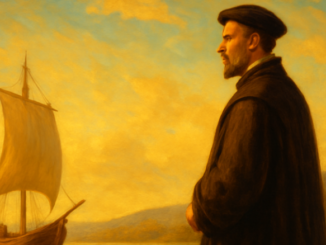
Montaigne on Dreux: Philosophical Roots of Doubt
A broken sword on a battlefield. It lies half-buried in the mud, its hilt still warm from the hand that gripped it. At first glance, it is nothing more than the debris of war — a remnant of violence. But for Michel de Montaigne, such an image became the starting point for a far deeper question: what do we actually know for certain about what really happened? In his brief essay on the Battle of Dreux, an entire philosophical landscape unfolds — one rooted in ancient traditions of doubt, self-examination, and intellectual humility. Those same traditions continue to resonate today in the rituals and thinking of Freemasonry. The Battle Nobody Fully Witnessed In December 1562, Catholic and Huguenot armies clashed near the northern French town of Dreux. Both sides claimed victory. Both sides suffered devastating losses. Montaigne, a young nobleman who experienced the Wars of Religion at close range, did not use this battle to write a military analysis. Instead, he used it to expose something far more fundamental: the unreliability of eyewitness accounts. Even those who stood in the thick of the fighting could not possibly grasp the full picture. Each person saw only a fragment, coloured by fear, […]