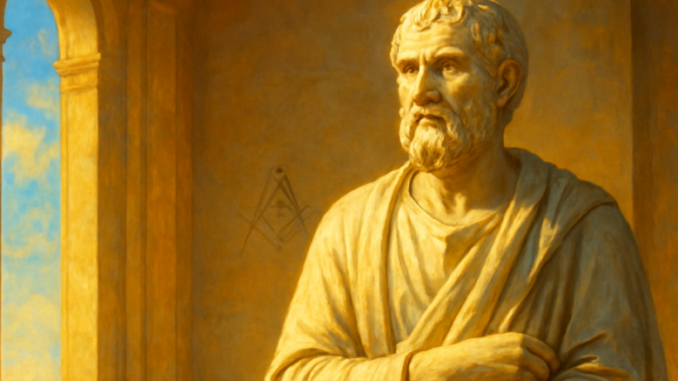
In the year 55 AD, Lucius Annaeus Seneca composed a remarkable treatise dedicated to his friend Serenus. Its central claim was as simple as it was provocative: the truly wise person cannot be harmed. No insult, no loss, no adversity touches them at their core. This essay, known as De Constantia Sapientis — On the Constancy of the Wise — is one of the sharpest texts in the Stoic tradition. It offers not only a philosophical argument for inner invulnerability, but a way of life that would find echoes centuries later in the rituals and ethical foundations of Freemasonry.
The Historical Context of the Essay
Seneca wrote this work during the early years of Emperor Nero’s reign — a ruler whose education Seneca himself had helped shape. It was a period of growing political unpredictability in Rome. Attacks on personal honor, accusations, and public humiliations were everyday occurrences in the Roman Senate. In that context, the question of whether a person could truly make themselves untouchable was not merely academic — it was a matter of daily survival.
Seneca addressed his treatise to Annaeus Serenus, a younger friend who was struggling with doubts about the Stoic path. The essay served as a philosophical shield: a manual for standing firm while the world around you crumbles.
The Core Idea: Invulnerability Through Inner Virtue
Seneca’s central argument is that the wise person cannot be insulted or harmed, because they do not derive their worth from external circumstances. In making this case, he draws a crucial distinction between two concepts: iniuria (injury or real harm) and contumelia (insult or belittlement). Both, he argues, only affect those who choose to be susceptible to them.
The wise person recognizes an insult for what it is, but does not allow it to penetrate. Their inner fortress is built on virtue, reason, and self-knowledge — and that combination makes it impregnable. This is not emotional numbness, Seneca emphasizes, but the highest level of awareness: knowing what truly holds value and what is merely noise.
The constancy of the wise in Seneca’s philosophy is not insensitivity, but the ability to distinguish between what truly touches the soul and what merely scratches the surface.
The Examples Seneca Invokes
Seneca was a master at using historical examples to make abstract philosophy tangible. In this essay, he repeatedly turns to the life of Socrates, who endured mockery and misunderstanding without losing his equanimity. Socrates received the blows of his wife Xanthippe and the ridicule of Athenian citizens with the same composure he brought to his philosophical dialogues.
Seneca also invokes Cato the Younger, the Roman statesman who chose death over surrendering his principles under Julius Caesar’s tyranny. For Seneca, Cato was the ultimate proof that constancy is not a theoretical ideal but a lived reality.
He further employs the image of the gladiator: just as a trained fighter absorbs blows without losing their strategy, the wise person absorbs life’s setbacks without losing their inner course. It is discipline, not detachment, that keeps them steady.
The Distinction Between Harm and Insult
A significant portion of the essay is devoted to the difference between genuine harm and perceived insult. Real harm may affect possessions, the body, or one’s social position — but according to Stoic teaching, it does not reach the true self. Insult is even less than that: it exists only in the perception of the receiver.
Seneca compares it to an arrow bouncing off armor. The armor of the wise person is their character. Those who have tempered their character through self-reflection and practice need not even refute insults. They simply fall beside them, like stones thrown against a fortress wall.
Parallels with Freemasonry
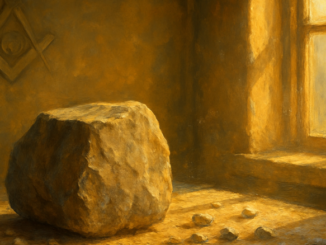
Seneca’s philosophy connects with the ethical foundations of Freemasonry at multiple points. In Masonic ritual, the Freemason is continually invited to work upon themselves — to shape the rough ashlar into a more perfect form. That perfected stone represents precisely what Seneca describes: an inner foundation that does not crumble under external pressure.
Both traditions are not about denying difficulties, but about developing a character that can withstand the vicissitudes of existence. Where Seneca writes about the wise person who lets insults pass, Masonic ritual speaks of tolerance and brotherly love as active virtues. Both traditions share the insight that true strength lies not in aggression or defensiveness, but in a deeply rooted inner calm.
The Perfected Stone and the Stoic Ideal
The image of the rough stone being transformed through labor and discipline into a perfect cube is one of the most recognizable symbols in Freemasonry. It is striking how closely this aligns with the Stoic ideal that Seneca develops in this essay. The wise person in Seneca’s vision is not born that way. They are shaped by adversity, by practice, by the constant testing of their reactions against the standard of reason.
Likewise, the Freemason does not enter the lodge as a Master. They progress through a path of degrees, rituals, and self-reflection. Michel de Montaigne, who frequently referenced Seneca in his famous Essays, would later write that self-knowledge is the most difficult and most necessary study a person can undertake. That thread of self-examination runs like a golden line from the Stoa, through the Renaissance, into the modern lodge room.
What This Essay Teaches Us Today
In an age where public attacks, digital shaming, and social pressure are omnipresent, Seneca’s message is more relevant than ever. His essay reminds us that we ourselves determine how much power we grant an insult or setback. That is not passive resignation — it is a radical act of inner sovereignty.
For Freemasons, this resonates deeply with the ongoing work of self-improvement that lies at the heart of the Craft. The tools may be symbolic, but the labor is real. Every moment of patience in the face of provocation, every choice to respond with dignity rather than anger, is another strike of the gavel on the rough stone. Seneca would have recognized this work immediately — and likely would have approved.
Seneca’s On the Constancy of the Wise is far more than an ancient philosophical curiosity. It is a living text that speaks directly to anyone committed to inner development — and especially to Freemasons who understand that the most important building project is the one within. The fortress Seneca describes is not built of stone and mortar, but of virtue, reason, and the quiet courage to remain unmoved when the world tests your resolve. In both the Stoic tradition and Freemasonry, the message endures: true strength is forged from within.
Copyright text & image: devrijmetselaar.nl
Texts are based on the ideas and content of the author of devrijmetselaar.nl, reviewed, corrected, and supplemented with the assistance of OpenAI. Images are created based on the ideas of the author of devrijmetselaar.nl using OpenAI/DALL-E.



Be the first to comment