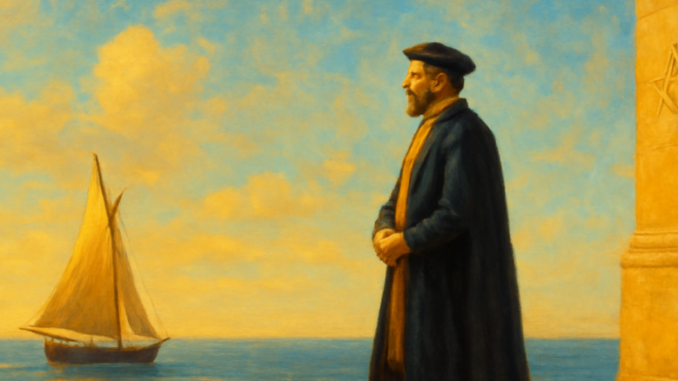
In the sixteenth century, Michel de Montaigne penned a series of essays that continue to resonate with seekers of wisdom and self-knowledge. His thirtieth essay from the first book, often titled ‘Of a Defect in Our Policies’ or ‘On Defective Partisanship,’ examines a phenomenon we all recognize: the tendency to be only half-committed to a cause we claim to support. Montaigne dissects with surgical precision how this half-heartedness is not only ineffective but morally questionable. For Freemasons, who strive toward sincerity and wholeness in their actions, this essay holds up a mirror that still reflects with remarkable clarity.
The Historical Context of the Essay
Montaigne wrote his essays during the French Wars of Religion, a period of extreme polarization between Catholics and Protestants. In these times of violence and irreconcilability, he observed how people frequently chose sides without fully committing to their choice. They supported a cause with words but not with deeds. They professed loyalty to a faction yet refused to accept the consequences of that loyalty. This defective partisanship, Montaigne argues, is worse than outright indifference.
The philosopher drew on his own experiences as a mediator between the warring parties. He witnessed how those who claimed neutrality often secretly favored one side. Conversely, he saw supporters who undermined their own party through lukewarm allegiance. This pattern of duplicity provided the impetus for his incisive analysis.
Montaigne’s Central Argument
The core theme of this essay revolves around the ethical problem of choosing without truly choosing. Montaigne contends that anyone who takes a position has a duty to uphold that position with conviction and consistency. A half-hearted ally is useless to either side and, moreover, undermines his own integrity. The philosopher compares this to a soldier who wears the uniform but refuses to fight — enjoying the benefits of membership without accepting the accompanying risks.
“He who chooses half-heartedly ultimately chooses against himself: he loses both the cause and his own credibility.”
Montaigne emphasizes that this defective partisanship often springs from fear or self-interest. People want to stand on the winning side, regardless of which side that turns out to be. They keep their options open at the expense of their honesty. This lack of commitment, he warns, corrupts not only public affairs but the individual soul as well.
Historical Examples and Illustrations
Montaigne illustrates his argument with examples from classical antiquity. He references Roman senators who, during civil wars, attempted to remain in the good graces of both factions — with disastrous consequences for themselves and the republic. He also mentions Greek statesmen who sold their loyalty to the highest bidder, thereby forfeiting the trust of everyone.
Consider the senator who supports both consuls and is distrusted by each. Or the nobleman who refuses to show his true colors and loses his estates to both warring parties. Or the councilor whose diplomatic neutrality is perceived not as wisdom but as cowardice. These historical examples serve not as moralistic judgments but as mirrors. Montaigne invites the reader to recognize their own tendencies in these figures. Who among us has never hesitated to stand fully behind a conviction? Who has never felt the temptation to keep an escape route open?
Resonance with Masonic Values
The lesson Montaigne teaches finds a natural echo within Freemasonry. The Craft does not demand political or religious allegiance from its members, but it does require complete sincerity on the chosen path. The rituals and symbols of Freemasonry are steeped in the value of integrity: the square as a symbol of moral rectitude, the compasses as an instrument of self-discipline and measured action.
A Freemason who stands with only one foot in the lodge — who professes brotherhood on the surface but avoids the inner work — embodies precisely the defective partisanship Montaigne critiques. The symbolic journey from Entered Apprentice to Fellow Craft to Master Mason presupposes a wholehearted surrender to the process of self-improvement. Half-heartedness blocks that very development. The working tools are not meant to be admired from a distance; they are meant to be wielded with purpose and dedication.
The Contemporary Relevance
Although Montaigne wrote during an era of religious wars, his analysis is astonishingly relevant today. In an age of social media and public posturing, we see daily examples of defective partisanship. People take public stands for the sake of visibility, only to retreat the moment headwinds pick up. Organizations proclaim values loudly but abandon them when it becomes economically inconvenient.
Montaigne’s essay reminds us that genuine commitment comes at a price. Whoever truly stands for something must be willing to bear the consequences. This does not mean we should be blind to nuance or unyielding in our judgments. It does mean we must be honest about our actual position and have the courage to defend it when it matters most. In a world that often rewards strategic ambiguity, Montaigne’s call for authentic engagement feels more urgent than ever.
Michel de Montaigne demonstrates in this essay how defective partisanship harms both the community and the individual. His timeless warning against half-heartedness speaks to all who aspire to a life of integrity and sincerity. For Freemasons, the essay serves as a powerful encouragement to not merely admire the symbolic tools of the Craft but to truly wield them — with full dedication and without reservation. The question Montaigne poses is ultimately the same one the lodge places before us: are we willing to fully be who we claim to be?
Copyright text & image: devrijmetselaar.nl
Texts are based on the ideas and content of the author of devrijmetselaar.nl, reviewed, corrected, and supplemented with the assistance of OpenAI. Images are created based on the ideas of the author of devrijmetselaar.nl using OpenAI/DALL-E.


Be the first to comment