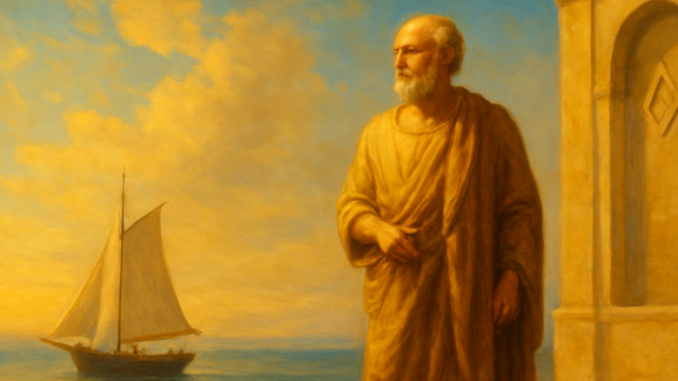
When the Roman philosopher Lucius Annaeus Seneca wrote his twenty-third letter to Lucilius on the subject of true joy, he touched on something universal. His words, nearly two thousand years old, still resonate with anyone searching for meaning beyond the superficial. For Freemasons, this letter strikes a particularly familiar chord — the conviction that genuine fulfillment does not come from the outside, but must be built from within. Let us explore how Seneca’s insights and the Masonic tradition converge in their shared pursuit of inner light.
The Stoic and His Student: A Conversation About Happiness
Seneca wrote his famous letters to a younger friend, Lucilius, as a form of philosophical correspondence. In Letter XXIII, he poses a fundamental question: what makes a person truly happy? He warns Lucilius against the mistake so many of us make — seeking joy in possessions, status, or fleeting pleasures. These forms of happiness, Seneca argues, are fragile and entirely dependent on circumstances beyond our control. True joy, by contrast, springs from a clear conscience and a virtuous character.
The Stoic philosopher uses the image of a spring that wells up from within, as opposed to water piped in from elsewhere. External happiness is like that imported water: it can dry up the moment the supply is cut off. But whoever draws joy from within — from their own character and attitude toward life — possesses an inexhaustible source. This distinction between inner and outer wealth lies at the heart of Seneca’s message.
The Rough Stone as a Mirror of the Self
In Freemasonry, one of the most recognizable symbols is the rough ashlar — the unworked stone that represents the unrefined individual. Through dedicated labor on oneself, this rough stone is gradually shaped into a perfect ashlar, a smooth cubic stone fit for the builder’s purpose. This image carries the very same message as Seneca’s philosophy. The rough stone does not call for external decoration or a pretty wrapping. It demands inner transformation — the chipping away of imperfections and the deliberate cultivation of virtue. The Freemason works not primarily on his outward circumstances, but on his inner architecture.
True joy is not a reward bestowed from outside, but a state built from within through consistent work on character and virtue.
Where Seneca speaks of developing a good conscience, the Freemason speaks of working with the square and compasses to govern his own conduct. Both traditions recognize that happiness is no accident — it is the result of conscious effort. The compasses that draw boundaries around the self, the square that keeps actions upright: these are tools for the same inner construction that Seneca describes.
Two Paths Leading to the Same Truth
Seneca was a Stoic, not a Freemason. The Craft as we know it emerged roughly sixteen hundred years after his death, with the founding of the Grand Lodge of England in 1717. Yet both traditions share a deeply rooted conviction: that human beings are capable of moral perfection, and that this perfection is the path to genuine fulfillment. The Stoics called it the pursuit of wisdom and virtue. Freemasons call it building the inner temple.
What stands out is how both traditions place such strong emphasis on self-reflection. Seneca encourages Lucilius to examine his thoughts and actions every single day. The Freemason, in turn, knows the ritual moment of introspection — pausing to ask whether he has added a worthy stone to the edifice of his life that day. This parallel practice of self-examination may well be the strongest bridge between the Roman philosopher and the modern Brotherhood.
The Joy Found in Connection
Seneca’s letter makes it clear that true joy is not selfish. A person who has found inner peace radiates that peace outward to others. He becomes a source of calm and wisdom for everyone around him. This principle is echoed powerfully in the Masonic value of brotherhood. The lodge is not a collection of individuals each working on their own stone in isolation. It is a community in which brothers help one another grow — where the progress of one contributes to the well-being of all.
The Freemason who builds his inner temple does not do so alone. He does it in the company of brothers who share the same aspiration, within a space symbolically consecrated to that common endeavor. Just as Seneca shared his wisdom with Lucilius, Freemasons share their insights with one another. The search for true joy becomes a shared journey — one that is enriched by fellowship and mutual support.
What Both Traditions Teach Us Today
In an age when happiness is often equated with consumption and external validation, both Seneca and Freemasonry offer a powerful counterbalance. Both remind us that lasting fulfillment cannot be bought. It must be earned through inner labor — through cultivating virtues such as temperance, justice, and wisdom. The difference in form — the philosophical letter versus the ritual work of the lodge — does nothing to diminish the shared essence.
Both traditions emphasize self-reflection as a daily practice. Both see virtue as the foundation of genuine happiness. Both warn against the emptiness of outward display. And both acknowledge that personal growth is a lifelong process, never truly complete.
The Stoic philosopher and the Freemason would recognize each other if they ever met. Not because they speak the same language or practice the same rituals, but because they have discovered the same fundamental truth: that we forge our own happiness from within — stone by stone, day by day.
Seneca’s Letter XXIII is far more than a historical document. It is an invitation that remains as valid today as it was two millennia ago — an invitation that Freemasons understand intuitively. The true joy he writes about is not an abstract ideal but a living reality for anyone willing to do the work. Whether you speak the language of the Stoics or employ the symbols of Freemasonry, the message is the same: build yourself, and you build your happiness.
Copyright text & image: devrijmetselaar.nl
Texts are based on the ideas and content of the author of devrijmetselaar.nl, reviewed, corrected, and supplemented with the assistance of OpenAI. Images are created based on the ideas of the author of devrijmetselaar.nl using OpenAI/DALL-E.


Be the first to comment