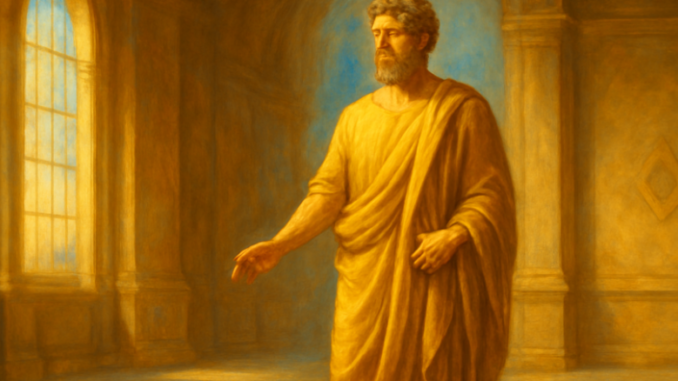
Perhaps you’ve found yourself lying awake at night, trying to make peace with the fact that everything is temporary. Not as some abstract philosophical puzzle, but as something deeply personal — something that unsettles you. In Book IX of his Meditations, Marcus Aurelius wrestles with exactly these questions. As a Roman emperor who faced war, plague, and loss on a daily basis, he turned to ancient philosophical traditions for solace. What he found still resonates today, and touches on something that Freemasons will recognize in their own rituals around mortality and what lies beyond.
The Stoic Legacy: Death as a Natural Process
To understand what Marcus Aurelius writes about death and immortality, you first need to understand the tradition he inherited. Stoic philosophy, founded by Zeno of Citium around 300 BCE, formed the bedrock of his thinking. For the Stoics, death was not an enemy to be feared but a natural part of the cosmic order. Everything that comes into being eventually passes away — not as punishment, but as part of a greater whole they called the logos: the rational structure that pervades the entire universe.
Marcus Aurelius drew directly from the teachings of Epictetus, the freed slave whose lessons reached him through his tutor Junius Rusticus. Epictetus taught that we are merely stewards of our bodies and possessions, never their true owners. Death is simply the moment when we return what was never really ours to begin with. This idea recurs throughout Book IX — sometimes offering comfort, sometimes delivering a sharp confrontation with reality.
Heraclitus and the Eternal Flow
Behind the Stoics stands an even older thinker: Heraclitus of Ephesus. His famous observation that you cannot step into the same river twice echoes throughout Book IX. Marcus Aurelius meditates repeatedly on the constant flux of all things. Emperors who came before him have been forgotten, their fame dissolved like smoke. Why should his fate be any different? This is not pessimism — it is an attempt to see reality for what it truly is.
Death is not a destination but a transition — not the end of meaning but a return to the source from which all things emerge.
Heraclitus envisioned the universe as an ongoing process of becoming and dissolution, driven by a cosmic fire. The Stoics adopted this image and refined it into their concept of periodic cosmic renewal. For Marcus Aurelius, this meant that individual death was part of a larger pattern of transformation, not destruction. Every ending fed a new beginning.
Seneca as a Direct Influence
Although Marcus Aurelius never mentions Seneca by name in the Meditations, the influence is unmistakable. Seneca, who lived and wrote a generation earlier, had made the Stoic approach to death accessible to a Roman audience. His Letters to Lucilius, in which he reflects on how to prepare properly for dying, are a direct precursor to what we encounter in Book IX.
Seneca taught that every day should be lived as though it were your last — not out of fear, but out of appreciation. This attitude transforms death from a threat into a source of motivation. Marcus Aurelius applies this insight when he reminds himself that he does not have unlimited time to become the person he wants to be. The urgency that runs through these passages is not panic — it is clarity.
Platonic Echoes: The Question of the Soul
Interestingly, Marcus Aurelius never takes a definitive position on what happens after death. Here he departs from orthodox Stoic doctrine, which held that individual souls are reabsorbed into the cosmic soul after death. In Book IX, he sometimes seems to flirt with Platonic ideas about the immortality of the soul, only to release them again moments later.
Plato had argued extensively in the Phaedo and other dialogues for the survival of the soul beyond bodily death. Marcus Aurelius was familiar with these texts but remained agnostic. Perhaps we dissolve into nothingness, he writes; perhaps we are absorbed into something greater. Both possibilities are acceptable — as long as we live rightly in the present. This openness is remarkable for an emperor and philosophically astute: it shifts the focus from speculation to action, from metaphysical debate to moral conduct.
Freemasonry and the Confrontation with Mortality
Anyone familiar with Masonic ritual will recognize something deeply familiar in all of this. The lodge is steeped in symbolism surrounding impermanence and what lies beyond it. The imagery of death found in certain degrees compels the candidate to face his own mortality — not as a morbid exercise, but as an invitation to live more fully. Just as Marcus Aurelius used the contemplation of death to see more clearly what truly matters.
The skull, the hourglass, the broken column — these are all reminders of the temporary nature of earthly existence. But in Freemasonry, just as in Stoic philosophy, this recognition is no cause for despair. It is a call to work now on what holds lasting value: character, brotherhood, and the improvement of yourself and the world around you. The Stoic philosopher-emperor and the Masonic initiate share this common ground — the understanding that acknowledging death is not the end of the conversation, but the beginning of a more meaningful one.
Historical Context: An Emperor Amid the Plague
Book IX must also be understood against the backdrop of Marcus Aurelius’ own time. The Antonine Plague — likely smallpox or measles — devastated the Roman Empire during his reign. Millions died, possibly including his own tutor and several of his children. When he writes about death, he is not dealing in abstractions. He was writing surrounded by the dead.
This context makes his philosophical reflections all the more impressive. Here was a man who had to make daily decisions about war and peace, who watched the plague tear through his military camps, and who still found the composure to meditate on the meaning of existence. His conclusion was not cynicism or indifference, but a renewed commitment to virtuous action for as long as life endures.
When you read Book IX, you are not merely reading philosophy. You are reading the testament of a man who tried to live with dignity while the world crumbled around him — and who believed that this effort, however fleeting, was the one thing that truly mattered.
Marcus Aurelius’ reflections on death and immortality in Book IX of the Meditations are far more than historical curiosities. They form a living philosophical tradition that continues to speak to anyone grappling with questions of mortality, meaning, and legacy. For Freemasons, his words carry a particular resonance — echoing the same truths embedded in the ritual symbolism of the lodge. Whether we dissolve into nothing or are gathered into something greater, the imperative remains the same: live well, act justly, and let the contemplation of your own impermanence be not a source of dread, but the very foundation of a life well lived.
Copyright text & image: devrijmetselaar.nl
Texts are based on the ideas and content of the author of devrijmetselaar.nl, reviewed, corrected, and supplemented with the assistance of OpenAI. Images are created based on the ideas of the author of devrijmetselaar.nl using OpenAI/DALL-E.



Be the first to comment