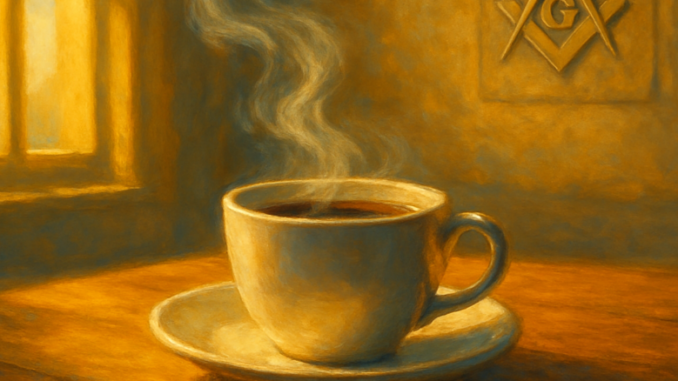
The lodge falls silent as the master of ceremonies places a steaming cup of tea before a newly initiated brother. The scent of bergamot rises from the near-boiling liquid. The young man reaches for it immediately, but an older brother calmly places a hand on his arm: “Wait. Let it cool first.” In that simple gesture lies a lesson far deeper than preventing a burned tongue.
When Haste Becomes Harmful
Recent medical research confirms what many have long suspected: regularly drinking very hot liquids — above 65 degrees Celsius (149°F) — can triple the risk of esophageal cancer. The heat damages the delicate lining of the esophagus, and repeated injury leads to cellular changes that can eventually become malignant. The science is clear: impatience with something as mundane as drinking coffee or tea can have life-threatening consequences.
To most people, this sounds like an overreaction. A cup of tea is harmless, surely? But that very underestimation is the problem. We have grown accustomed to instant gratification — to the immediate fulfillment of our desires. Modern life encourages this at every turn: fast service, instant delivery, zero wait time. Yet nature, and our own bodies, operate on a different rhythm. Sometimes waiting isn’t merely wise; it is essential.
Temperance as a Cardinal Virtue
In Freemasonry, the virtue of temperance holds a place of special significance. It belongs to the four cardinal virtues that every Freemason is encouraged to cultivate: prudence, justice, fortitude, and temperance. These virtues trace their roots to the ancient Greeks — to Plato and Aristotle in particular — and were later refined by Stoic philosophers. Marcus Aurelius wrote repeatedly in his Meditations about the importance of self-control, not as abstinence for its own sake, but as a prerequisite for a life of dignity.
The Greek word for temperance, sophrosyne, literally means “soundness of mind.” It is not about denying pleasure, but about finding the right measure. Aristotle called this the “golden mean” — the balance between deficiency and excess. Pouring a scalding drink straight down your throat is a small act of excess, a moment of impatience that ignores the body’s boundaries. It seems insignificant, but the pattern behind it is anything but.
The Symbolism of Waiting
Time plays a vital role in Masonic ritual. A candidate is not initiated immediately but undergoes a process of preparation and reflection. There are moments of silence, of waiting, of letting experiences settle. This is not bureaucratic delay — it is a deliberate pedagogical choice. Some things can only be understood when the mind is ready for them, when haste has ebbed away and space has opened for genuine insight.
Temperance is not a limitation of freedom, but the very condition that makes truly free choice possible.
Waiting for your coffee to cool may seem trivial. But practicing it daily exercises a muscle that proves indispensable when facing life’s greater questions. The ability to interrupt an impulse — to pause before acting — is precisely what makes ethical behavior possible. Seneca wrote to his friend Lucilius that the wise person is not governed by desires but governs them. Not by suppressing them, but by fulfilling them at the right moment and in the right measure.
Self-Care as an Ethical Duty
Freemasonry teaches its members not only to be good to others but also to be good to themselves. This is not narcissism — it is an acknowledgment that those who neglect themselves will ultimately have less to offer their community. The body is the instrument through which we act in the world. Damaging that instrument through carelessness is a form of negligence.
The Stoics drew a clear distinction between things within our control and things beyond it. Whether we fall ill is not entirely in our hands. But whether we inflict daily damage on our own bodies through avoidable behavior — that most certainly is. Drinking excessively hot beverages falls squarely into the latter category. It is a small choice, but ethics is ultimately composed of thousands of small choices that together form a life.
From a Cup of Tea to a Way of Life
What began as a medical report about esophageal cancer turns out, on closer reflection, to be a window onto a much broader question: How do we live? Do we rush through life, driven by desires that tolerate no delay? Or do we cultivate the patience to wait, to find the right moment, to seek the proper measure?
Freemasonry offers no ready-made answers, but it does offer a method: continuous self-reflection and the ongoing work of shaping the rough ashlar of one’s own character. Temperance is no minor detail in this process — it is foundational. It is the virtue that makes all other virtues possible, because it creates the space in which conscious choices can emerge.
Consider what the practice of temperance truly offers:
- It protects the body from avoidable harm.
- Practicing patience in small matters prepares us for greater challenges.
- Self-care is not selfishness — it is a prerequisite for service to others.
- The golden mean requires practice, not perfection.
The older brother in the lodge understood all of this when he placed his hand on the newcomer’s arm. He didn’t preach. He didn’t judge. He simply offered a quiet gesture of brotherly care. Within that gesture lay a world of wisdom, passed down from generation to generation. Sometimes the most important lesson is the simplest one: wait a moment. Let it cool. There is no rush.
The news about the health risks of too-hot beverages is more than a medical warning. It is an invitation to reflect on the value of temperance — a virtue that Freemasonry considers indispensable. In a world that prizes speed and instant gratification, the ability to pause, to wait, and to choose with care is not just a Masonic ideal. It is a profoundly human one. The next time you reach for that steaming cup, remember: the pause before the first sip may be the most meaningful part of the ritual.
Copyright text & image: devrijmetselaar.nl
Texts are based on the ideas and content of the author of devrijmetselaar.nl, reviewed, corrected, and supplemented with the assistance of OpenAI. Images are created based on the ideas of the author of devrijmetselaar.nl using OpenAI/DALL-E.


Be the first to comment