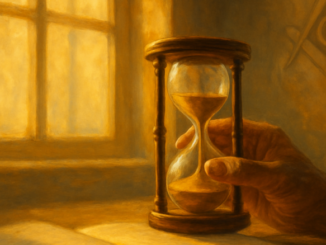
An hourglass sits on a table. Sand flows silently from the upper chamber to the lower, grain by grain, impossible to grasp or hold back. It is an everyday image, almost forgotten in our age of digital clocks. Yet that simple object contains a truth that Michel de Montaigne articulated with uncommon clarity in his brief but penetrating essay ‘On Age’: we are not the masters of time — time is the quiet sculptor of our lives.
The Heart of the Essay
In this fifty-seventh essay from the first book of his celebrated collection, Michel de Montaigne takes up a theme that touches every human being sooner or later: growing old. The essay is remarkably short compared to many of his other reflections, but that very brevity gives it a particular force. Montaigne argues that our assumptions about age, lifespan, and the ‘right’ time to die are often founded on misconceptions. We imagine that a long life is the norm, while reality teaches us something quite different. In his era, reaching the age of fifty was already exceptional. Montaigne points out that anyone who regards death as something strange or untimely is simply deceiving themselves.
Impermanence as a Starting Point
Montaigne begins with a concrete observation: the average life expectancy in antiquity and in his own time. He draws on classical sources, including Aristotle, who divided human life into distinct phases, and the Roman tradition in which the age of seventy was regarded as a kind of upper limit. Montaigne notes that many of the great heroes and thinkers of antiquity died young. Alexander the Great barely reached thirty-three. Augustus, while he lived to a more advanced age, could already look back on a fully lived life by thirty-five. The message Montaigne distills from these examples is clear: a life need not be long to be complete. What matters is not the quantity of years, but the intensity and honesty with which they are lived.
Here the essay reaches beyond mere statistics or history. Montaigne does not invoke the fact of impermanence to spread gloom — he uses it to wake his readers up. If death can come at any moment, then the task is to live now, not tomorrow. That may sound like a platitude, but Montaigne supports it with such personal honesty that it moves far beyond cliché.
The Sand and the Mirror: A Deeper Layer
Picture that hourglass once more. The sand that has already fallen cannot be retrieved. But the sand still in the upper chamber cannot be counted either. Montaigne describes how we tend to measure ourselves against an expectation — an age we believe we have ‘earned’ or are owed. We calculate forward: ten more years, twenty more years. But that calculation is an illusion. The only thing that truly exists is the moment the grain of sand falls.
In Freemasonry, this awareness is translated into a tangible ritual object: the rough ashlar that must be worked and shaped. That stone does not represent some future ideal — it represents the work that can be done right now. Like Montaigne, Freemasons emphasize that the value of a human life does not depend on its duration, but on the quality of the labor invested in it.
A life is not measured in years, but in the degree to which it is lived honestly and consciously.
Montaigne’s Examples and Method
As in nearly all his essays, Montaigne draws generously from classical sources. He references not only Aristotle but also Pliny the Elder and various Roman statesmen. His method is characteristic: he layers example upon example, not to prove that he is right, but to show how broad and multifaceted the human experience of aging truly is. Some figures of antiquity considered forty the pinnacle of life. Others placed that threshold at sixty. From this, Montaigne draws the conclusion that there is no universal standard for the ‘correct’ lifespan. Every attempt to fix one is merely a projection of our own fears and desires.
What makes this essay particularly compelling is that Montaigne also writes about himself. He observes that at the time of writing, he has already passed the age considered average in his day. He describes how he notices the signs of decline in his own body — not with despair, but with a kind of curious acceptance. It is precisely this ability to take himself as a subject of study that makes Montaigne such a timeless thinker. His essays, and this one in particular, are exercises in self-knowledge.
Life’s Phases and the Building of the Self
Montaigne plays with the idea that life is not a straight line from birth to death, but a series of phases, each with its own character and its own demands. Youth has its boldness, middle age its responsibilities, old age its wisdom — but also its losses. This view bears striking parallels with the way Freemasonry describes the path of the Entered Apprentice, the Fellow Craft, and the Master Mason. Each phase calls for different virtues and different insight.
The Apprentice learns to listen and observe. The Fellow Craft learns to work and to collaborate. The Master learns to let go and to pass on what has been gained. Montaigne would recognize this framework: he describes growing older not as loss, but as a shift in perspective. The eyes may dim, but the inner vision can become sharper. The body may slow, but the mind — if well tended — can deepen.
Why This Essay Still Resonates Today
In a society obsessed with youthfulness, productivity, and the postponement of old age, Montaigne’s voice sounds refreshingly sobering. He does not ask us to fear death or to deny it, but to acknowledge it as a structural part of life. There is no gloom in this recognition — only an invitation to go deeper. Those who understand that time is finite approach their remaining hours differently. Not with more haste, but with greater attention. Not with anxiety, but with purpose.
For Freemasons, this insight carries a particular resonance. The lodge is, among many things, a space for reflection on the great questions of human existence. The memento mori — the reminder of death — is not a morbid fixation but a call to meaningful action. Montaigne’s essay ‘On Age’ serves as a philosophical companion to this Masonic principle: by accepting the reality of our mortality, we free ourselves to live with greater depth, honesty, and intention.
Montaigne’s brief meditation on age is far more than a historical curiosity. It is a mirror held up to every reader, asking a deceptively simple question: given that your time is finite, how will you use the grains of sand that remain? The answer, whether we find it through philosophy, through Freemasonry, or through quiet personal reflection, is always the same — not by counting the years, but by making each one count. The hourglass does not stop. But the hand that shapes the rough stone can begin its work at any moment.
Copyright text & image: devrijmetselaar.nl
Texts are based on the ideas and content of the author of devrijmetselaar.nl, reviewed, corrected, and supplemented with the assistance of OpenAI. Images are created based on the ideas of the author of devrijmetselaar.nl using OpenAI/DALL-E.

Be the first to comment