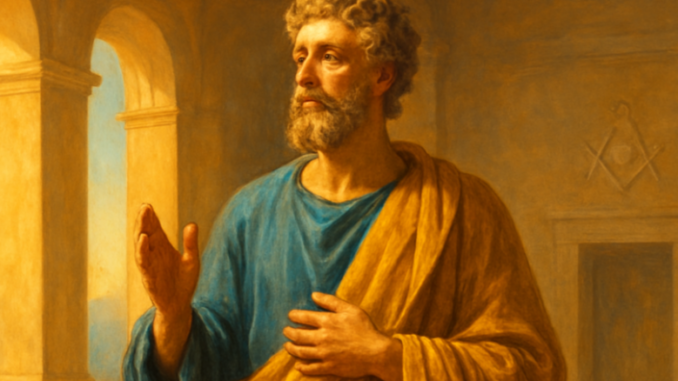
In the ninth book of the Meditations, Marcus Aurelius pauses to reflect on the true meaning of prayer. Not as a plea for divine favors, but as a deliberate attunement to something greater than the self. This passage touches on a theme that lies at the very heart of Freemasonry: the search for connection with the higher — not through passive waiting, but through active inner work. The Roman emperor writing his thoughts by candlelight and the brother turning inward in the silence of the lodge share a strikingly kindred experience.
The Candle as a Symbol of Inner Light
Picture a candle burning on a writing desk in ancient Rome. The flame flickers softly as a weary ruler organizes his thoughts after yet another day of state decisions and military campaigns. That candle illuminates more than parchment — it symbolizes the inner light that Marcus Aurelius strove to cultivate throughout his life.
In Freemasonry, light is one of the most fundamental symbols. It represents knowledge, truth, and the enlightenment of the mind. When a candidate is initiated, he symbolically receives light. This parallel is neither coincidental nor superficial. Both traditions recognize that genuine growth begins with kindling an inner flame.
In Book IX, Marcus Aurelius writes about prayer not as a petition to the gods, but as an exercise in moral clarity. He asks: why should we pray to receive things, when we could pray for the right attitude toward those things? This shift from external desire to internal transformation mirrors precisely what Freemasons mean by “working the rough ashlar.” It is not about what you receive — it is about who you become.
Prayer as Self-Reflection
In the Stoic philosophy that Marcus Aurelius practiced, prayer is not a negotiation with higher powers. It is a form of self-reflection — a moment in which the mind measures itself against universal principles. The emperor does not ask for victory or wealth. He asks for the strength to act justly, the wisdom to accept impermanence, and the courage to fulfill his duty regardless of the outcome.
Prayer is not a plea for favors, but an exercise in attunement to virtue and truth.
This approach resonates deeply with the Masonic practice of silence and contemplation. During rituals, there are deliberate moments of stillness in which brethren are invited to turn inward. This is not empty waiting. It is active self-reflection, comparable to what Marcus Aurelius describes. Both traditions understand that connection with the higher begins with an honest look at oneself.
The Square of Conscience
The square is one of Freemasonry’s most recognizable symbols, representing righteousness and moral rectitude. It reminds the brother to measure his actions against ethical standards, just as a stonemason checks his stones for right angles. Marcus Aurelius did not know this symbol, but his reflections in Book IX breathe the same spirit. He speaks of the importance of consistency between inner conviction and outward action. What you think must align with what you do. What you pray for, you must also pursue.
This principle of moral integrity connects the Stoic’s meditative practice with the work carried out in the lodge. Neither tradition demands perfection — both ask for honesty. The rough ashlar does not need to be shaped in a single blow. What matters is the daily discipline of small improvements, of continually applying the square to your own conduct.
Brotherhood and the Logos
Marcus Aurelius writes extensively about the logos — the ordering principle that connects all things. In Stoic cosmology, all human beings are part of a single whole, bound together by a shared rationality. This awareness of universal connectedness is precisely what Freemasons mean by brotherhood. It extends beyond the brethren in one’s own lodge to the recognition that all people share a common origin and destination.
When the emperor prays, he does not address a distant deity. He attunes himself to this universal principle, to the order that pervades all things. The Freemason who beholds the All-Seeing Eye of the Great Architect in the temple experiences something remarkably similar. It is not an anthropomorphic god who judges, but a symbol of the higher order to which we seek to align ourselves.
The Practice of Daily Attunement
What makes these ancient reflections relevant today? Marcus Aurelius never wrote his Meditations for publication. They were personal notes — exercises in mental discipline. Every evening, he reviewed his day. What had he done well? Where had he fallen short? This ritual of daily evaluation is a practice that Freemasons know as “reviewing the work of the day.” Before sleep, the brother asks himself how he has spent his hours.
Have I acted according to my principles? Where can I improve tomorrow? Have I contributed to the well-being of others?
These questions are not new. They were asked by a Roman emperor in the second century, and they are still asked by people who seek to live with intention. The form differs, but the essence remains: connection with the higher does not arise from passive belief, but from the active practice of virtue.
The candle on the writing desk of Marcus Aurelius was extinguished long ago. But the light he sought burns on in everyone willing to ask the same questions — in the lodge and beyond, in prayer and in silence, in the steady application of the square to one’s own actions. Connection with the higher is not a mystical experience reserved for the chosen few. It is the daily practice of anyone who refuses to live without direction. Marcus Aurelius and Freemasonry share a fundamental insight: connecting with the higher is not about passive receiving — it is about actively becoming.
Copyright text & image: devrijmetselaar.nl
Texts are based on the ideas and content of the author of devrijmetselaar.nl, reviewed, corrected, and supplemented with the assistance of OpenAI. Images are created based on the ideas of the author of devrijmetselaar.nl using OpenAI/DALL-E.


Be the first to comment