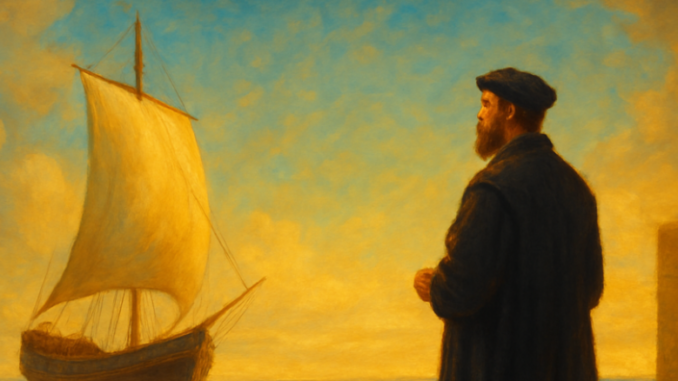
In 1580, Michel de Montaigne published a brief but piercing text on the dangers of blind partisanship. His observation that we tend to diminish our enemies and inflate our allies struck a nerve that resonates to this day. For Freemasons — who hold brotherhood and the pursuit of truth among their highest values — this sixteenth-century essay offers a surprisingly relevant mirror.
The Historical Context of Montaigne’s Warning
Michel de Montaigne wrote his essays during the bloody French Wars of Religion, a period in which Catholics and Huguenots fought one another with a fanaticism that laid entire cities to waste. The St. Bartholomew’s Day massacre of 1572, in which thousands of Protestants were slaughtered, was still fresh in collective memory when Montaigne took up his pen. Amid this climate of religious hatred and political division, he chose an unusual stance: the stance of nuance.
In essay thirty of his first book, titled Of a Defect in Our Partisanship, Montaigne argued that we systematically fail to judge others fairly. We praise our allies beyond their merits and diminish our opponents below their actual qualities. This tendency, he maintained, undermines not only the truth but our own integrity as well.
The Heart of the Argument: Honesty Over Loyalty
Montaigne rejected the idea that loyalty to a group or cause automatically justifies distorting reality. He described how his contemporaries glossed over the flaws of their own faction while magnifying every detail of the opposition’s shortcomings. This selective blindness, he reasoned, makes us poor judges and even poorer human beings.
True connection arises not from diminishing enemies, but from recognizing the other in their full humanity.
This insight cuts far deeper than a simple call for fairness. Montaigne suggests that partisanship ultimately corrodes the partisan himself. Anyone who grows accustomed to twisting facts in favor of their own camp gradually loses the capacity for clear thought. The search for truth is sacrificed on the altar of group identity.
Freemasonry and the Ideal of Impartial Judgment
Freemasonry, which assumed its modern form in the early eighteenth century, inherited much of the humanistic tradition in which Montaigne was a central figure. The desire for truth, the emphasis on self-reflection, and the pursuit of moral improvement are pillars that resonate directly with Montaigne’s objections to defective partisanship.
In the Masonic lodge, brethren meet as equals, regardless of social standing, religious background, or political conviction. This principle of universal brotherhood demands precisely the attitude Montaigne advocated: the ability to look beyond superficial oppositions and to value others for their intrinsic qualities.
The Rough Ashlar as a Symbol of Self-Criticism
In Freemasonry, the rough ashlar symbolizes the unworked self — full of sharp edges and imperfections. The task of shaping this rough stone into a smooth, perfect cube represents the lifelong labor of refining one’s own character. Montaigne’s essay reminds us that partisanship is one of those sharp edges in urgent need of polishing.
Consider the Masonic values this challenge engages:
Self-reflection — recognizing our own prejudices as the first step toward wisdom.
Brotherhood — accepting others despite differences of opinion.
Truth-seeking — having the courage to place facts above group loyalty.
Inner growth — shedding lazy, comfortable judgments in favor of honest assessment.
From the Sixteenth Century to Today
Montaigne’s world was torn apart by religious warfare; ours is plagued by polarization along political and cultural lines. Social media amplifies the tendency to glorify the like-minded and demonize those who think differently. The algorithms that populate our feeds create precisely the distorted reality Montaigne warned against over four centuries ago.
Yet his message also offers hope. If defective partisanship is a learned habit, it can also be unlearned. Freemasonry provides concrete tools for this work: ritual that calls us to contemplation, the symbolic mirror held up before each brother, and the silence in which one’s own conscience is allowed to speak.
The Lesson for Today’s Seekers
Montaigne invites us to examine our own convictions with the same rigor we apply when criticizing those of others. This is not a call for relativism or indifference. It is an invitation to intellectual honesty — to acknowledge that even our opponents are sometimes right and that our allies are not infallible.
For the Freemason, this means that brotherhood does not stop at the boundaries of one’s own lodge, one’s own beliefs, or one’s own country. The chain that links brethren across the world is forged from the understanding that our shared humanity runs deeper than any partisan allegiance. In this sense, Montaigne’s short essay remains a compass for anyone who sincerely seeks light and connection.
Michel de Montaigne wrote more than four hundred years ago about a human weakness that has lost none of its relevance. His warning against defective partisanship speaks directly to Freemasons who strive for truth, self-knowledge, and genuine brotherhood. By recognizing and working on our own prejudices, we lay the foundations for real connection — not only within the lodge, but throughout the world.
Copyright text & image: devrijmetselaar.nl
Texts are based on the ideas and content of the author of devrijmetselaar.nl, reviewed, corrected, and supplemented with the assistance of OpenAI. Images are created based on the ideas of the author of devrijmetselaar.nl using OpenAI/DALL-E.

Be the first to comment