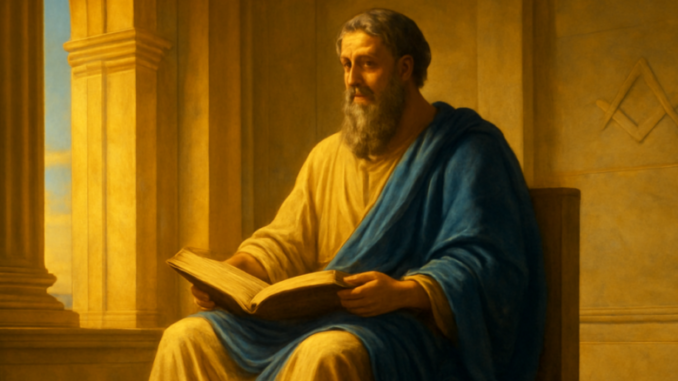
When Plato unfolds his vision of education in the third book of The Republic, he touches on questions that had already been asked for centuries before him — and that continue to resonate today in traditions devoted to the shaping of character. How do we cultivate virtue in a human being? What stories do we tell, what music do we play, and why? For the Freemason, these are far from abstract questions. The lodge itself is a space of formation, where ritual and symbol serve the very pedagogical function Plato envisioned. This article explores the philosophical sources Plato drew upon and places his educational ideal alongside the formative practice of Freemasonry.
The Legacy of the Early Greek Thinkers
Plato’s educational philosophy in Republic III did not emerge in a vacuum. He built upon a rich tradition of Greek paideia — the ideal of comprehensive human formation that had already taken root in the works of Homer and Hesiod. For Homer, the hero Achilles was the embodiment of aretē: virtue understood as a fusion of courage, honor, and physical excellence. Hesiod, in his Works and Days, added industriousness and justice to the equation. Plato knew these texts intimately, but he took a critical stance toward the moral messages they conveyed.
Where Homer portrayed the gods as capricious and sometimes immoral, Plato saw a danger to the education of young souls. His teacher Socrates had taught him that virtue is knowledge — that no one does evil willingly. If the young grow up hearing stories in which the gods lie and steal, how can they ever attain true virtue? This Socratic foundation lies at the heart of Plato’s pedagogical program: the soul must be nourished with truth and beauty, not with the arbitrary chaos of mythology.
Pythagoras and Musical Harmony
One of the most influential voices in Plato’s thinking about education was that of Pythagoras. The Pythagoreans regarded music not as mere entertainment but as a cosmic force capable of ordering the soul. They discovered that musical intervals follow mathematical ratios and concluded that harmony is a universal principle. The soul, they believed, could be brought into balance through the right kind of music.
Plato adopted this insight and developed it in Republic III. He considered certain modes and rhythms suitable for the formation of courageous and temperate characters, while other forms of music would weaken the soul or lead to excess. For the Freemason, there is something deeply familiar here. Music plays a formative role in the lodge as well, and the choice of melody and text is made with care to create a particular atmosphere and focus — an alignment of inner feeling with outward purpose.
The Influence of the Sophists
Plato’s philosophy of education cannot be fully understood without acknowledging the Sophists, even though he positioned himself firmly against them. Thinkers like Protagoras and Gorgias had turned teaching into a profession. They traveled throughout Greece, instructing wealthy young men in rhetoric, persuasion, and social success. Their guiding principle was that man is the measure of all things.
Plato rejected this relativism outright. For him, education was not training in cleverness or eloquence but a transformation of the whole person toward the Good. Where the Sophists taught technique, Plato sought to shape character. This distinction echoes powerfully within Freemasonry: the lodge is not a debating club or a networking event. It is a workshop for the rough ashlar — a place where a person works upon themselves.
For Plato, education is not the transmission of knowledge, but a turning of the soul toward the light of the Good.
Two Perspectives: The Philosopher and the Master
Consider two worlds side by side: Plato’s ideal state and the Masonic lodge. For Plato, the guardians of the state are the product of careful selection and years of formation. They learn the right stories, hear the right music, and train body and mind in harmony. The goal is not personal success but service to the community.
The Freemason undergoes a remarkably similar process. A candidate is not simply admitted; he passes through a period of reflection and preparation. The rituals, symbols, and allegories he encounters are not chosen at random — they are designed to bring about an inner transformation. Like Plato’s guardians, the Freemason learns that formation has no endpoint. It is a continuous obligation, a lifelong endeavor of self-improvement and moral refinement.
What Both Traditions Share
Both Plato and Freemasonry treat education as a fundamentally moral undertaking. The aim is not the accumulation of facts or the acquisition of credentials, but the development of character and virtue. Both traditions recognize that the environment in which a person is formed matters profoundly — the stories that are told, the examples that are set, the rituals that are performed.
Several key principles unite these two traditions of formation:
Selection: Not everyone is suited for every role or degree. Readiness must be demonstrated.
Gradual progression: Formation unfolds in stages and requires patience and time.
Community purpose: The individual is shaped in service of the whole — not for personal glory.
Symbol and story: Abstract values are made tangible through narrative, allegory, and ritual.
Later Echoes: From Aristotle to the Renaissance
Plato’s pupil Aristotle built upon his teacher’s educational ideal but placed greater emphasis on habit and practice. Virtue, Aristotle argued, is not learned through knowledge alone but through repetition and exercise. This idea finds a direct parallel in Freemasonry, where ritual and symbol are not offered once and then set aside. They are lived and re-lived, worked and reworked, deepening in meaning with each experience.
During the Renaissance, humanists such as Marsilio Ficino and Pico della Mirandola rediscovered Plato’s works. They saw in his educational philosophy a blueprint for the formation of the ideal human being — the uomo universale. This renewed interest in Plato indirectly influenced early Freemasonry as well, which took shape during the eighteenth century in an intellectual climate thoroughly permeated by classical ideals. The Masonic emphasis on self-knowledge, moral architecture, and the pursuit of light owes much to this Platonic inheritance.
Plato’s vision of education in Republic III remains strikingly relevant — not as a rigid prescription, but as a living philosophical tradition that asks us to take the formation of character seriously. For the Freemason, reading Plato is not an exercise in antiquarianism. It is a recognition that the lodge stands within a lineage of thought stretching back millennia — a tradition that insists on the power of beauty, truth, and structured experience to transform the human soul. The rough ashlar does not shape itself. It requires the right tools, the right environment, and above all, the right intention. In this, Plato and the Craft speak with one voice.
Copyright text & image: devrijmetselaar.nl
Texts are based on the ideas and content of the author of devrijmetselaar.nl, reviewed, corrected, and supplemented with the assistance of OpenAI. Images are created based on the ideas of the author of devrijmetselaar.nl using OpenAI/DALL-E.


Be the first to comment