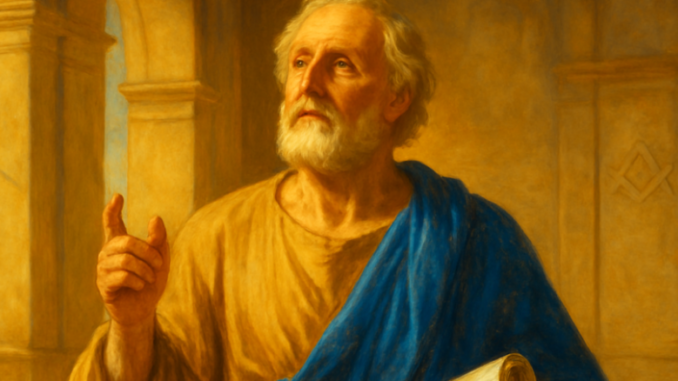
Can anyone truly practice philosophy when their life contradicts their words? Lucius Annaeus Seneca poses this question with striking sharpness in his twentieth letter to Lucilius. It is a question that has echoed through the centuries and still reverberates today in the silence of the Masonic lodge, where the tension between professing and practicing lies at the very heart of the work. Let us explore the philosophical sources Seneca drew upon when he composed this remarkable letter.
The Paradox of the Talking Philosopher
Seneca opens his letter with a challenge that is as simple as it is unsettling: let your actions match your words. The demand sounds self-evident, and that is precisely what makes it so treacherous. The Stoic tradition from which Seneca emerged had always wrestled with the gap between theory and practice. Zeno of Citium, the founder of the Stoa around 300 BCE, was already criticized by opponents who argued that his strict doctrines were impossible to live by.
Seneca acknowledges this tension openly. He was himself a wealthy man at the court of Emperor Nero — a position that was difficult to reconcile with his preaching of sobriety. Yet this is not hypocrisy in the simple sense of the word. Seneca did not see philosophy as a state of perfection, but as a continuous movement toward improvement. The philosopher is not the one who already lives flawlessly, but the one who tries, every single day, to bring his life a little closer to his ideals.
The Stoic Roots of Simplicity
The ideal of simplicity that Seneca develops in this letter has deep roots in early Stoicism. Cleanthes, the second head of the Stoic school, reportedly lived in poverty and earned his bread as a water carrier. Chrysippus, his successor, systematized Stoic ethics and established that external goods such as wealth and fame were indifferent things — neither good nor evil in themselves.
Seneca translates this abstract doctrine into concrete rules for living. For him, simplicity does not necessarily mean poverty, but freedom from the tyranny of desire. Whoever can be content with little possesses more than the one who always wants more. This thought also connects Seneca to the Cynics, whose radical way of life he admired without wishing to fully embrace it. Diogenes of Sinope, who lived in a barrel and asked Alexander the Great to step out of his sunlight, represented an extreme that Seneca considered too far, though he valued its essential kernel.
True simplicity is not the absence of possessions, but freedom from the compulsion to possess.
Epicurus as an Unexpected Ally
It is striking that Seneca quotes Epicurus in this letter, as he so often does in his correspondence with Lucilius. The Stoics and Epicureans were rival schools in antiquity, yet Seneca proved remarkably eclectic. He gathered wisdom wherever he found it, regardless of the school label attached to it. Epicurus taught that the highest good consisted of ataraxia — tranquility of the soul — achieved through moderation and friendship.
This willingness to look beyond the boundaries of one’s own school makes Seneca a thinker of particular relevance today. He understood that truth is not the property of any single system. This attitude is mirrored in Freemasonry, where people of different religious and philosophical backgrounds come together in the conviction that wisdom has many sources. The Masonic lodge, like Seneca’s philosophical practice, welcomes light from every quarter.
Fidelity as a Virtue of Perseverance
The second great theme of the letter is fidelity to philosophy itself. Seneca warns against hopping from one doctrine to another, superficially collecting quotations without genuine commitment. True philosophy demands constantia — steadfastness. For the Stoics, this virtue was closely linked to the cardinal virtue of courage. Whoever cannot remain faithful to his principles under pressure never truly possessed them in the first place.
Here Seneca touches on a theme that is equally central to Freemasonry: fidelity to the oath, to one’s brethren, and to the principles of the Craft. The rough ashlar that must be shaped into a perfect cube requires years of patient labor. The brother who gives up after the first disappointment will never achieve mastery. Constancy of purpose, in philosophy as in Masonic work, is the indispensable condition for genuine transformation.
The Mirror of Conscience
Seneca also introduces in this letter the image of the philosopher who examines himself as a judge examines a defendant. This practice of self-reflection — the daily examination of conscience — connects Seneca to the Pythagoreans, who according to tradition reviewed each evening the actions of the day. Pythagoras, whose mystical brotherhood can in many respects be seen as a forerunner of later initiatory societies, placed great emphasis on self-discipline and inner purification.
Plutarch, the later Greek philosopher and biographer, would continue this tradition in his moral essays. The line extends further into the Renaissance, where humanists such as Petrarch rediscovered and disseminated Seneca’s letters. Michel de Montaigne called Seneca one of his most important teachers. The chain of transmission stretches across millennia, linking ancient Stoic practice to the reflective disciplines cultivated within the lodge to this day.
Philosophy as the Art of Living
Seneca’s twentieth letter ultimately reveals his vision of philosophy as an art of living. Philosophy is not an academic discipline or a collection of trivia, but a way of life that permeates one’s entire existence. This conception distinguishes Hellenistic philosophy from much of modern academic philosophy and makes it profoundly relevant for anyone seeking meaning and purpose.
Freemasonry shares this ideal. The rituals and symbols of the Order are not ends in themselves, but instruments on the path toward moral perfection. The square and compasses remind the brother to measure his actions, just as Seneca advised Lucilius to weigh his days. The resemblance is no coincidence — it testifies to a shared heritage of wisdom traditions reaching back to antiquity, a golden thread that runs from the Stoa through the medieval builders’ guilds to the lodges of the present age.
What remains after this exploration is a recognition that Seneca’s call to simplicity and fidelity is far more than a historical curiosity. It is a living challenge, as urgent now as it was two thousand years ago. For the Freemason who enters the lodge seeking light, Seneca’s message offers both a mirror and a compass: examine yourself honestly, live simply, remain faithful to your principles, and never mistake the recitation of wisdom for the practice of it. The rough stone does not shape itself — it demands the steady hand and unwavering commitment of the craftsman who refuses to abandon his work.
Copyright text & image: devrijmetselaar.nl
Texts are based on the ideas and content of the author of devrijmetselaar.nl, reviewed, corrected, and supplemented with the assistance of OpenAI. Images are created based on the ideas of the author of devrijmetselaar.nl using OpenAI/DALL-E.
Frequently Asked Questions
What is Seneca's main point about the relationship between words and actions in philosophy?
Seneca challenges people to let their actions match their words, arguing that true philosophy requires continuous effort to bring one's life closer to one's ideals. He does not view philosophy as a state of perfection, but rather as a daily practice of improvement. This tension between professing and practicing philosophy lies at the heart of Masonic work.
How did Seneca reconcile his own wealth with his teachings on simplicity and sobriety?
Rather than viewing himself as a hypocrite, Seneca saw philosophy as a continuous movement toward improvement rather than a state of perfection. As a wealthy man at Emperor Nero's court, he acknowledged the tension between his circumstances and his teachings, but believed the true philosopher is one who tries every day to improve, not one who already lives flawlessly.
What is the Stoic concept of simplicity that Seneca develops in his letter?
Drawing from early Stoic philosophers like Cleanthes and Chrysippus, Seneca defines simplicity not as poverty itself, but as freedom from the tyranny of desire. He argues that whoever can be content with little possesses more than one who always wants more. This concept values contentment over the accumulation of external goods like wealth and fame, which Stoics considered indifferent things.

Be the first to comment