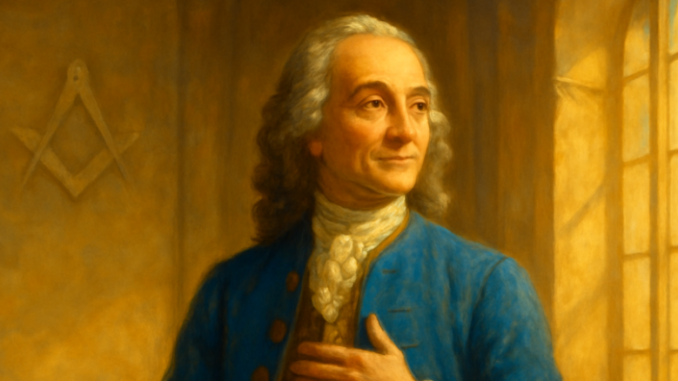
In 1762, the Protestant merchant Jean Calas was executed in Toulouse on charges of murdering his own son. The trial was steeped in religious prejudice and judicial arbitrariness. Voltaire, deeply shaken by this judicial scandal, took up his pen and wrote his celebrated Traité sur la tolérance — Treatise on Tolerance. Yet this was no impulsive reaction. It was the culmination of centuries of philosophical thought on tolerance, reason, and human dignity. The intellectual heritage behind this essay reveals deep roots that continue to resonate in the principles of Freemasonry to this day.
The Stoic Legacy: Universal Humanity
The deepest roots of Voltaire’s thinking on tolerance reach back to the Stoic philosophy of antiquity. Thinkers such as Seneca, Epictetus, and Marcus Aurelius developed the concept of the cosmopolis — a world community in which all human beings share in the same universal reason. For the Stoics, every person, regardless of origin or creed, carried a divine spark within. Seneca wrote in his letters to Lucilius that we are all members of one great body and that nature has brought us forth as kindred. This idea formed a foundation upon which later arguments for tolerance could be built.
Voltaire was an avid reader of the Stoic classics. In his correspondence and philosophical works, he regularly referenced Marcus Aurelius, whose Meditations he admired for their sobriety and humanity. The Stoic emphasis on self-discipline, reasonableness, and the acceptance of differences as part of the cosmic order echoes throughout Voltaire’s attack on religious fanaticism. Where the fanatic divides, the philosopher unites — by pointing to what all human beings have in common.
Montaigne’s Scepticism and Intellectual Humility
A second major influence on Voltaire’s ideas about tolerance came from Michel de Montaigne, the sixteenth-century essayist who cultivated scepticism as a way of life. In his Essays, Montaigne argued that human knowledge is limited and that our certainties are often little more than prejudices shaped by habit and upbringing. This intellectual humility led Montaigne to a deep respect for other ways of living and believing. His famous question — “Que sais-je?” (What do I know?) — was not an expression of defeatism, but an invitation to openness.
Voltaire adopted this sceptical stance and applied it directly to religious claims. If even the most brilliant minds cannot determine with certainty which religion is the true one, by what right do people persecute their fellow human beings over matters of belief? In the Calas affair, Voltaire saw how religious certainty degenerated into lethal violence. Scepticism offered an antidote: those who acknowledge their own fallibility are far less likely to light the pyre.
John Locke and Reasonable Tolerance
The most direct philosophical inspiration for Voltaire’s plea for tolerance was undoubtedly John Locke. In 1689, the English philosopher published his Epistola de Tolerantia (Letter Concerning Toleration), in which he argued that civil government has no jurisdiction over the soul. Faith, according to Locke, is an inner matter that cannot be compelled by force. True religion consists of inner conviction, not outward conformity imposed by the power of law.
Tolerance is not the absence of conviction, but the recognition that conviction must never be imposed through violence.
Voltaire brought Locke’s ideas to continental Europe. During his exile in England from 1726 to 1728, he experienced firsthand the relative religious freedom that prevailed there. In his Lettres philosophiques (Philosophical Letters), he praised the English model, where Quakers, Anglicans, and Presbyterians lived side by side without persecuting one another. This experience strengthened his conviction that tolerance was not only morally right but also practically achievable.
The Enlightenment Network and Early Freemasonry
Voltaire’s advocacy for tolerance did not arise in a vacuum. It emerged within a broad network of Enlightenment thinkers who corresponded, published, and reinforced each other’s ideas. Pierre Bayle had already produced a monumental work in his Dictionnaire historique et critique that exposed religious intolerance for what it was. Bayle argued that atheists could act morally and that Christians held no monopoly on virtue. These bold propositions paved the way for Voltaire’s own assaults on ecclesiastical dogmatism.
Within this intellectual climate, the emerging institution of Freemasonry also played a significant role. The first Grand Lodge was founded in London in 1717, precisely during the period when Enlightenment ideas were spreading across Europe. Freemasonry offered a space where men of different faiths could meet as brothers, bound by shared values of tolerance, brotherly love, and the pursuit of truth. Although Voltaire’s own relationship with Freemasonry was complex — he was initiated into the Lodge of the Nine Sisters in Paris only weeks before his death in 1778 — he unmistakably shared its core ideals.
The Symbolism of Light and Darkness
The Enlightenment derived its very name from a powerful symbol: light dispelling the darkness of ignorance and superstition. This image was far from new. In the Stoic tradition, light represented reason taming the chaos of the passions. In Christian mysticism, it symbolized divine grace. Freemasonry adopted this symbol and placed it at the centre of its rituals: the candidate steps out of darkness and into the light, an allegory for the quest for knowledge and self-improvement.
Voltaire employed the same symbolism in his battle against intolerance. Fanaticism, for him, was darkness — a blindness that drove people to commit atrocities in the name of God. Philosophy brought light, not by imposing a new dogma, but by letting the lamp of reason illuminate prejudices that had festered too long in the shadows. The Calas affair was, in this symbolic framework, a stark example of what happens when darkness prevails — and a rallying cry for those who believed that reason and compassion could triumph.
A Living Legacy in Masonic Principles
The philosophical lineage running from the Stoics through Montaigne, Locke, and Voltaire finds a living expression in Freemasonry’s foundational principles. The Masonic commitment to meeting on the level — treating every brother as an equal regardless of religious affiliation, social status, or political persuasion — is a direct descendant of the Stoic idea of the cosmopolis. The Masonic insistence on the freedom of conscience echoes Locke’s argument that belief cannot be coerced. And the ritual journey from darkness to light mirrors the Enlightenment conviction that reason, tempered by humility, offers humanity its best hope.
Voltaire’s Traité sur la tolérance remains one of the most powerful defenses of religious freedom ever written. But it did not spring from one mind alone. It drew upon a rich philosophical tradition — Stoic universalism, Montaignean scepticism, Lockean liberalism — and it contributed to a broader cultural movement in which Freemasonry played a distinctive and enduring part.
The Calas affair was a tragedy born of intolerance, but it also sparked one of history’s most eloquent defenses of human dignity and freedom of conscience. The philosophical roots of Voltaire’s argument — reaching from ancient Rome to Enlightenment-era London and Paris — are the same roots that nourish the principles of Freemasonry. Tolerance, reason, and brotherly love are not abstract ideals sealed in dusty books. They are living values, renewed in every Lodge meeting, in every encounter between people who choose understanding over judgment. In a world where fanaticism still threatens, the light that Voltaire and the Masonic tradition champion is as vital as ever.
Copyright text & image: devrijmetselaar.nl
Texts are based on the ideas and content of the author of devrijmetselaar.nl, reviewed, corrected, and supplemented with the assistance of OpenAI. Images are created based on the ideas of the author of devrijmetselaar.nl using OpenAI/DALL-E.
Frequently Asked Questions
What was the Calas Affair and why did it matter to Voltaire?
In 1762, Jean Calas, a Protestant merchant, was executed in Toulouse on charges of murdering his own son in a trial marked by religious prejudice and judicial corruption. Voltaire was deeply shaken by this judicial scandal and used it as the catalyst to write his celebrated Treatise on Tolerance, which became a foundational work advocating for religious freedom and fair justice.
How did Stoic philosophy influence Voltaire's ideas on tolerance?
Voltaire drew from Stoic philosophers like Seneca, Epictetus, and Marcus Aurelius, who developed the concept of cosmopolis—a universal world community where all humans share in divine reason regardless of origin or creed. This Stoic emphasis on universal humanity, self-discipline, and reasonableness became central to Voltaire's attack on religious fanaticism and his argument that all people have common ground.
What role did Montaigne's scepticism play in shaping tolerance as a philosophical principle?
Michel de Montaigne's intellectual humility—expressed in his question 'Que sais-je?' (What do I know?)—taught that human knowledge is limited and our certainties are often mere prejudices shaped by habit. Voltaire adopted this sceptical approach to challenge religious claims, arguing that if brilliant minds cannot determine which religion is absolutely true, tolerance and openness become necessary virtues rather than weaknesses.


Be the first to comment