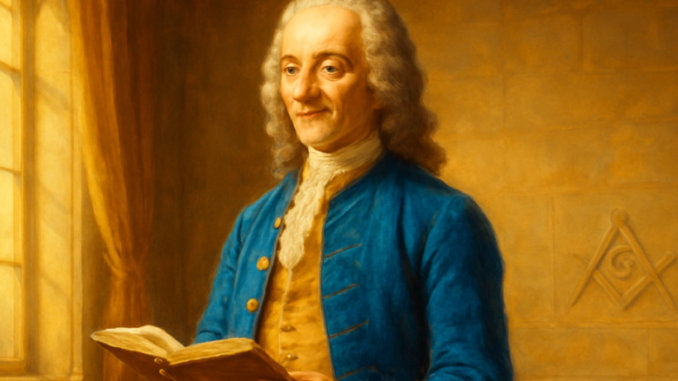
In 1726, François-Marie Arouet — better known as Voltaire — fled to England. What he found there would permanently reshape his thinking. It wasn’t the Anglican cathedrals or the royal courts that left the deepest impression, but a small community of plainly dressed believers who addressed everyone as equals and refused to remove their hats for anyone. The Quakers, or the Society of Friends, showed Voltaire a radically different way of coming together. His observations, recorded in the first of his Letters on the English, contain strikingly relevant insights into what genuine human connection truly means — insights that resonate deeply with the principles of Freemasonry.
An Encounter That Changed Everything
In his letters, Voltaire describes visiting a Quaker in London and being astonished by the man’s behavior. The Quaker remained seated when Voltaire entered, kept his hat on, and spoke without any trace of subservience. Where the French philosopher expected politeness shaped by hierarchy, he found equality instead. The Quaker explained that their community had no priests, performed no rituals, and accepted no authoritative interpretation of sacred texts. Every person, they believed, carried an inner light that provided direct access to truth.
This experience struck Voltaire profoundly — not because he shared their religious convictions, but because he recognized that these people lived together on the basis of mutual respect without the intervention of any external authority. The Quakers had found something the great churches of Europe lacked: authentic brotherhood.
The Inner Light as a Source of Connection
The Quaker doctrine of the inner light bears remarkable parallels with Masonic thought. Both traditions acknowledge that truth cannot be imposed from the outside but must be discovered from within. In Freemasonry, we speak of the search for light and knowledge — a journey each Brother undertakes individually, yet one that simultaneously strengthens the collective. Just as the Quakers gathered in silence and waited until someone was moved by inner inspiration to speak, Freemasons observe their own ritual silences in which reflection and introspection take center stage.
True connection does not arise from uniform beliefs, but from a shared dedication to inner truthfulness.
Voltaire understood that the Quakers were not a sect that excluded others, but a community held together precisely by its openness. They did not reject the truths of others — they simply refused to accept any single interpretation as the only valid one. This principle of tolerance and respect for individual conscience would later become a cornerstone of Enlightenment thinking, and it remains a living principle within the Masonic lodge to this day.
Brotherhood Without Hierarchy
What fascinated Voltaire most was the absence of priests among the Quakers. No individual stood above another by virtue of ordination or office. Everyone was equal before the inner light. This radical equality finds its echo in the Masonic lodge, where men from vastly different backgrounds come together as Brothers. The distinctions of the outside world — rank, class, social standing — are left at the lodge door. Inside, a different order prevails, one founded on shared values and mutual recognition.
The historical context makes this all the more remarkable. In eighteenth-century Europe, social hierarchy was considered sacred. For a group of people to consciously set aside class distinctions was nothing short of revolutionary. Voltaire saw in the Quakers living proof that society was possible without oppression — that people could come together of their own free will around shared principles. This was precisely the vision that the emerging fraternity of Freemasons was also building upon during the same era.
Silence as the Language of Connection
One of the most distinctive aspects of Quaker meetings was their silence. While other churches filled their services with sermons, hymns, and elaborate rituals, the Quakers gathered in expectant stillness. Only when someone truly had something to say would the silence be broken. This practice reflected a profound trust — the conviction that not all truth needs to be captured in words.
Silence plays an equally meaningful role in Freemasonry. The Entered Apprentice learns to listen before he speaks. Ritual workings are surrounded by moments of contemplation. It is within this silence that fellowship becomes tangible — not as an abstraction, but as a shared experience. Voltaire, a man famous for his razor-sharp wit and biting satire, recognized the surprising power of this quietude. Sometimes what goes unsaid communicates far more than any speech ever could.
Lessons for Today
What can we learn today from Voltaire’s observations? First, that genuine community does not emerge from enforcing conformity. The Quakers remained united precisely because they left room for individual conscience. Second, that hierarchy is not a prerequisite for order. People can live and work together based on shared values without one person standing above another.
Consider these enduring principles: Fellowship grows from mutual respect, not from imposed rules. Inner conviction is more powerful than external authority. Silence can contain deeper truth than words. Equality makes authentic brotherhood possible.
Freemasonry has preserved and passed down these principles through the centuries. In an age of increasing social polarization — when people retreat into like-minded groups and public discourse grows ever more strident — the example of the Quakers and the insights of Voltaire offer a valuable counterbalance. Brotherhood without dogma is not only possible; it may well be the only sustainable form of human community.
Voltaire’s first philosophical letter about the Quakers is far more than a historical curiosity. It is a timeless argument for a way of being together that honors both the freedom of the individual and the strength of the community. Freemasonry shares this vision: a brotherhood that does not demand uniformity but embraces diversity, that does not preach but invites each person toward their own discovery. As Voltaire realized nearly three hundred years ago in a simple London parlor, true connection begins where there is a willingness to listen, to respect, and to recognize the light that burns in every human soul.
Copyright text & image: devrijmetselaar.nl
Texts are based on the ideas and content of the author of devrijmetselaar.nl, reviewed, corrected, and supplemented with the assistance of OpenAI. Images are created based on the ideas of the author of devrijmetselaar.nl using OpenAI/DALL-E.
Frequently Asked Questions
Why did Voltaire's experience with the Quakers have such a profound impact on his thinking?
Voltaire was struck by how the Quakers lived together based on mutual respect and equality without external authority or hierarchy. Unlike the rigid social structures of France, the Quakers treated everyone as equals, refused to bow or remove their hats for anyone, and had no priests or authoritative religious figures. This demonstrated to Voltaire that authentic brotherhood and genuine human connection could exist without imposed dogma or social hierarchy.
What is the Quaker concept of the 'inner light' and how does it relate to Freemasonry?
The Quaker doctrine of the inner light holds that truth cannot be imposed from outside but must be discovered within each individual through direct personal access to truth. This concept bears remarkable parallels with Freemasonry, which also emphasizes a personal search for light and knowledge undertaken individually by each Brother. Both traditions value introspection and inner truthfulness as paths to genuine connection, rather than requiring uniform beliefs or external authorities.
How did the Quakers achieve community without dogma or formal religious authority?
The Quakers created community by accepting that each person carried an inner light providing direct access to truth. They had no priests, performed no mandatory rituals, and accepted no authoritative interpretation of sacred texts. Instead, they gathered in silence and spoke only when moved by inner inspiration. This approach created openness and inclusion rather than exclusion, as they did not reject the truths of others but simply relied on their own inner guidance for connection and spiritual understanding.


Be the first to comment