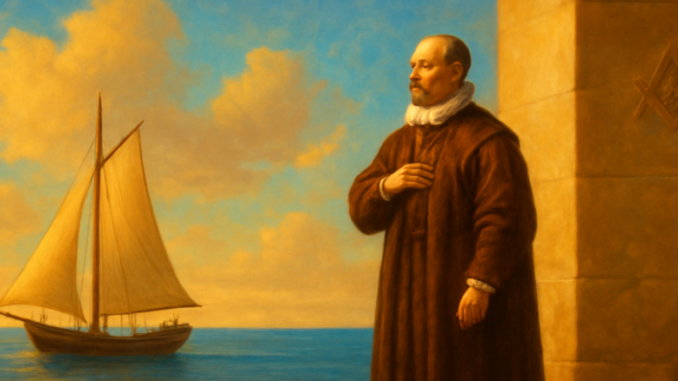
Somewhere in a dimly lit study in the Dordogne, in the middle of the sixteenth century, Michel de Montaigne bends over a yellowed copy of Plutarch. He underlines a passage about Roman generals who, after a great battle, received not gold but a simple laurel wreath. He pauses. What does it say about the human soul that a symbolic gesture can be worth more than a chest full of coins? From that moment of wonder grew his seventh essay in the second book: ‘On the Rewards of Honor.’ The philosophical sources he weaves together reach from the Athenian agora to the Roman Stoa — and they cast a surprising light on questions that still echo through the halls of Freemasonry today.
Plutarch as Mirror and Guide
Montaigne was a tireless reader of Plutarch, whose Lives and Moralia flow through the Essays like an inexhaustible spring. In ‘On the Rewards of Honor,’ Montaigne draws on Plutarch’s descriptions of Greek and Roman heroes who placed honor above material gain. Plutarch was not a systematic philosopher but a moralist who revealed ethical truths through concrete life stories. This suited Montaigne’s own method perfectly: reasoning not from abstract principles but from lived experience.
What Montaigne recognized in Plutarch was the conviction that true virtue is its own reward. The laurel wreath, the public tribute, the mention of someone’s name after death — these are not payments but marks of respect. They affirm what someone is, not what someone possesses. Plutarch showed how figures like Aristides the Just earned the highest form of recognition precisely through their detachment from wealth. Montaigne takes that insight and makes it personal: he wonders whether the people of his own era are still capable of choosing honor over possession.
The Stoic Undercurrent
Beneath the surface of this essay runs a powerful Stoic undercurrent. Seneca, whom Montaigne counted among his most beloved authors, argued in his letters to Lucilius that external rewards distract the soul rather than elevate it. The truly wise person, Seneca maintained, finds satisfaction in the awareness of having acted rightly. Marcus Aurelius, the philosopher-emperor whose Meditations Montaigne knew well, wrote in similar terms that fame is fleeting and that only the inner disposition of a person holds lasting value.
Montaigne embraces this Stoic thinking, but not without reservation. As a committed skeptic, he always adds qualifications to overly certain doctrines. Yet he does adopt the core idea: honor is only truly valuable when it is not sought. This distinction — between honors as a byproduct of virtuous action and honors as a goal in themselves — forms the philosophical heart of the essay. It is a theme we also find in Aristotle, who argued in the Nicomachean Ethics that honor is the outward sign of inner excellence but must never become the purpose of one’s actions.
Skepticism and the Limits of Human Judgment
Montaigne’s relationship with honor is thoroughly colored by his Pyrrhonian skepticism, the philosophical tradition he encountered through Sextus Empiricus. If honor depends on the judgment of others, how reliable is that judgment? People are fickle, impressionable, and often blind to true merit. Montaigne observes that the same general who is celebrated today may be forgotten tomorrow. The reward of honor is therefore inherently fragile — a construction of human consensus that can collapse at any moment.
This skeptical perspective transforms the essay into something more than a hymn to honor. It becomes a subtle warning: do not attach yourself too strongly to the recognition of the outside world, for it rests on uncertain ground. In this regard, Montaigne aligns with the classical wisdom of both the Stoa and Pyrrhonism, while adding something distinctly contemporary. He writes from a world in which the Wars of Religion demonstrated daily how quickly heroism can turn into vilification, and how arbitrary the distribution of honor can sometimes be.
Renaissance Humanism: Rediscovering Virtue
The essay fits seamlessly into the broader tradition of Renaissance humanism. Thinkers like Petrarch and Erasmus had already advocated, before Montaigne, for a return to classical virtue ethics. They believed that people could improve themselves through the study of Greek and Latin texts — not as an academic exercise but as a practical art of living. Montaigne shared that conviction but added his characteristic personal voice. Where Erasmus was often didactic, Montaigne is exploratory and questioning. He offers no recipe for a virtuous life, but an invitation to search alongside him.
That search has a striking parallel with the approach found within Freemasonry. There, too, the focus is not on transmitting a fixed body of doctrine but on personal development through reflection, ritual, and dialogue. The question Montaigne poses — ‘What makes honor truly honorable?’ — is essentially the same question a Freemason asks when contemplating the inner meaning of a ritual act. It is not the outward gesture that matters, but the intention and insight that lie behind it.
Honor as Inner Work
What makes the philosophical background of this essay so compelling is the way Montaigne brings disparate traditions into conversation with one another. Plutarch provides the examples, Seneca and Marcus Aurelius supply the ethical foundation, Sextus Empiricus introduces doubt, and Renaissance humanism contributes the trust that human beings can grow through self-study. From this convergence emerges a vision of honor that is neither naively idealistic nor cynical, but rooted in honest self-examination.
For anyone familiar with Masonic thought, this synthesis will feel remarkably familiar. The rough ashlar that must be shaped into a perfect cube is not polished by external applause but by persistent inner labor. Montaigne would have understood this metaphor instinctively. His entire literary project — the Essays as an exercise in self-knowledge — mirrors the Masonic commitment to working on oneself, not for the sake of accolades, but because the work itself is what gives life meaning.
True honor, as Montaigne reveals through his tapestry of classical sources and personal reflection, is not a reward you receive but a quality you build in silence. It emerges where virtue and self-knowledge converge — in the quiet space where a person is honest with themselves, beyond the gaze of the crowd. For Freemasons and seekers alike, this remains a timeless insight: the most meaningful recognition is not the laurel wreath placed upon your head by others, but the inner certainty that you have striven, however imperfectly, to live with integrity.
Copyright text & image: devrijmetselaar.nl
Texts are based on the ideas and content of the author of devrijmetselaar.nl, reviewed, corrected, and supplemented with the assistance of OpenAI. Images are created based on the ideas of the author of devrijmetselaar.nl using OpenAI/DALL-E.
Frequently Asked Questions
What inspired Montaigne to write his essay 'On the Rewards of Honor'?
Montaigne was inspired by reading Plutarch's accounts of Roman generals who received symbolic laurel wreaths instead of gold after great battles. This moment of reflection led him to contemplate why a symbolic gesture could hold more value than material wealth, ultimately resulting in his seventh essay in the second book of his Essays.
How did Plutarch influence Montaigne's philosophical approach?
Montaigne admired Plutarch's method of revealing ethical truths through concrete life stories rather than abstract principles. Plutarch's descriptions of Greek and Roman heroes who valued honor over material gain perfectly suited Montaigne's own approach of reasoning from lived experience, particularly his exploration of virtue as its own reward.
What role does Stoic philosophy play in Montaigne's essay on honor?
Stoic philosophy, particularly through the works of Seneca and Marcus Aurelius, runs as a powerful undercurrent in the essay. Montaigne adopts the Stoic conviction that true satisfaction comes from acting rightly rather than pursuing external rewards, though he maintains his characteristic skeptical reservations about overly certain doctrines.


Be the first to comment