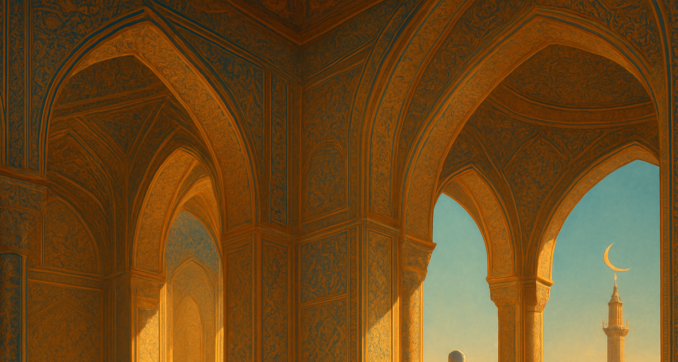
In the seventh century, somewhere on the rocky plains of the Arabian Peninsula, a prayer was composed that has since been spoken billions of times each day. Al-Fatiha — The Opening — is the first chapter of the Quran. It consists of only seven verses, yet it forms the beating heart of Islamic worship. This brief text carries a universal spiritual message that reaches far beyond the boundaries of any single religion. For Freemasons, who study sacred texts from all traditions in their pursuit of light and moral growth, this opening chapter offers striking parallels with their own journey.
A Historic Breakthrough in Spiritual Language
When the Prophet Muhammad received his first revelations in the seventh century, the Arabian world was in the grip of a spiritual struggle. Tribal gods competed for attention while monotheistic influences from Christianity and Judaism slowly seeped into the region. The Opening emerged in this context as a radically simple prayer: no complex rituals, no priestly intermediaries — just a direct invocation of the One. The prayer begins with the words “In the name of God, the Most Gracious, the Most Merciful” and closes with a supplication for guidance upon the straight path. This structure — a combination of praise and a request for direction — would become the foundation of daily prayer for Muslims around the world.
What stands out about this historic text is its emphasis on guidance over obedience. The believer does not ask for power, wealth, or victory over enemies, but for the ability to walk the right path. This priority reflects a deeply human longing that transcends time and culture — a longing that any Freemason will immediately recognize.
The Seven Verses and Their Inner Logic
The Opening follows a clear pattern that Freemasons will find familiar. The first three verses focus on the Divine: the name of God, His attributes of mercy, and His sovereignty over the Day of Judgment. Verse four serves as the pivotal point: “You alone do we worship, and You alone do we ask for help.” The final three verses turn toward the human condition: the request for guidance, the desire to follow the path of the righteous, and the avoidance of error.
This threefold structure — from the Divine, through devotion, to human aspiration — bears a remarkable resemblance to the symbolic journey a Freemason undertakes. In the Craft, one also begins with the acknowledgment of a higher order, followed by personal dedication, and finally the work of self-improvement. The medieval Islamic scholar Ibn Arabi, whose mystical writings are still studied to this day, called The Opening “a summary of all divine books.” His interpretation emphasizes that each verse opens a gate to deeper understanding — an idea that resonates powerfully with the Masonic concept of progressive degrees of knowledge.
Light and Guidance as Shared Themes
In Freemasonry, the concept of “light” holds a central place. The candidate is initiated by moving from darkness into light — a symbolic rebirth representing personal enlightenment. The Opening does not speak of light in literal terms, but the concept of “the straight path” functions in a strikingly similar way. To walk the straight path is to dwell in the light; to stray from it is to fall into darkness. This parallel is not coincidental. It reflects a universal human awareness that moral growth is inseparable from clarity of mind and spirit.
The Opening teaches us that spiritual growth begins with humility — with the honest recognition that we need guidance to find the right path. We cannot build the temple of the self without a blueprint greater than our own design.
The great Sufi poet Rumi, who lived in the thirteenth century, wrote extensively about this theme of seeking and being guided. His poems emphasize that the search itself is already a form of arriving. This thought resonates deeply with the Masonic understanding that the journey toward self-knowledge never truly ends, but that every step along the way holds value in itself.
Brotherhood Beyond Religious Boundaries
One of the most remarkable aspects of The Opening is its absence of exclusivity. The prayer speaks of “those whom You have favored” without specifying which religion or lineage that might include. This openness has historically allowed for interpretations that transcended religious boundaries. In tenth- and eleventh-century Andalusia, where Muslims, Jews, and Christians lived side by side, this kind of universal spiritual language was valued as common ground — a shared vocabulary of the soul.
For Freemasons, who welcome brothers of all faiths into the Lodge, The Opening offers a model of spiritual language that unites rather than divides. The Lodge does not require its members to follow a specific religion, but it does ask them to believe in a higher power. This principle of unity in diversity finds a clear echo in the way The Opening speaks: personal enough to be meaningful, universal enough to be shared.
Lessons for the Modern Seeker
What can we learn today from this ancient prayer? First, the value of daily reflection. Muslims recite The Opening at least seventeen times a day during the five obligatory prayers. This repetition is not mindless routine — it is a continual reminder of priorities, a disciplined return to what matters most. For Freemasons, who practice their rituals with regularity, this is a familiar principle: repetition deepens understanding. Each time a ceremony is performed, new layers of meaning reveal themselves.
Second, The Opening underscores the importance of community. The prayer consistently uses “we” instead of “I.” Even when a Muslim prays alone, he speaks on behalf of a larger community. This collective consciousness runs counter to modern individualism, but it aligns seamlessly with the Masonic emphasis on brotherhood. We do not build for ourselves alone — we build for all who come after us.
The core lessons from The Opening can be distilled into four guiding principles: begin with the recognition of something greater than yourself; ask for guidance rather than material gain; speak on behalf of the community, not just for yourself; and seek the straight path as a metaphor for moral clarity. These are principles that any Freemason, regardless of personal faith, can take to heart.
A Gateway to Deeper Understanding
The Opening of the Quran is, in every sense, a gateway — not just to the holy book that follows it, but to a way of thinking about spirituality that prizes humility, direction, and shared purpose. Its seven short verses have echoed through fourteen centuries of human history, spoken in deserts and cities, in mosques and private chambers, by scholars and by those who could barely read.
For Freemasons, this text is a reminder that the great spiritual traditions of the world share more common ground than we often realize. The search for light, the desire for moral guidance, the commitment to community — these are threads that run through every sacred text worth studying. When we place The Opening on the altar of our contemplation alongside the writings of other traditions, we do not diminish any of them. We illuminate them all.
Al-Fatiha, The Opening, stands as proof that the most profound spiritual truths are often the simplest. In just seven verses, it maps out a journey from divine recognition to human aspiration — a journey that mirrors the Masonic path from darkness to light. Whether you approach it as a believer, a scholar, or simply a seeker of wisdom, this ancient prayer has something to teach every Brother who is willing to listen. In the end, the straight path and the path toward Masonic light may be different roads, but they lead in the same direction: toward a life of meaning, purpose, and service to something greater than ourselves.
Copyright text & image: devrijmetselaar.nl
Texts are based on the ideas and content of the author of devrijmetselaar.nl, reviewed, corrected, and supplemented with the assistance of OpenAI. Images are created based on the ideas of the author of devrijmetselaar.nl using OpenAI/DALL-E.
Frequently Asked Questions
What is Al-Fatiha and why is it significant in Islam?
Al-Fatiha, meaning 'The Opening,' is the first chapter of the Quran consisting of seven verses. It forms the beating heart of Islamic worship and is spoken billions of times each day by Muslims around the world. Composed in the seventh century on the Arabian Peninsula, it emerged as a radically simple prayer emphasizing direct invocation of the One God without complex rituals or priestly intermediaries. The prayer begins with praise of God's grace and mercy and closes with a supplication for guidance on the straight path.
How does Al-Fatiha relate to Freemasonry?
Al-Fatiha contains striking parallels with the Freemasons' own spiritual journey. Both emphasize guidance over obedience, reflecting a universal human longing to walk the right path. The prayer's threefold structure—beginning with the Divine and God's attributes, moving through devotion and worship, and concluding with human aspiration for guidance—mirrors the symbolic journey Freemasons undertake in the Craft, which begins with acknowledgment of a higher order, followed by personal dedication and spiritual work.
What does Al-Fatiha teach about the nature of prayer and spiritual seeking?
Al-Fatiha teaches that spiritual prayer does not seek power, wealth, or victory over enemies, but rather the ability to walk the right path and receive divine guidance. This emphasis on guidance as the primary spiritual aspiration transcends time and culture, making it universally relevant. The prayer's structure of combining praise for the Divine with a request for direction became the foundation for daily Islamic worship and reflects a deeply human longing that any sincere spiritual seeker, including Freemasons studying sacred texts from all traditions, will recognize.


Be the first to comment