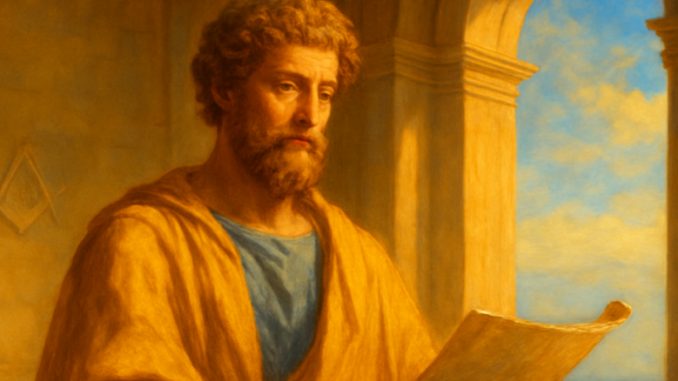
Picture a Roman emperor sitting alone by candlelight after a grueling day of affairs of state and military decisions. He reaches not for a sword, but for a stylus. In the stillness of the night, he writes words meant for no one else — only for himself. Words about reason, about the inner life, about what it truly means to be human. Nearly two thousand years later, Freemasons gather in their lodges to wrestle with the very same questions, searching for the same light that Marcus Aurelius sought in the quiet hours before dawn.
Reason as an Inner Compass
In the third book of his Meditations, Marcus Aurelius turns his attention to the essence of human existence: the ruling faculty, or hegemonikon. This inner capacity is what sets human beings apart from all other creatures. It enables us to distinguish truth from illusion, substance from noise. The emperor writes not to impress or instruct others, but to remind himself of what genuinely matters. That personal quest for inner truth runs remarkably parallel to the Masonic journey.
For the Freemason, every journey begins in darkness. The candidate is symbolically blindfolded before receiving the light — a light that is not physical, but represents knowledge, self-awareness, and moral clarity. Marcus Aurelius would have recognized this immediately. His meditations are a continuous exercise in purifying the mind, stripping away unnecessary anxieties, and focusing on what reason identifies as essential. Both the Stoic philosopher and the Masonic initiate understand that the path to wisdom starts with turning inward.
Mortality as a Teacher
A recurring theme in Book Three is the brevity of human life. Marcus Aurelius reminds himself that fame fades, bodies decay, and even the mightiest rulers are eventually forgotten. This is not pessimism — it is a call to clarity. When all externals are stripped away, what remains? Only the quality of our actions and the purity of our intentions.
The true Freemason does not build walls of stone, but an inner edifice capable of withstanding every storm and outlasting every age.
This same idea sits at the heart of Freemasonry. The brotherhood teaches its members to work on the rough ashlar — the symbol of the unrefined self — with the goal of shaping it into a perfect cube. That cube does not represent outward perfection, but inner harmony. Like Marcus Aurelius, the Freemason understands that impermanence is not an enemy but a teacher, pointing us toward what truly counts. When we accept that our time is limited, every act of virtue becomes more urgent and more meaningful.
Connection Through Reason
Although Marcus Aurelius often wrote in solitude, he consistently emphasizes that human beings are social creatures by nature. According to Stoic philosophy, the reason that dwells in each individual is part of a universal logos — a cosmic order that connects all people. To cultivate your own reason is to contribute to the well-being of the whole. Individualism and community are not opposites; they reinforce each other.
This principle resonates deeply with the Masonic value of brotherhood. In the lodge, men from vastly different backgrounds, professions, and beliefs meet as equals. What unites them is not social standing or worldly success, but a shared dedication to self-improvement and mutual respect. The chain that Freemasons symbolically form during certain rituals embodies exactly this connection: individual links that together create an unbreakable whole. Marcus Aurelius, who governed an empire of astonishing diversity, would have understood this bond instinctively.
Virtue as Daily Practice
In Book Three, Marcus Aurelius warns against procrastination. Cultivating virtue is not a project for someday — it is a task for today, for this very moment. Every morning offers a fresh chance to act justly; every encounter is an opportunity to show compassion. The emperor urges himself not to wait for perfect conditions, but to begin now with what is possible.
Freemasonry carries a similar sense of urgency. The work on the rough ashlar is never finished, but that is no excuse for passivity. On the contrary, it is precisely the awareness that perfection lies beyond our reach that makes every step forward meaningful. The lodge serves as a workshop where this awareness is kept alive, where brothers encourage one another to work daily on their moral character. There is no final degree that marks the end of personal growth — the work itself is the point.
The Inner Sanctuary
One of the most powerful images in Book Three is that of the inner sanctuary — the place where reason can dwell undisturbed. Marcus Aurelius calls upon himself to retreat into this sanctuary whenever the outside world becomes overwhelming. Not as an escape, but as a renewal. From that inner stillness, one can face the world again with restored strength and purpose.
The Freemason recognizes this image in the symbolism of the temple. The outer temple — the lodge itself — is merely a reflection of the inner temple that every brother builds within himself. Rituals and symbols serve as tools to access that inner space. It is there, in the hidden depths of the soul, that the real transformation takes place — not in what is visible, but in what is concealed. Both the Stoic emperor and the Masonic brother know that the most important architecture is invisible to the eye.
Lessons for the Modern Seeker
What can we learn from this ancient wisdom in an age of constant distraction and surface-level living? Both Marcus Aurelius and the Masonic tradition point us toward the same fundamental truths: that inner growth matters more than outward success, that genuine connection with others springs from connection with ourselves, and that the search for truth is a lifelong endeavor requiring patience and dedication.
Consider these principles as daily guideposts: Cultivate your inner reason through regular reflection and honest self-examination. View mortality not as a threat, but as an invitation to live authentically. Recognize in others the same searching spirit that lives within you. Build your inner temple with the same devotion you bring to every external task. These are not abstract ideals — they are practical commitments that shape the quality of a life.
The Meditations of Marcus Aurelius and the Masonic tradition, despite their vastly different origins, speak the same language. It is the language of inner labor, of quiet growth, of connection that transcends time and circumstance. Whether you find yourself drawn to the Stoic page or the Masonic lodge, the invitation is the same: look inward, work steadily, and trust that the light you seek has been waiting for you all along.
Copyright text & image: devrijmetselaar.nl
Texts are based on the ideas and content of the author of devrijmetselaar.nl, reviewed, corrected, and supplemented with the assistance of OpenAI. Images are created based on the ideas of the author of devrijmetselaar.nl using OpenAI/DALL-E.
Frequently Asked Questions
What is the connection between Marcus Aurelius's concept of the 'ruling faculty' and Freemasonry?
Marcus Aurelius's 'hegemonikon' (ruling faculty) is the inner capacity that distinguishes humans from other creatures and enables us to distinguish truth from illusion. This concept parallels the Masonic journey, where candidates begin in darkness and receive symbolic light representing knowledge, self-awareness, and moral clarity. Both the Stoic philosopher and the Masonic initiate understand that wisdom begins with turning inward and purifying the mind of unnecessary distractions.
How does Freemasonry use the symbolism of the 'rough ashlar' in relation to Stoic philosophy?
The rough ashlar in Freemasonry symbolizes the unrefined self that must be shaped into a perfect cube, representing inner harmony rather than outward perfection. This mirrors Marcus Aurelius's Stoic teachings about focusing on what truly matters—the quality of our actions and purity of our intentions—rather than external appearances or material success.
What role does mortality play in both Stoicism and Freemasonry according to this article?
Both Marcus Aurelius and Freemasons view mortality not as something to fear, but as a teacher that provides clarity. By recognizing that fame fades, bodies decay, and all externals are temporary, practitioners are called to focus on what truly endures: the quality of their character and inner development. This perspective helps strip away illusions and redirect attention toward genuine values.


Be the first to comment