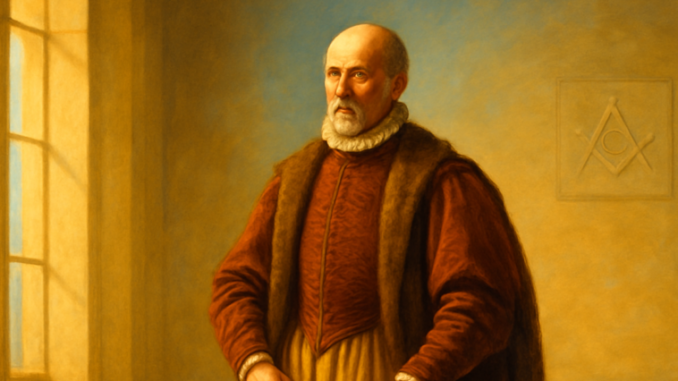
An hourglass sits on a table. Sand flows steadily, grain by grain, from the upper bulb to the lower. We watch it and see time passing. But what do we truly see? Michel de Montaigne looked at this same image and saw something different — not the decay of the body, but an invitation to understand how the great thinkers before him had reflected on old age, mortality, and the value of a life fully lived. In his essay “On Age,” he weaves a philosophical tapestry that draws together Stoic, Skeptic, and Humanist threads into something entirely his own. This article unfolds those philosophical roots.
The Hourglass as a Philosophical Instrument
At first glance, an hourglass is a simple measuring device. But look longer, and you discover an entire framework for thought. The ancient Stoics saw in the passage of time not a cause for sorrow, but a call to live with intention. Seneca wrote in On the Shortness of Life that the problem is not that we have too little time, but that we waste too much of it. That idea resonates deeply in Montaigne’s essay on aging. For him, the hourglass is not a symbol of loss but of clarity: as the remaining sand dwindles, each grain becomes more precious.
In Freemasonry, this awareness is equally present. The hourglass is one of the classic symbols found in the lodge, reminding every Brother that his time on earth is finite. Not to instill fear, but to cultivate wakefulness. Montaigne and Freemasonry share a fundamental conviction here: whoever faces their mortality squarely lives more richly and more consciously.
Seneca and the Stoic Undercurrent
Montaigne was an avid reader of Seneca. This is evident in nearly all his essays, but in “On Age” the influence comes through with particular sharpness. Seneca argued that old age holds no burden for those who have learned to live well. It is not the length of life that matters, but its depth. Montaigne adopts that starting point but adds his characteristic nuance: he refuses to idealize aging. Where Seneca sometimes tends toward glorifying the wise elder, Montaigne insists on the honest observation that the body crumbles, the mind slows, and there is nothing noble about that in itself.
This combination of Stoic acceptance and unflinching honesty is what makes Montaigne’s position unique. He borrows from the Stoics the courage to face death, but refuses to polish away the reality of physical decline with philosophical platitudes. Marcus Aurelius, another Stoic thinker Montaigne knew well, wrote in his Meditations that everything in nature changes and that resisting this is futile. Montaigne agrees — but adds that acceptance is not the same thing as indifference.
Plutarch and the Art of Comparison
Alongside Seneca, Plutarch was one of Montaigne’s most beloved sources. The Greek writer was renowned for his Parallel Lives, in which he placed two historical figures side by side, offering insight through comparison. Montaigne applied the same method to the stages of life. In “On Age,” he compares youth and old age — not to declare a winner, but to show that each phase has its own character, its own virtues, and its own failings.
Plutarch also taught Montaigne that moral reflection only gains power when it is rooted in real lives and concrete experiences. No abstract systems — just stories drawn from practice. This approach is precisely what made Montaigne’s essays so accessible and so timeless. Freemasonry recognizes this same principle: moral development does not happen through dogma, but through ritual, experience, and brotherly conversation.
Skepticism as Liberation
Montaigne is often placed within the Skeptical tradition, and rightly so. His famous motto “Que sais-je?” — What do I know? — expresses a fundamental doubt about certainties. In his essay on aging, this skepticism manifests in his refusal to equate old age with wisdom. Aristotle, in his Rhetoric, described the elderly as cautious but also fearful and cynical. Cicero, in On Old Age, made an optimistic case for the ripeness of one’s later years. Montaigne chooses neither side. He doubts. He observes. He weighs.
This skeptical stance is not nihilistic. It is more a form of intellectual humility that creates space for genuine insight. Freemasonry shares a kindred tradition: the search for truth begins with the acknowledgment that one does not yet possess it. Only those willing to let go of their assumptions can truly build toward inner growth.
Montaigne teaches us that wisdom about growing older does not begin with answers, but with the courage to look honestly at what time does to us.
Renaissance Humanism and the Authority of Personal Experience
Montaigne did not write in a vacuum. He was a child of the Renaissance, a period in which the rediscovery of classical texts went hand in hand with a new confidence in individual experience. The humanism of Petrarch and Erasmus had paved the way for a mode of thinking that no longer saw human beings solely as parts of a divine plan, but as beings capable of examining and shaping themselves. Montaigne pushed that door wide open. His essays may well be the first great example of what we would now call autobiographical philosophy: thinking from one’s own body, one’s own habits, one’s own fears.
In “On Age,” this personal voice is unmistakable. Montaigne does not speak about old age as an abstract concept but about his own experience of growing older — the changes he observes in himself, the expectations he must adjust. It is precisely this honesty that gives the essay its power. Goethe would later write in a similar spirit about the formative force of self-examination, and within Freemasonry the same impulse lives on: the work of the rough ashlar is always deeply personal, always rooted in one’s own encounter with imperfection.
Montaigne’s essay on aging is far more than a reflection on getting old. It is a meeting point of philosophical traditions — Stoic discipline, Plutarchian comparison, Skeptical humility, and Renaissance self-inquiry — woven together by a mind that refused easy answers. For Freemasons, his approach holds a special resonance. The hourglass on the lodge floor, the call to self-knowledge, the rejection of dogma in favor of lived experience — these are not just Masonic principles but deeply Montaignean ones as well. To read Montaigne on age is to be reminded that the most important philosophical work is not done in libraries, but in the honest reckoning each of us must make with the passage of our own time.
Copyright text & image: devrijmetselaar.nl
Texts are based on the ideas and content of the author of devrijmetselaar.nl, reviewed, corrected, and supplemented with the assistance of OpenAI. Images are created based on the ideas of the author of devrijmetselaar.nl using OpenAI/DALL-E.
Frequently Asked Questions
What is the significance of the hourglass symbol in Montaigne's philosophy on aging?
In Montaigne's essay "On Age," the hourglass represents not loss or decay, but clarity and increased value. As the sand dwindles, each remaining grain becomes more precious. This symbol serves as a philosophical instrument that, following Stoic tradition, calls for intentional living and wakefulness rather than instilling fear. Both Montaigne and Freemasonry use the hourglass to cultivate consciousness of mortality and encourage richer, more deliberate living.
How does Montaigne differ from Seneca in their approach to aging and old age?
While Montaigne draws heavily from Seneca's Stoic philosophy—particularly the idea that life's depth matters more than its length—he adds characteristic nuance and honesty. Seneca tends to idealize the wise elder, whereas Montaigne refuses to use philosophical platitudes to obscure the physical reality of aging. He combines Stoic acceptance and courage in facing mortality with unflinching observation that the body deteriorates and the mind slows, rejecting any romanticization of decline.
What is the connection between Montaigne's essay and Freemasonry's teachings on mortality?
Montaigne and Freemasonry share a fundamental conviction about confronting mortality. The hourglass appears as a classic symbol in Freemasonry lodges, reminding each Brother that time on earth is finite. Like Montaigne's philosophy, this symbol is not meant to instill fear but to cultivate wakefulness and consciousness. Both traditions believe that those who face their mortality squarely live more richly and more consciously.


Be the first to comment