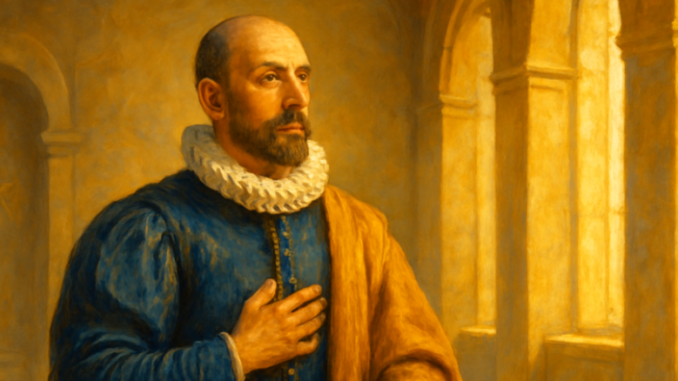
An hourglass sits on the table. Sand flows steadily, grain by grain, from the upper bulb to the lower. You watch it and perhaps think of time slipping away, of a deadline approaching, of something still left undone. But Michel de Montaigne would see something entirely different in that same image — not how much sand remains, but whether the sand that has already fallen was well spent. In his brief yet penetrating essay ‘On Age,’ the fifty-seventh essay from the first book of his celebrated collection, Montaigne examines what growing older truly means and why the length of a life matters far less than its depth.
The Core Idea: Age Is Not an Achievement
The central theme of this essay is remarkably clear by Montaigne’s standards. He pushes back against the notion that old age is inherently worthy of reverence. In many cultures, advanced years are automatically associated with wisdom, but Montaigne fundamentally questions that assumption. Simply growing old, he argues, says nothing about the quality of the life lived. Someone who reaches eighty without ever truly reflecting on their existence has not lived more fully than someone who died at thirty with a profound sense of fulfillment.
In making this argument, Montaigne draws on a classical philosophical tradition. He references the Roman poet and philosopher Lucretius and the Stoic thinker Seneca, both of whom maintained that the value of life does not reside in its duration. Seneca wrote in his famous letter on the shortness of life that most people do not have too little time — they waste too much of it. Montaigne echoes this thought and makes it personal, applying it to his own experience as a man acutely aware of his mortality.
The Examples Montaigne Uses
The essay is short but rich with examples from classical antiquity. Montaigne points to the many great figures who died young yet left an indelible mark on history. He mentions Alexander the Great, who died at thirty-two yet had conquered an empire spanning the known world. He also draws attention to the average life expectancy of his own era, which was considerably lower than what we are accustomed to today. The age of thirty-six was already considered respectable by many, and Montaigne observes that Jesus Christ completed his earthly mission before his thirty-fifth year.
With these examples, Montaigne is not suggesting that dying young is desirable. His point is more subtle: he wants to demonstrate that we set the wrong standard for a successful life when we base it solely on the number of years lived. A life lived with attention, courage, and reflection possesses its own completeness, regardless of how many years it encompasses. It is what Montaigne elsewhere in his essays calls the ‘art of living’ — the conscious engagement with the time you have been given.
The Hourglass as a Mirror of the Inner Self
Anyone who reads this essay through the eyes of a Freemason will recognize a familiar idea in Montaigne’s reasoning. Within Freemasonry, the awareness of mortality plays an essential role. The hourglass, which is present on the tracing board or worktable in many lodges, serves as a reminder to every Brother that his time is finite. Not to instill fear, but to awaken a sense of urgency: use your time meaningfully, work on yourself, and leave something of value behind when you depart. In the Masonic tradition, this awareness of finitude is not experienced as something somber but as an invitation to live more deeply.
Montaigne expresses this same awareness without clothing it in ritual language, but the essence is identical. The hourglass on his writing desk and the hourglass in the lodge carry the same message: it is not about how much sand there is, but about what you do while it flows. In this sense, ‘On Age’ is an essay that strikes at the heart of what it means to live consciously — a theme dear to both the philosopher and the Freemason.
The value of a life is not measured in years but in the depth with which each year is lived. That is the essence of Montaigne’s essay on age, and it is an insight that never grows old.
What Montaigne Still Has to Tell Us Today
In an age when we live longer than ever before, Montaigne’s message sounds paradoxically timely. We live longer, but do we live more fully? Modern healthcare has dramatically extended average life expectancy, but the question Montaigne posed in the sixteenth century remains as relevant as ever: what do you do with the time you have? It is a question that cannot be answered by statistics or medical advances. It is answered by the way someone fills their days, nurtures their relationships, and tends to their inner life.
Montaigne also warns in this essay against the vanity that surrounds age. Those who boast about their years as though they were accomplishments forget that time itself is blind. Time makes no distinction between those who spend it well and those who squander it. Only the individual can make that distinction, by looking honestly into the mirror. That honesty — that capacity for self-examination — is precisely what Montaigne pursues throughout all his essays and what makes him a timeless companion in thought.
The True Measure of a Life
The essay ‘On Age’ is one of the shortest in Montaigne’s first book, yet it carries a message far greater than its size would suggest. Montaigne invites us not to count but to weigh — not to tally the years but to assess their content. Aristotle once wrote that the purpose of life is not merely to live, but to live well. Montaigne would wholeheartedly agree. And for anyone wondering what that ‘good life’ looks like, this essay offers no definitive answer, but it does present a clear invitation: begin with yourself, begin today, and do not let the number of years remaining determine the quality of the life you are living now.
Montaigne’s essay ‘On Age’ reminds us that the hourglass — whether it sits on a philosopher’s desk or on the altar of a Masonic lodge — asks the same timeless question of every person who pauses to watch the sand fall: not how long will you live, but how well? It is a question worth carrying with you, not as a burden, but as a compass pointing toward a life of greater depth, purpose, and self-awareness.
Copyright text & image: devrijmetselaar.nl
Texts are based on the ideas and content of the author of devrijmetselaar.nl, reviewed, corrected, and supplemented with the assistance of OpenAI. Images are created based on the ideas of the author of devrijmetselaar.nl using OpenAI/DALL-E.
Frequently Asked Questions
What is the main argument Montaigne makes about age and wisdom in Essay 57?
Montaigne argues that old age is not inherently worthy of reverence and that simply growing old says nothing about the quality of life lived. He contends that the length of a life matters far less than its depth, and that someone who dies young with profound fulfillment has lived more fully than someone who reaches eighty without ever truly reflecting on their existence.
Which philosophers influenced Montaigne's thoughts on the value of life?
Montaigne draws on classical philosophical traditions, particularly referencing the Roman poet and philosopher Lucretius and the Stoic thinker Seneca. Seneca's famous letter on the shortness of life significantly influenced Montaigne's argument that most people do not have too little time—they waste too much of it.
What examples does Montaigne use to support his thesis about the quality of life over its duration?
Montaigne references historical figures who died young yet left significant marks on history, such as Alexander the Great, who died at thirty-two after conquering a vast empire. He also mentions Jesus Christ, who completed his earthly mission before age thirty-five, and notes that in his own era, reaching thirty-six was already considered respectable.

Be the first to comment