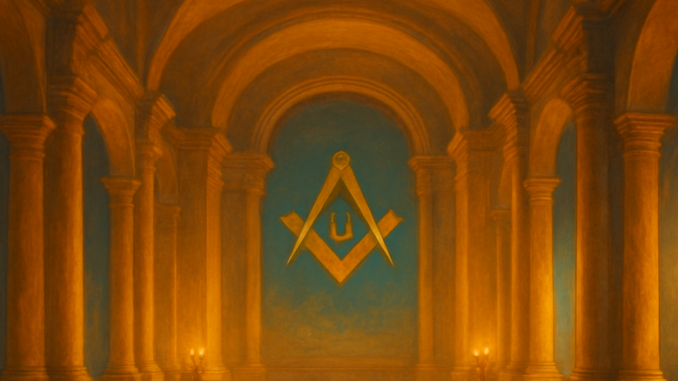
In 1495, Leonardo da Vinci began work on one of the most discussed paintings in Western history: The Last Supper, a mural in the Dominican convent of Santa Maria delle Grazie in Milan. More than five centuries later, that same painting became the centerpiece of a worldwide obsession, fueled by Dan Brown’s bestselling thriller The Da Vinci Code. The novel suggests that Leonardo embedded hidden messages in his artwork — codes allegedly linked to secret societies and suppressed truths. But how much of this actually holds up when examined through the lens of real Masonic tradition?
What Dan Brown Claims About Leonardo’s Hidden Language
The Da Vinci Code presents Leonardo da Vinci as an initiate who deliberately concealed coded messages within his paintings. A central premise of Brown’s novel is that The Last Supper is not simply a depiction of a biblical scene, but contains an encrypted reference to a female figure and a secret society entrusted with guarding this knowledge. Brown places Leonardo in a lineage of alleged Grand Masters of a secret brotherhood, alongside figures such as Isaac Newton and Victor Hugo.
This narrative struck a nerve. Millions of readers around the world began looking at museums, churches, and historical documents with fresh eyes after reading the novel. The suggestion that great works of art conceal more than meets the eye captured the imagination on a massive scale. But it also raises a fundamental question: to what extent does Dan Brown draw on historical fact, and where does fiction begin?
Leonardo da Vinci in His Own Time
To understand why the claims in The Da Vinci Code are problematic, we need to return to fifteenth- and sixteenth-century Italy. Leonardo da Vinci was born in 1452 in Vinci, a small town in Tuscany. He was a painter, inventor, anatomist, and engineer — a universal genius driven by curiosity and empirical investigation. His notebooks, known as codices, reveal a mind that sought to understand everything, from the flow of water to the mechanics of human muscles.
What Leonardo was not, however, was a Freemason. Organized Freemasonry as we know it did not emerge until 1717, when four lodges in London united to form the first Grand Lodge. The Constitutions of Anderson, written by James Anderson and partly shaped by Jean Théophile Désaguliers, were published in 1723. Leonardo died in 1519 — nearly two centuries before the formal establishment of Freemasonry. It is historically untenable to make him a member of an organization that did not yet exist.
The Misconception of the Secret Societies
In The Da Vinci Code, Dan Brown blends several distinct historical traditions into a single grand narrative. The Priory of Sion, presented in the novel as an ancient society, turned out in reality to be an organization founded in France only in 1956. The documents that were supposed to give the Priory a medieval origin were later exposed as forgeries. Yet The Da Vinci Code presents this fictitious organization as historical fact, complete with a list of alleged Grand Masters including Leonardo da Vinci, Sandro Botticelli, and Isaac Newton.
From a Masonic perspective, this is a crucial point. Freemasonry has a well-documented history that traces back to the medieval stonemason guilds and developed into a speculative fraternity during the seventeenth and eighteenth centuries. The rituals, degrees, and traditions of Freemasonry are not secret in the way Dan Brown suggests. They are private: the content of rituals is not publicly shared, but the existence, structure, and values of the order are public and extensively documented.
Freemasonry does not hide secret truths in works of art. It offers a private space in which Brothers work together toward self-knowledge and moral growth — not toward guarding conspiracies.
What Leonardo and Freemasonry Actually Share
That said, it would be inaccurate to claim there are no points of connection between Leonardo da Vinci’s thinking and the values of Freemasonry — they simply lie on a different plane than Dan Brown suggests. Leonardo was, above all, a seeker. His work reflects a deep desire to understand the world through observation, experiment, and reflection. That same pursuit of knowledge and truth forms one of the pillars of Freemasonry.
The Vitruvian Man, Leonardo’s famous drawing of the human body inscribed within a circle and a square, references the work of the Roman architect Vitruvius. This image is sometimes associated with Freemasonry because of its geometric forms. But the drawing is first and foremost a study of human proportion, inspired by classical ideals of harmony and balance. It exemplifies how Leonardo, as a Renaissance thinker, built upon the work of ancient authors — not a hidden code meant for a secret brotherhood.
Shared Values, Not Shared Membership
The connection between Leonardo and Freemasonry is one of intellectual kinship, not organizational ties. Both traditions place great value on:
- The pursuit of knowledge and truth through personal inquiry
- The conviction that beauty and harmony are expressions of a deeper order
- Respect for craft, whether that craft is stonemasonry or painting
- The willingness to look beyond superficial answers
Johann Wolfgang von Goethe, himself a Freemason, would articulate similar ideals centuries later in his literary and scientific work. The line from Leonardo to Goethe does not run through secret societies but through a shared intellectual tradition that values the search itself above the finding.
Why Fiction and Reality Diverge Here
The enormous success of The Da Vinci Code speaks to a very human fascination: the desire to believe that hidden truths lie just beneath the surface of the visible world. There is something deeply appealing about the idea that a genius like Leonardo left secret messages for future generations to decode. But appealing does not mean accurate.
Dan Brown wrote a gripping thriller, and there is nothing wrong with enjoying it as such. The problem arises when fiction is mistaken for history — when the entertaining premise of a novel is taken as evidence for claims about real organizations and real people. Freemasonry has long contended with myths and misconceptions, and The Da Vinci Code added a particularly tenacious layer to that challenge.
The real story of Freemasonry — its origins in operative stonemasonry, its transformation into a philosophical and moral fraternity, its emphasis on tolerance, self-improvement, and brotherhood — is arguably more compelling than any fictional conspiracy. It does not need hidden codes in Renaissance paintings to be meaningful. Its meaning is found in the lived experience of its members, in the quiet work of the lodge, and in the enduring human aspiration to build something better — within oneself and in the world.
Leonardo da Vinci was not a Freemason, and his paintings do not contain Masonic codes. But he was a seeker of truth, a master of craft, and a mind dedicated to understanding the deeper structures of the world — qualities that resonate powerfully with Masonic ideals. The real connection between Leonardo and Freemasonry is not one of membership or conspiracy, but of a shared commitment to inquiry, beauty, and the belief that there is always more to learn. That is a legacy worth celebrating on its own terms, without the embellishments of fiction.
Copyright text & image: devrijmetselaar.nl
Texts are based on the ideas and content of the author of devrijmetselaar.nl, reviewed, corrected, and supplemented with the assistance of OpenAI. Images are created based on the ideas of the author of devrijmetselaar.nl using OpenAI/DALL-E.
Frequently Asked Questions
Was Leonardo da Vinci actually a Freemason?
No. Leonardo da Vinci died in 1519, nearly two centuries before organized Freemasonry was formally established in 1717 when four lodges in London united to form the first Grand Lodge. The Constitutions of Anderson, which formalized Masonic principles, were not published until 1723. It is historically impossible for Leonardo to have been a Freemason.
What does Dan Brown claim about Leonardo's paintings in The Da Vinci Code?
The Da Vinci Code suggests that Leonardo da Vinci deliberately embedded hidden codes and encrypted messages within his paintings, particularly The Last Supper. Brown claims these messages contain references to a female figure and a secret society, and presents Leonardo as an initiate in a brotherhood of Grand Masters that allegedly included figures like Isaac Newton and Victor Hugo.
How much of Dan Brown's claims about Leonardo are historically accurate?
While Brown's narrative captured the imagination of millions of readers, the historical claims are problematic. Leonardo was a painter, inventor, anatomist, and engineer driven by curiosity and empirical investigation during the fifteenth and sixteenth centuries. There is no historical evidence supporting the notion that he was part of a secret Masonic society or that his artwork contains deliberately concealed Masonic codes.


Be the first to comment