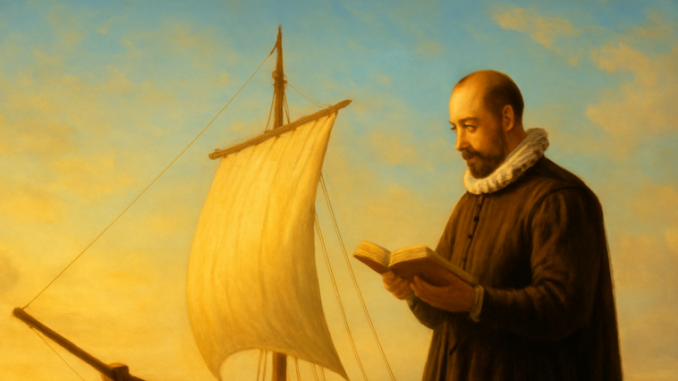
In 1580, Michel de Montaigne published an essay that unsettled the theological establishment of sixteenth-century France. Writing about prayer in the fifty-sixth essay of his first book, he approached the subject not as a priest or preacher would, but as a philosopher drawing on sources far beyond Church doctrine — Greek and Roman philosophy, Renaissance humanism, and a profound skepticism that both fascinated and disturbed his contemporaries. This essay is more than a meditation on prayer. It sits at a crossroads of intellectual traditions that would, centuries later, find a lasting home in the principles and practices of Freemasonry.
A Thinker Between Two Worlds
Montaigne lived during the French Wars of Religion, a brutal period in which Catholics and Huguenots fought each other to the death. Yet he refused to play the role of polemicist. In his essay on prayer, he chose a philosophical approach that rose above sectarian conflict — and this choice was anything but accidental. Montaigne had inherited from his father a library steeped in classical antiquity. On the beams of his study, he had quotations engraved from Sextus Empiricus, Lucretius, and Seneca. Those sentences literally looked down on him as he wrote, and their influence can be felt in every essay he produced.
What set Montaigne apart from many of his contemporaries was his ability to treat ancient wisdom not as dogma but as a living conversation. He read Plutarch not to prove himself right, but to question himself more deeply. That same attitude — the continual examination of one’s own assumptions — would become a core principle of Freemasonry centuries later. The Mason is not asked to arrive at the lodge with all the answers. He is asked to arrive willing to question, to learn, and to grow.
Stoic Foundations: Virtue Over Form
Stoic philosophy is one of the clearest sources running beneath Montaigne’s essay on prayer. Seneca, whom Montaigne read and quoted extensively, argued that the divine is not reached through outward display but through inner virtue. In his letters to Lucilius, Seneca wrote that true piety does not consist of slaughtering sacrificial animals or reciting formulas — it consists of living a pure and upright life. Montaigne took this idea and sharpened it further: a prayer without moral foundation is hollow; a ritual act without inner transformation is meaningless.
Marcus Aurelius, the Roman emperor-philosopher, emphasized in his Meditations that a person should align his actions with reason rather than with the applause of the crowd. Montaigne echoes this when he writes that anyone who prays while his daily conduct contradicts his prayer is only deceiving himself. This Stoic demand for coherence between word and deed resonates deeply within the Masonic tradition, where the Brother is called upon to embody in everyday life what he professes within the temple. The rough ashlar must be worked upon — not merely admired from a distance.
The Skepticism of Sextus Empiricus
Alongside Stoicism, Montaigne drew heavily from Pyrrhonian skepticism, particularly the writings of Sextus Empiricus. This second-century Greek philosopher argued that human beings are incapable of reaching absolute certainty on any subject whatsoever. Montaigne embraced this radical doubt not as nihilism but as intellectual humility. If we cannot even be certain about the limits of our own knowledge, how dare we claim to know what God demands of us?
In the essay on prayer, this skepticism translates into a fundamental question: by what right do people dictate the form and content of prayer, as though they have fathomed the divine will? Montaigne does not argue against praying itself — he argues against the human presumption that surrounds it. He calls for humility, an attitude that is also cultivated within Freemasonry. The Entered Apprentice who crosses the threshold of the lodge is reminded that he does not know everything and does not need to know everything. The beginning of wisdom, in both Montaigne’s philosophy and Masonic teaching, is the honest recognition of one’s own ignorance.
From the skeptics, Montaigne learned that genuine piety does not begin with certainty about God. It begins with honesty about the boundaries of our own understanding.
Plutarch and the Moral Mirror
Plutarch was perhaps Montaigne’s most beloved author. The Greek writer, famous for his Parallel Lives and his moral essays, offered Montaigne a model of philosophy as personal formation. Plutarch wrote about superstition as a disease of the soul — more dangerous than atheism, because it traps the individual in a state of fear and servility. Montaigne applied this insight to the prayer practices of his own era: anyone who prays out of fear of divine punishment rather than from a genuine desire for self-improvement is not practicing piety — he is practicing superstition.
This view connects to a tradition that, through the Renaissance humanism of Erasmus and the rediscovery of classical literature, would grow into a broad movement of religious deepening and moral self-reflection. In the eighteenth century, the founders of modern Freemasonry — including James Anderson and Jean Théophile Désaguliers — would embrace strikingly similar principles. What matters is not the letter of dogma, but the spirit of virtue. The Craft has always been more concerned with how a man lives than with what creed he recites.
Renaissance Humanism as a Bridge
Montaigne did not stand alone in his approach. Renaissance humanism had been preparing the ground for decades — a philosophy that placed humanity at the center without denying God. Erasmus of Rotterdam had advocated for an internalized Christianity, stripped of outward pomp and empty rituals. Giovanni Pico della Mirandola, in his famous Oration on the Dignity of Man, argued that human beings possess the freedom to shape themselves, toward the base or toward the sublime.
Montaigne added to this tradition his inimitable personal voice. Where Erasmus wrote as a scholar and Pico della Mirandola as an orator, Montaigne wrote as a man thinking aloud. His essay on prayer is not a treatise but a self-examination. It is precisely this honesty — the willingness to reveal one’s own doubts and contradictions — that makes the work so enduring and so relevant to Freemasons today. The Masonic journey, after all, is not a march toward certainty. It is a practice of self-knowledge, carried out with humility, guided by symbols, and sustained by the fellowship of Brothers who share the same commitment to honest inquiry.
From Stoic virtue to Pyrrhonian doubt, from Plutarch’s moral clarity to Erasmus’s call for inner faith, the philosophical currents that shaped Montaigne’s essay on prayer flow directly into the streams that would nourish Freemasonry. Understanding these roots does not diminish the Craft — it deepens our appreciation for the rich intellectual heritage that the lodge, often without naming it, continues to carry forward.
Montaigne’s essay on prayer remains a powerful reminder that the most meaningful spiritual life is one grounded in philosophical honesty, moral coherence, and intellectual humility. These are not merely abstract ideals — they are living principles that Freemasons encounter every time they enter the lodge. By tracing the lines from Seneca and Sextus Empiricus through Montaigne to the foundations of modern Freemasonry, we see that the Craft does not exist in isolation. It is part of a centuries-long conversation about what it means to live an examined, virtuous life. And that conversation, as Montaigne would surely remind us, is never finished.
Copyright text & image: devrijmetselaar.nl
Texts are based on the ideas and content of the author of devrijmetselaar.nl, reviewed, corrected, and supplemented with the assistance of OpenAI. Images are created based on the ideas of the author of devrijmetselaar.nl using OpenAI/DALL-E.
Frequently Asked Questions
How did Montaigne's essay on prayer influence Freemasonry?
Montaigne's philosophical approach to prayer, which emphasized inner virtue over outward ritual and continuous self-examination, established intellectual foundations that would later become core principles of Freemasonry. His belief that one should arrive willing to question and learn rather than claiming to have all the answers directly parallels the Masonic emphasis on personal growth and self-discovery within the lodge.
What classical sources shaped Montaigne's thinking about prayer?
Montaigne drew extensively from Greek and Roman philosophers, particularly the Stoics. He was deeply influenced by Seneca's letters, which argued that true piety comes from inner virtue rather than outward display, and by Marcus Aurelius's Meditations. These classical texts were literally engraved on the beams of his study and shaped his conviction that prayer without moral foundation is hollow.
Why was Montaigne's approach to prayer considered controversial in sixteenth-century France?
Montaigne lived during the brutal French Wars of Religion and refused to take a sectarian stance. Instead, he approached prayer as a philosopher drawing on ancient wisdom and Renaissance humanism rather than Church doctrine alone. This skeptical, questioning approach unsettled the theological establishment because it challenged orthodox religious authority during a time of intense religious conflict.


Be the first to comment