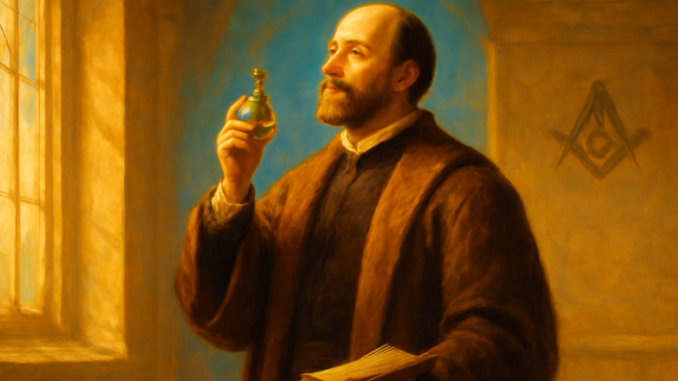
When Michel de Montaigne wrote his brief essay ‘Of Smells,’ reflecting on the invisible world of perfumes, body odors, and incense, he touched on a question that has occupied philosophers for centuries: how reliable are our senses as a source of knowledge? It seems straightforward enough, but behind that question lies a vast landscape of philosophical traditions — from ancient Stoicism to Renaissance humanism. In this article, we place two perspectives side by side: that of the classical thinkers who inspired Montaigne, and that of Freemasonry, which engages with sensory perception and inner knowledge in its own distinctive way.
The Classical Sources: Plutarch, Pliny, and Scent as a Philosophical Problem
Montaigne was an avid reader of the classics, and his essay on scent is saturated with references to ancient authors. Plutarch, whose Moralia served Montaigne as something of a philosophical handbook, wrote extensively about the relationship between body and character. The idea that a person’s body odor reveals something about their inner disposition appears in Plutarch’s descriptions of Alexander the Great, whose skin was said to emit a pleasant fragrance. Montaigne borrows this story and places it in a broader context: if the body truly mirrors the soul, what does scent tell us about virtue?
Pliny the Elder, the Roman encyclopedist whose Natural History was an inexhaustible resource for Montaigne, also contributed to this essay. Pliny catalogued odors with scientific curiosity — from the perfumes of the East to the stench of disease. Montaigne, however, did not use such inventories as science but as a springboard for self-reflection. Where Pliny classifies, Montaigne doubts. That difference in approach reveals the influence of another tradition entirely: skepticism.
Sextus Empiricus and the Skeptical Challenge to the Senses
The deepest philosophical layer in Montaigne’s essay is his Pyrrhonian skepticism, inspired by Sextus Empiricus. This second-century Greek philosopher argued that our senses systematically deceive us: what one person finds pleasant, another finds revolting. Scent is subjective par excellence. Montaigne embraces this insight when he observes that the same fragrance sometimes delights him and sometimes repels him, depending on his mood and health. In doing so, he calls the reliability of sensory knowledge into question — without rejecting it outright. This is quintessential Montaigne: he balances on the boundary between knowing and not-knowing, never committing to a final verdict.
This skepticism stands in sharp contrast to the Stoic tradition of Seneca and Epictetus, whom Montaigne also admired. The Stoics held that the wise person should not be guided by sensory impressions but by reason. In their view, scent is an adiaphoron — a matter of indifference that should have no bearing on moral judgment. Montaigne partially adopts this Stoic sobriety when he writes that while a pleasant scent attracts him, he prefers the absence of odor over artificial perfumery. The best scent, he suggests with a nod to Seneca, is no scent at all.
Renaissance Humanism: The Body as Text
Montaigne’s essay is inseparable from Renaissance humanism — the intellectual movement that placed the human being at center stage and regarded the study of classical texts as a path toward self-knowledge. Thinkers like Erasmus and Marsilio Ficino had already argued, before Montaigne, for a philosophy that took not only abstract thought but also bodily existence seriously. Ficino, the Florentine translator of Plato, wrote extensively about the influence of scent on the mind and saw aromatic substances as a bridge between the material and spiritual worlds. Montaigne secularizes this idea: for him, scent is not so much a bridge to the divine as a mirror of the human condition in all its unpredictability.
The humanist ideal of “know thyself,” tracing back to the Oracle at Delphi and elevated by Socrates to the very heart of philosophy, resonates powerfully in this essay. Montaigne examines his own body with the same honesty he brings to examining his thoughts. He describes his own scent, his preferences, his physical peculiarities. This is not vanity — it is philosophical method. Anyone who does not know themselves in the small things cannot know themselves in the large.
The Freemason and the Senses: A Different Path to the Same Truth
Where Montaigne arrives at self-examination through philosophy, Freemasonry approaches the same goal along a different route: that of ritual and lived experience. In the lodge, the candidate is deliberately confronted with sensory experiences during initiation. The blindfold removes sight; sounds, touches, and sometimes scents are employed to facilitate an inner transformation. In doing so, Freemasonry implicitly acknowledges what Montaigne explicitly argues: that sensory perception is not a mere sideshow, but a gateway to deeper understanding.
Yet the approaches differ in fundamental ways. Montaigne is the solitary thinker who, in his tower study surrounded by the books of Plutarch and Seneca, analyzes his own experience. The Freemason, by contrast, undergoes his insights within a shared space, carried by ritual and brotherhood. Montaigne’s doubt is personal and intellectual; the ritual path of the lodge is collective and experiential. The philosopher asks, “What do I know?” The Freemason asks, “What am I becoming?”
And yet, philosopher and Freemason share the same starting point: the recognition that true knowledge begins with the honest examination of one’s own perception — including its limitations.
What Both Worlds Share: Humility as Foundation
The most surprising common ground between Montaigne’s philosophical skepticism and the Masonic tradition is the virtue of humility. Montaigne’s famous motto, “Que sais-je?” — “What do I know?” — is not a declaration of ignorance but an invitation to remain open, to resist the temptation of certainty. The Freemason encounters a similar principle in the symbolism of the Rough Ashlar: the unfinished stone that represents the self before it has been shaped by reflection and moral effort. Both traditions insist that genuine wisdom requires acknowledging how much we do not yet understand.
Montaigne’s essay on scent, seemingly a minor piece about noses and perfume, ultimately makes a profound philosophical point. Our senses are neither perfectly trustworthy nor entirely useless. They are tools — imperfect, subjective, shaped by context — but indispensable for anyone seeking to understand themselves. The Masonic initiate learns the same lesson through experience: the blindfold does not simply block perception, it reframes it. When sight is removed, other senses sharpen and new forms of understanding emerge.
In both traditions, the goal is not to transcend the senses but to engage with them consciously and critically. The philosopher does this through writing and reflection; the Freemason does it through symbol and ceremony. The methods differ, but the destination converges: a richer, more honest relationship with one’s own experience of the world.
Montaigne’s brief essay on scent may seem like a minor curiosity, but it opens a door into some of the most enduring questions in Western philosophy — and into territory that Freemasonry has long explored through its own means. Whether we approach self-knowledge through the page or through the lodge, through skeptical inquiry or ritual experience, the underlying commitment is the same: to pay attention, to remain humble, and to recognize that even the most fleeting sensory impression — a passing fragrance, a sudden silence — can become a vehicle for genuine understanding.
Copyright text & image: devrijmetselaar.nl
Texts are based on the ideas and content of the author of devrijmetselaar.nl, reviewed, corrected, and supplemented with the assistance of OpenAI. Images are created based on the ideas of the author of devrijmetselaar.nl using OpenAI/DALL-E.
Frequently Asked Questions
What is the main philosophical question Montaigne explores in his essay 'Of Smells'?
Montaigne's essay examines how reliable our senses are as a source of knowledge, specifically through the lens of smell and scent. He questions whether sensory perception can be trusted to reveal truth about the world and about human nature, particularly whether body odor reflects inner character and virtue.
Which classical authors influenced Montaigne's thinking on scent and sensation?
Montaigne drew heavily from Plutarch, whose Moralia provided philosophical insights about the relationship between body and character, including the famous example of Alexander the Great's pleasant fragrance. He also referenced Pliny the Elder's Natural History, which catalogued various odors. However, his approach differed from these sources—while Pliny classified odors scientifically, Montaigne used them as a basis for philosophical doubt and self-reflection.
How does Pyrrhonian skepticism shape Montaigne's essay on scent?
Inspired by Sextus Empiricus, Montaigne adopts Pyrrhonian skepticism to argue that our senses systematically deceive us because scent perception is subjective—what pleases one person may repel another. Montaigne illustrates this by noting that the same fragrance can delight or repel him depending on his mood and health, demonstrating that sensory knowledge is unreliable while not rejecting sensation entirely.


Be the first to comment