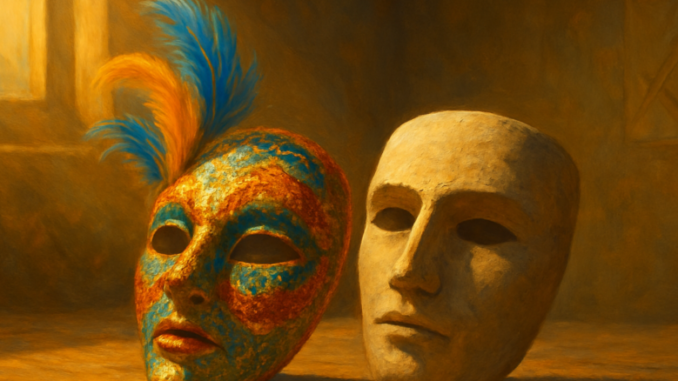
A theater show about a flamboyant party animal who becomes a father touches on one of humanity’s oldest questions: who are you really when your life changes dramatically? It’s a question seldom asked as honestly as it is on stage — yet Freemasons recognize it instantly. In the lodge, everything revolves around discovering, questioning, and refining your own personality. Two worlds, one shared quest.
The Stage as Mirror: Breaking Open the Exterior
A production currently drawing considerable attention tells the story of an extravagant figure from the nightlife scene who is suddenly confronted with fatherhood. Funny and moving, the critics say. But beneath the humor lies a deeper theme: the collision between the personality you project outward and the person you truly are — or want to become. The audience watches someone wrestle with roles that seem irreconcilable. Can you be both an extravagant party animal and a loving parent? The stage says yes — provided you dare to look honestly at who you are.
Theater has always served this function. In the Greek tragedies of Sophocles and Euripides, the tension between mask and essence was already center stage — the role society imposes on you versus the character that beats beneath it. The Greek word persona originally meant nothing more than the mask actors wore. Personality, seen from this angle, is what remains when you take the mask off.
The Lodge as Workshop: Building the Interior
In Freemasonry, the question of the true self is not posed on a stage but in the stillness of the lodge. Where theater confronts the audience with characters who transform, the lodge invites the Brother or Sister to undergo that transformation personally. The methods differ enormously, but the core is the same. The Freemason works on what tradition calls the “rough ashlar” — the unworked material of one’s own personality, gradually refined through reflection, dialogue, and ritual.
Johann Wolfgang von Goethe, himself a Freemason and one of history’s greatest playwrights, saw no contradiction between these two worlds. In his novel Wilhelm Meister’s Apprenticeship, he described how a young man achieves self-knowledge through the theater, only to receive the real lessons about personality within a secret society. For Goethe, the outer world was the practice ground; the inner work was the real labor.
Two Perspectives on Change
The difference between the theatrical and the Masonic perspective on personality is telling. In theater, change is usually forced by an external event: a child being born, a loss, an unexpected encounter. The character reacts, struggles, and either makes it through or doesn’t. The power of the story about the party animal becoming a father lies precisely in that unexpected turn. The audience recognizes the vulnerability of someone whose self-image is shaken to its foundations.
In Freemasonry, change is a consciously chosen path. No one is forced to step inside the lodge. The candidate knocks on the door of their own free will. That difference is fundamental. Where the stage shows us how life happens to us, the Freemason practices the ability to consciously choose who they want to be — not by denying the past, but by integrating it. Marcus Aurelius, the Stoic emperor whose Meditations are still widely read, wrote that it is not events that shape us, but the attitude we take toward those events.
What Both Worlds Share
Yet the distinction is less sharp than it appears. Both theater and the lodge acknowledge that personality is not a fixed given. It is not an unchanging block of granite but rather a living organism that grows, contracts, collides, and blooms. The performance shows that a person can carry multiple identities without one excluding the other. The lodge teaches that every phase of life reveals new facets of the self that previously remained hidden.
Personality is not a mask you wear, but the face that becomes visible when you have the courage to lay all masks aside.
There is an even deeper parallel. Both worlds demand vulnerability. On stage, the actor must expose themselves to be believable. In the lodge, the Freemason must be willing to look at themselves honestly, even when it is uncomfortable. This willingness to be vulnerable is perhaps the most underestimated form of strength.
The Lesson: Integration Over Fragmentation
What can we learn from this comparison? That the question “who am I?” never needs to be answered definitively. The strength lies not in choosing one identity over another, but in the ability to embrace contradictions. The party animal doesn’t have to disappear to make room for the father. The Freemason doesn’t have to abandon worldly life to work on their inner self. On the contrary: the richest personality is the one that acknowledges all of its layers and brings them into dialogue with each other.
Aristotle spoke of the importance of eudaimonia — a flourishing life in which all aspects of human existence come into their own. Not by avoiding extremes, but by finding the right balance in every situation. That idea resonates on stage and in the lodge alike.
Three Insights to Carry With You
First, personality is not static — it is a continuous process of discovery and integration. Second, vulnerability is not weakness but the prerequisite for genuine growth, both on stage and in life. Third, the apparent contradictions between the different roles you play in life dissolve when you have the courage to see them as parts of a single whole.
Theater and the lodge speak different languages, but ultimately they tell the same story. It is the story of the human being who refuses to be reduced to a single role — who dares to look behind the mask and discovers that true personality is not something you perform, but something you patiently build, layer by layer, for a lifetime.
Copyright text & image: devrijmetselaar.nl
Texts are based on the ideas and content of the author of devrijmetselaar.nl, reviewed, corrected, and supplemented with the assistance of OpenAI. Images are created based on the ideas of the author of devrijmetselaar.nl using OpenAI/DALL-E.
Frequently Asked Questions
What is the connection between the theater production described and Freemasonry?
Both the theater production and Freemasonry explore the same fundamental human question: who are you really when your life changes dramatically? The stage presents this transformation through a character who becomes a father, while Freemasonry addresses it through personal inner work in the lodge. Both seek to reconcile the exterior personality you project with your authentic self.
What does Freemasonry mean by the 'rough ashlar'?
In Freemasonry, the 'rough ashlar' refers to the unworked material of one's own personality. It is a metaphor for the raw, unrefined aspects of the self that a Freemason gradually refines and improves through reflection, dialogue, and ritual work within the lodge.
How did Johann Wolfgang von Goethe view the relationship between theater and Freemasonry?
Goethe, who was both a Freemason and a great playwright, saw no contradiction between these two worlds. In his novel Wilhelm Meister's Apprenticeship, he portrayed the outer world of theater as a practice ground for self-knowledge, while viewing the inner work within a secret society like Freemasonry as the real labor of personal transformation and personality development.


Be the first to comment