
Picture a hectic Monday morning. You’re stuck in traffic, your schedule is falling apart, colleagues are on edge, and a mountain of tasks awaits you at home. In moments of chaos like these, wisdom written nearly two thousand years ago can prove remarkably practical. In the fourth book of his Meditations, Marcus Aurelius reflected on the constant flow of existence — the relentless current of change that defines every human life. But where did this Roman emperor draw his ideas from? And more importantly, how can those insights still serve you today?
The River of Heraclitus as Foundation
When Marcus Aurelius writes about change and flux, the voice of Heraclitus of Ephesus echoes through his words. This Greek philosopher, who lived around 500 BCE, articulated the famous insight that you can never step into the same river twice. The water flows constantly, and by the time you take that second step, you yourself have already changed. Marcus Aurelius adopted this image directly and applied it to everyday life. Strictly speaking, every morning you wake up, you are a different person than the day before. Your cells have renewed, your thoughts have shifted, your circumstances have altered.
This may sound abstract, but it carries immediate consequences. When you cling to the way things were yesterday, or to how someone behaved last week, you are resisting the natural order. Heraclitus called this cosmic order the logos — a concept that the Stoics would later refine into their own philosophical system, one that would shape Western thought for centuries to come.
Stoic Masters as Direct Inspiration
Marcus Aurelius did not learn Stoicism from books alone. His most important teacher was Epictetus, a former slave who became one of the most influential philosophers of antiquity. Epictetus’ core lesson was simple yet powerful: distinguish between what lies within your control and what does not. Change itself lies beyond your power. Your response to it does not. In Book IV, Marcus Aurelius applies this principle consistently to the stream of events that characterize life.
Seneca, the Roman statesman and philosopher, also left a clear imprint on Marcus Aurelius’ thinking. Seneca wrote extensively about the shortness of life and the necessity of living each day as though it were your last. You can feel that same urgency when Marcus Aurelius meditates on the speed with which generations pass and empires rise and fall.
Change is not a threat to be conquered, but a natural law to be embraced.
The Cosmic Context of Change
For the Stoics, change was no random phenomenon. They viewed the universe as a living, rational whole, permeated by the logos. Everything that happens — even what we experience as misfortune — is part of a larger pattern. In Book IV, Marcus Aurelius speaks of all matter returning to its origin, like waves flowing back into the ocean. This perspective puts personal worries into proportion without trivializing them.
The practical application is clear. When your project fails, your relationship shifts, or your health declines, you can view it as a random blow dealt by fate. Or you can recognize it as part of an ongoing movement in which nothing is permanent. This does not mean passive resignation — it means actively choosing how you relate to whatever comes your way.
Practical Steps for Today
The philosophical background of Book IV is fascinating, but ultimately Marcus Aurelius wrote for himself — as a practical manual for daily living. How can you apply these same insights?
Begin each day with acknowledgment. Accept that things will change, regardless of your plans. This isn’t fatalism; it’s preparation. When you expect change, it loses its power to destabilize you.
Question your frustrations. When irritation arises, ask yourself honestly: am I fighting against something that lies beyond my control? If the answer is yes, redirect your energy toward what you can influence — your own attitude and actions.
Remember the impermanence of problems. What feels urgent and overwhelming right now will likely be forgotten within a year. This awareness creates breathing room in the midst of difficulty.
Look for patterns in the chaos. Change often follows cycles that you can learn to recognize. The more you observe these rhythms, the less disorienting they become.
Change as a Source of Growth
What unites Marcus Aurelius, Heraclitus, Epictetus, and Seneca is their refusal to treat change as the enemy. Where others complained about the fleeting nature of existence, they saw opportunity. Every change offers a chance to reveal your character, to practice adaptability, to move closer to wisdom. The river does not flow to drown you — it flows to carry you.
In the fourth book of the Meditations, this insight is repeated again and again, expressed in different words but always carrying the same core message. What Marcus Aurelius presents is not an abstract philosophical principle — it is a daily practice he held before himself amid wars, political intrigue, and personal loss.
The philosophical roots of Book IV reach from Heraclitus’ river metaphor to the practical ethics of Epictetus and Seneca. What binds these thinkers together is the conviction that change should not be fought but understood. For Marcus Aurelius, this was no comforting abstraction — it was a daily exercise. And that is precisely what it can be for you: a reminder that the current of life need not overwhelm you, as long as you learn to move with the flow.
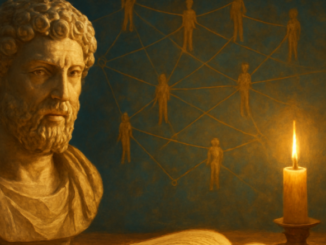
Copyright text & image: devrijmetselaar.nl
Texts are based on the ideas and content of the author of devrijmetselaar.nl, reviewed, corrected, and supplemented with the assistance of OpenAI. Images are created based on the ideas of the author of devrijmetselaar.nl using OpenAI/DALL-E.
Frequently Asked Questions
What is the philosophical connection between Heraclitus and Marcus Aurelius' views on change?
Marcus Aurelius drew directly from Heraclitus, the Greek philosopher who lived around 500 BCE. Heraclitus articulated the famous concept that you can never step into the same river twice because water flows constantly and both the river and the person change. Marcus Aurelius applied this image to everyday life, recognizing that each morning you wake up as a different person due to cellular renewal, shifting thoughts, and altered circumstances. This idea of constant flux became foundational to Marcus Aurelius' reflections on change in Book IV of his Meditations.
Who were Marcus Aurelius' most important philosophical influences and what did they teach?
Marcus Aurelius' most significant teacher was Epictetus, a former slave who became a renowned philosopher. Epictetus taught the core Stoic principle of distinguishing between what lies within your control and what does not—emphasizing that while change is beyond your power, your response to it is not. Additionally, Seneca, the Roman statesman and philosopher, influenced Marcus Aurelius through his writings on the shortness of life and the importance of living each day as though it were your last, creating a sense of urgency around how we spend our time.
How can Marcus Aurelius' ancient wisdom about change be applied to modern life?
Marcus Aurelius' insights from Book IV of Meditations remain remarkably practical for contemporary challenges. His reflections on constant change help us understand that resistance to the natural flow of existence creates unnecessary suffering. When faced with chaotic situations—like traffic, schedule disruptions, or workplace stress—we can apply his philosophy by accepting change as inevitable rather than viewing it as a threat. By following his teachings rooted in Heraclitus and Stoic principles, we can learn to respond to life's constant flux with wisdom and equanimity rather than resistance and frustration.



Be the first to comment