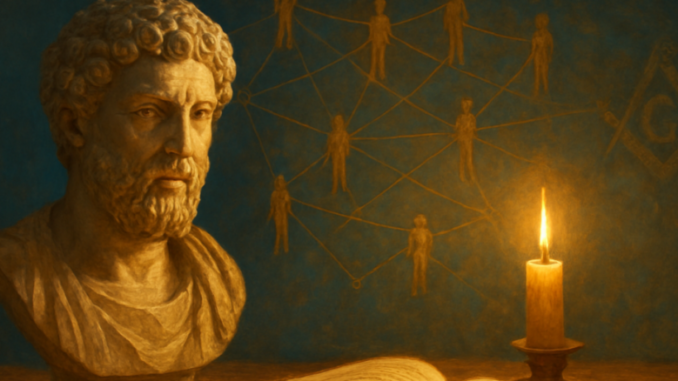
What truly makes us human? Marcus Aurelius posed this question to himself nearly two thousand years ago while serving as Roman Emperor, surrounded by wars and political intrigue, quietly writing his most intimate reflections. In Book VIII of the Meditations, he examines the true nature of humanity — not as isolated individuals, but as beings fundamentally connected to one another and to a greater whole. For Freemasons, this perspective opens a rich dialogue between Stoic wisdom and the fraternal ideals cherished within the lodge.
The Philosopher-Emperor on Human Connection
Marcus Aurelius never wrote his Meditations for publication. They were inner exercises — private conversations with himself. Throughout Book VIII, he returns again and again to a central theme: no person is an island. He describes how all of us form part of one great organism, with humanity functioning as a single body in which every individual is a limb. When we harm others, we harm ourselves. When we serve the common good, we fulfill our true nature.
This vision stands in sharp contrast to the popular image of the Stoic as an unmoved, emotionless figure. For Marcus Aurelius, genuine inner peace does not come from detachment but from the deep recognition that we are interconnected. He writes about the duty to bear with others, even when they frustrate or oppose us — not out of weakness, but out of insight into the shared human condition. Every person acts according to their own understanding of what is good, however limited that understanding may sometimes be.
The Freemason and the Ideal of Brotherhood
Anyone who enters Freemasonry quickly encounters the concept of brotherhood. This is no casual term. It refers to the conviction that all people, regardless of origin, religion, or social standing, are fundamentally equal in worth. In the lodge, outward differences are set aside, symbolically expressed through ritual attire. What remains is the human being in essence: seeking light, striving for improvement, connected to fellow human beings.
Compare this with Marcus Aurelius’ image of humanity as one body. The Freemason does not see himself as a solitary individual who happens to belong to an organization. He recognizes that his own growth is inseparably linked to the growth of others. The rough ashlar he works upon is not merely his own character — it is also his capacity to contribute to the greater edifice of human society.
Two Perspectives on True Human Nature
When we place these two worlds side by side, something remarkable emerges. The second-century Stoic and the modern Freemason approach the question of human nature from vastly different historical contexts, yet arrive at strikingly similar insights.
Marcus Aurelius sees humanity as part of the logos — the universal reason that pervades all things. His ethics are cosmic in scope: we must act in accordance with our place in the whole. The Freemason speaks of the Great Architect of the Universe and of building a spiritual temple. Here too, individual effort is embedded within a larger, meaning-giving framework.
Both traditions emphasize self-reflection as the path to wisdom. Marcus Aurelius constantly asks himself: am I acting justly? The Freemason examines his conscience in the silence of the lodge. Both understand that the unexamined life lacks direction and moral depth.
The difference, perhaps, lies in form. The Stoic seeks his path through solitary contemplation; the Freemason pursues it within a community of like-minded seekers. Yet these approaches complement rather than contradict one another. Personal reflection gains depth through sharing with others, while brotherly connection becomes hollow without inner work.
What Both Traditions Teach Us
The true nature of humanity unfolds not in isolation, but in the recognition that we are all part of the same great work. This core idea connects Marcus Aurelius to Freemasonry across the centuries. Both point out that moral perfection is not a destination reached in solitude, but a continuous process that takes shape in relationship with others. The Stoic who learns to look upon his fellow human beings with gentleness achieves inner peace. The Freemason who meets his brothers with tolerance builds a temple that reaches far beyond stone and mortar.
In Book VIII, Marcus Aurelius also warns against the temptation to withdraw from the world. It would be easy to judge others, to turn away from the chaos of human existence. But it is precisely this engagement — however difficult — that forms the heart of a virtuous life. Freemasonry shares this conviction. The lodge is a place of practice, but its ultimate purpose is to apply the lessons learned within its walls to the outside world, in daily interaction with others.
Connection as the Art of Living
Any Freemason reading the Meditations of Marcus Aurelius may recognize something familiar — something akin to the ritual work performed in lodge. Stoic practice, too, revolves around repetition, daily exercise, and the continual remembering of fundamental truths that we so easily forget amid the distractions of everyday life. The question “Who am I, really?” is never answered once and for all. It must be asked again and again.
Our true human nature, both traditions suggest, lies not in what we possess or achieve, but in how we relate to others. Not in our titles or accomplishments, but in our willingness to learn, to grow, and to contribute. Marcus Aurelius and Freemasonry reach across the centuries to shake hands — as witnesses to the enduring human need for connection, meaning, and moral deepening.
Book VIII of the Meditations invites us to reconsider our place within the greater whole. Marcus Aurelius demonstrates that true humanity does not reside in isolation but in the acknowledgment of our mutual connectedness. For Freemasons, this resonates deeply: the brotherhood we cultivate in lodge is not separate from the world but a living expression of the same universal bond that the philosopher-emperor described so eloquently nearly two millennia ago. To discover our true nature is to discover one another.
Copyright text & image: devrijmetselaar.nl
Texts are based on the ideas and content of the author of devrijmetselaar.nl, reviewed, corrected, and supplemented with the assistance of OpenAI. Images are created based on the ideas of the author of devrijmetselaar.nl using OpenAI/DALL-E.
Frequently Asked Questions
How does Marcus Aurelius define human nature in Book VIII of the Meditations?
Marcus Aurelius defines human nature not as isolated individuals, but as beings fundamentally connected to one another and to a greater whole. He describes humanity as functioning like a single body in which every individual is a limb. According to his philosophy, when we harm others, we harm ourselves, and when we serve the common good, we fulfill our true nature. This interconnectedness is central to understanding genuine human existence for both the Stoic and the Freemason.
What is the connection between Stoic philosophy and Freemasonry's ideals?
Both Stoic philosophy and Freemasonry emphasize the fundamental equality and interconnectedness of all people. Marcus Aurelius' vision of humanity as one organism aligns with the Masonic concept of brotherhood, which transcends origin, religion, and social standing. Both traditions reject the notion of the solitary individual and instead promote the idea that personal growth is inseparably linked to the growth of others and the greater human community.
How should Stoic inner peace be understood according to Marcus Aurelius?
Contrary to the popular image of Stoics as emotionless and detached, Marcus Aurelius teaches that genuine inner peace comes not from detachment but from the deep recognition that we are interconnected with others. He emphasizes the duty to bear with others, even when frustrated or opposed, not out of weakness but out of insight into our shared human condition. This compassionate understanding reflects the reality that every person acts according to their own understanding of what is good.

Be the first to comment