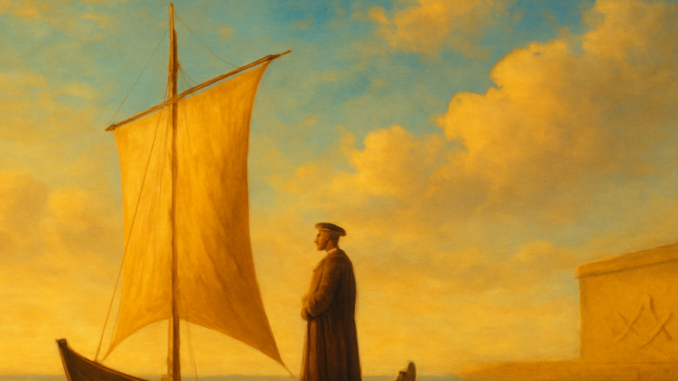
It can happen in the most unexpected moment: you’re walking down a busy street when a scent catches you off guard and pulls you straight back into a memory. Your grandparents’ kitchen. A summer evening from childhood. An encounter that changed everything. You can’t name the scent, but the feeling is overwhelming. In the sixteenth century, Michel de Montaigne wrote a short but striking essay about exactly this phenomenon — and what he uncovered touches remarkably close to the heart of what Freemasons seek: genuine, unadorned connection.
The Invisible Forces That Move Us
In the fifty-fifth essay of the first book of his Essays, Montaigne takes up the subject of smells with his characteristic blend of lightness and depth. He observes that he himself has little noticeable body odor, and that the most pleasant scent is, in fact, the absence of scent. It might sound like a trivial remark, but Montaigne transforms it into something essential. He suggests that the most sincere impression a person can leave is not one that has been deliberately constructed, but one that arises naturally. No perfume, no masquerade — just honesty in its most literal sense.
This idea may resonate more deeply than you’d initially expect. How much of what you project to the world each day is consciously cultivated? And how much of it is truly yours? These are precisely the kinds of questions Montaigne posed — and they sit at the very center of Freemasonry. The search for authenticity, for the rough stone hiding beneath layers of habit and learned behavior, is a shared pursuit.
Why Montaigne Distrusted Artifice
In his essay, Montaigne quotes the Roman playwright Plautus, who wrote that a woman smells best when she smells of nothing at all. This isn’t a plea for neglect — it’s a plea for sincerity. Montaigne saw the excessive use of perfume and fragrance as a sign of concealment. A person who constantly covers themselves in artificial scents may have something to hide. Or worse: they may have lost touch with their own authentic nature.
You might recognize this tendency in your own life. The urge to appear more polished, more intelligent, or stronger than you really are is deeply human. But genuine connection only becomes possible when you dare to remove the mask. Montaigne understood this. Throughout his Essays, he repeatedly described himself as imperfect, contradictory, and searching. It was precisely this vulnerability that made him one of the most widely read thinkers in Western history.
Brotherhood Beyond the Surface
Within Freemasonry, the concept of brotherhood is far from an empty phrase. It points to a deeper layer of human togetherness: the willingness to show your true self to another, and the willingness to truly see the other in return. The rituals and customs within the lodge are not designed to impress — they are designed to create a space where honesty becomes possible. A space free from the perfumes of everyday life, as Montaigne might have put it.
Think of the moment you first stepped into a lodge — or imagine that moment now. Everything is oriented toward stripping away outward display. Ranks, titles, and social positions are set aside. What remains is the person themselves. Just like Montaigne’s ideal scent: no artificial additions, only the pure, unadulterated self. That is the foundation upon which real brotherhood is built.
True connection doesn’t come from what you add to your presence — it comes from what you dare to leave out.
Self-Reflection as the Art of Living
What Montaigne actually does in this brief essay about scent is extend an invitation to self-reflection. He doesn’t ask you to follow your nose — he asks you to become aware of the ways in which you present yourself to the world. What about you is real, and what has been acquired? What layers of convention and habit have you built up, and what would remain if you peeled them all away?
In Freemasonry, this process is known as working the rough stone. The metaphor is clear: every person begins as an uncut block, and the work of a lifetime is to shape that block into something pure and harmonious. But unlike a sculptor who adds material, the Masonic approach is about removing what is unnecessary. The ancient Greek philosopher Aristotle spoke of stripping away the superfluous to reveal the true form beneath. Montaigne would have recognized this idea immediately — and so would any Freemason.
The Scent of Authenticity
There is yet another layer in Montaigne’s essay that holds particular relevance for Freemasonry. Scents are elusive. You cannot hold them, measure them, or prove them. Yet their presence is unmistakable. The same is true of the values cherished within the lodge: truth, virtue, charity, and inner growth. You cannot capture them in a handbook, but anyone who has experienced them knows they are real.
Montaigne understood that the most essential things in life often escape words and definitions. His entire writing project — which he began as a personal experiment in honesty — was an attempt to capture the uncapturable. Not as absolute truth, but as a snapshot of a searching mind. That attitude — humble, honest, and perpetually willing to revise one’s own thinking — is exactly what Freemasonry asks of its members.
The next time a scent catches you off guard and stirs something deep within, pause for a moment. Reflect not only on the memory it evokes, but on the question that lies behind it: what is truly mine? Montaigne invited his readers to take themselves as a subject of study. Freemasonry offers a brotherhood in which that study need not be undertaken in solitude, but within a circle of like-minded souls who share the same commitment to honesty. Connection doesn’t begin with what you choose to show — it begins with what you dare to be. That is the lesson a sixteenth-century essayist and a centuries-old fraternity still share today.
Copyright text & image: devrijmetselaar.nl
Texts are based on the ideas and content of the author of devrijmetselaar.nl, reviewed, corrected, and supplemented with the assistance of OpenAI. Images are created based on the ideas of the author of devrijmetselaar.nl using OpenAI/DALL-E.


Be the first to comment