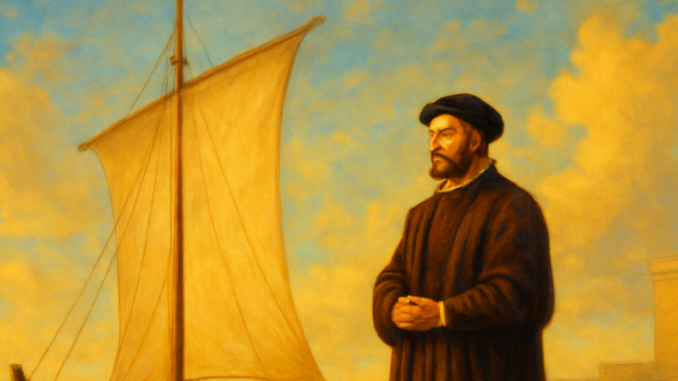
What does it truly mean to pray? Is prayer merely a formula you recite, or should it reflect something genuine about who you really are? Michel de Montaigne posed this question in the sixteenth century, and his answer remains strikingly relevant today. In Essay 56 of the first book of his Essays, titled “On Prayers,” he examines the tension between outward display and inner sincerity — a theme that also occupies a central place in Freemasonry.
What Is This Essay Really About?
In “On Prayers,” Montaigne takes up a seemingly simple subject: prayer, and specifically the Lord’s Prayer. But as so often with Montaigne, the surface is deceptive. This is not a theological treatise but a moral-philosophical exploration. The central question he raises is this: does a prayer have any value if it is not accompanied by a genuinely upright inner life?
Montaigne argues that praying without making any effort to improve your conduct is a form of hypocrisy. You cannot call upon God with the same lips that have just uttered lies or curses. He writes during a period of devastating religious wars tearing France apart, watching both Catholics and Protestants invoke the Almighty to justify their violence. That backdrop gives the essay its unspoken urgency. Montaigne takes no side in the conflict but asks a far more fundamental question: how do our words relate to our deeds?
Montaigne’s Central Argument
The core thesis of the essay can be stated clearly: a prayer is only valuable when the person praying is willing to reform themselves. Montaigne does not oppose prayer itself. He holds the Lord’s Prayer in high regard, calling it the most perfect prayer ever composed. But he objects fiercely to its mechanical recitation, as though the words themselves carry some magical power. A prayer, he insists, must be a mirror of the soul. Anyone who prays for forgiveness without any intention of bettering their life deceives not only themselves but also the divine presence they address.
A prayer without inner sincerity is like a ritual without meaning — the form is there, but the soul is absent.
Montaigne offers the vivid example of people who alternate their daily prayers with sinful behavior, as though one cancels out the other. He compares this to someone who prays in the morning, cheats in the afternoon, and then prays again in the evening. Prayer becomes a ritual shield — a license for immoral conduct. That idea fills him with genuine dismay.
Classical Sources and Telling Examples
As in many of his essays, Montaigne draws extensively on classical sources. He references Plato, who warned in his dialogues that the gods cannot be won over by flattering words alone. The Stoic philosopher Seneca also resonates throughout Montaigne’s argument: inner virtue matters far more than outward show. Alongside these classical references, Montaigne cites biblical passages to reinforce his point, though he never becomes dogmatic. He reads the Bible as a moral compass, not as a legal code.
One striking element in the essay is his treatment of psalm singing. He observes how people sing psalms of repentance and humility with full conviction during church services, only to leave the building and behave exactly as before. His observation is not bitter — it is more bewildered and concerned. Montaigne describes it as a person splitting themselves in two: a praying self and an acting self, with the two never entering into dialogue with each other.
Why This Matters for Freemasonry
Why would a sixteenth-century essay on prayer be relevant to Freemasonry? The answer lies in the concept Montaigne places at the center of his argument: inner sincerity. Freemasonry does not prescribe prayers, but it does employ rituals that demand a comparable attitude. A Brother who undergoes a ritual without any willingness to engage in genuine self-reflection misses its entire purpose.
James Anderson, who codified the first constitutions of modern speculative Freemasonry in 1723, already emphasized that the point is not the observance of outward forms but the inner disposition of the Brother. Montaigne’s essay touches on a foundation of Masonic practice. The ritual in the lodge is not a play to be performed — it is an experience to be inwardly lived. Just as Montaigne argues that a prayer gains its value only when it coincides with a sincere striving toward improvement, so too does Masonic ritual only work when the participant is willing to honestly confront himself.
Rough ashlar work is not merely a metaphor you recite. It is a commitment you fulfill every day.
Why This Essay Deserves Attention Today
We live in an era where words and deeds are frequently miles apart. Public declarations of good intentions, organizational mission statements, personal pledges on social media — the gap between what we say and what we do may be greater than ever before. Montaigne reminds us that sincerity does not reside in the words you choose but in the alignment between your words and your life. This is not a religious message; it is a universally human one.
In that respect, “On Prayers” is one of the most accessible of Montaigne’s essays. You do not need to be religious to grasp its core insight. Whether you pray, meditate, or simply reflect on your life, the question Montaigne poses remains the same: are you willing to live according to what you profess? It is a question that does not call for an answer so much as a way of life.
Key Themes at a Glance
Several interwoven themes make this essay enduringly powerful. First, there is the gap between word and deed as the central moral problem. Then there is the Lord’s Prayer as an example of a pure but often mechanically recited prayer. Montaigne offers a critique of religious hypocrisy without targeting any specific denomination — a remarkably ecumenical stance for his time. He insists on the necessity of inner transformation as a prerequisite for meaningful prayer or ritual. And finally, there is his use of classical philosophy — Plato, Seneca, and others — as a counterweight to purely theological reasoning.
Each of these themes has a direct parallel within Masonic thought. The emphasis on aligning one’s inner life with one’s outward conduct, the rejection of empty formalism, the call to genuine self-improvement — these are not just Montaigne’s concerns. They are the very foundation upon which the Craft is built.
Montaigne’s “On Prayers” is far more than a historical curiosity. It is a powerful reminder that ritual, whether religious or Masonic, only carries meaning when it is accompanied by genuine inner commitment. The words we speak in a church, a lodge, or even in the silence of our own minds gain their power not from repetition but from the sincerity behind them. In a world saturated with performative declarations, Montaigne’s challenge remains as urgent as ever: let your life be the truest expression of what you profess to believe.
Copyright text & image: devrijmetselaar.nl
Texts are based on the ideas and content of the author of devrijmetselaar.nl, reviewed, corrected, and supplemented with the assistance of OpenAI. Images are created based on the ideas of the author of devrijmetselaar.nl using OpenAI/DALL-E.
Frequently Asked Questions
What is Montaigne's main argument about prayer in Essay 56?
Montaigne argues that prayer only has value when accompanied by genuine inner sincerity and a willingness to reform oneself. He objects to the mechanical recitation of prayers, particularly the Lord's Prayer, when they are not backed by moral improvement in one's conduct. According to Montaigne, a prayer without inner sincerity is merely an empty ritual — the form exists but the soul is absent.
How does Montaigne criticize the practice of alternating prayer with sinful behavior?
Montaigne condemns those who pray in the morning, commit sins in the afternoon, and then pray again in the evening, as though prayer serves as a shield or license for immoral conduct. He views this as a form of hypocrisy and self-deception, arguing that one cannot call upon God with lips that have just uttered lies or curses, and that such practices deceive both oneself and the divine presence being addressed.
What historical context influenced Montaigne's essay on prayer?
Montaigne wrote 'On Prayers' during a period of devastating religious wars in France, when both Catholics and Protestants invoked God to justify their violence. This backdrop gives the essay urgency, as Montaigne transcends the theological conflict between sides to ask a more fundamental question: how do our words relate to our deeds? His essay represents a call for genuine morality over external religious display.

Be the first to comment