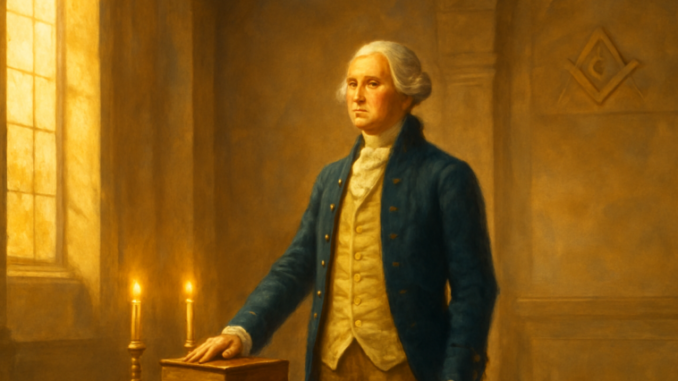
George Washington, the first President of the United States, is widely recognized as one of the most influential figures in American history. What is less commonly known — yet equally significant — is his deep involvement in Freemasonry. Washington’s membership in the Craft was not merely a social affiliation; it reflected the personal values and ideals that guided him as he helped build a new nation from the ground up.
Initiation into Freemasonry
On November 4, 1752, at the age of just twenty, George Washington was initiated as a Freemason at Fredericksburg Lodge No. 4 in Virginia. This moment marked the beginning of a lifelong association with the fraternity — one devoted to personal development, moral integrity, and service to the community. Washington would go on to advance through the degrees, eventually becoming a Master Mason and, later in life, the Worshipful Master of Alexandria Lodge No. 22.
Freemasonry in His Life and Leadership
As a Freemason, Washington embraced the core values of the Brotherhood: liberty, equality, and fraternity. These principles profoundly influenced his leadership during the American Revolutionary War and throughout his presidency. He viewed Freemasonry as a space where men from diverse backgrounds could come together to work on personal growth and contribute to the progress of society at large.
During the Revolutionary War, Masonic meetings were frequently held in military encampments. Washington was known for his strong support of these gatherings, which provided soldiers with a sense of brotherhood, moral encouragement, and shared purpose during some of the most difficult years of the conflict. The bonds formed within the lodge helped sustain morale and unity among the troops.
The Cornerstone of American Freemasonry
One of the most iconic moments in Washington’s Masonic career came on September 18, 1793, when he presided over the laying of the cornerstone of the United States Capitol. Dressed in his full Masonic regalia, Washington led the ceremony using the traditional symbolism and rituals of the Craft. The event was far more than a construction milestone — it symbolized the founding of a nation built upon moral principles, cooperation, and the shared aspiration for a just society.
This ceremony remains one of the most celebrated events in American Masonic history and continues to be referenced as a powerful example of how Freemasonry and public service intersected in the early days of the Republic.
Washington’s Masonic Legacy
Today, George Washington is remembered as a central figure in American Freemasonry. Numerous lodges across the United States bear his name, and the George Washington Masonic National Memorial in Alexandria, Virginia, stands as a lasting tribute to his contributions to both the nation and the fraternity. His example continues to inspire Freemasons around the world.
Washington’s dedication to ethics, personal responsibility, and community service makes him an enduring symbol of everything Freemasonry strives to cultivate in its members. His life demonstrates how the ideals of the Craft can shape exceptional leadership and drive meaningful societal transformation — both inside the lodge and far beyond its walls.
George Washington’s involvement in Freemasonry reinforces his legacy as a man of principle and vision. His life stands as a powerful testament to how Masonic ideals — when truly lived — can inspire greatness and leave a lasting impact on the world. As Washington himself is credited with saying: “The true measure of a man lies in his character and his deeds, and in how he inspires others to bring out the best in themselves.”
Copyright text & image: devrijmetselaar.nl
Texts are based on the ideas and content of the author of devrijmetselaar.nl, reviewed, corrected, and supplemented with the assistance of OpenAI. Images are created based on the ideas of the author of devrijmetselaar.nl using OpenAI/DALL-E.
Frequently Asked Questions
When did George Washington become a Freemason?
George Washington was initiated as a Freemason on November 4, 1752, at the age of twenty at Fredericksburg Lodge No. 4 in Virginia. He remained devoted to the fraternity throughout his life, eventually becoming a Master Mason and later serving as Worshipful Master of Alexandria Lodge No. 22.
How did Freemasonry influence George Washington's leadership?
Washington embraced the core Masonic values of liberty, equality, and fraternity, which profoundly influenced his leadership during the Revolutionary War and his presidency. He actively supported Masonic gatherings in military encampments, recognizing how the bonds of brotherhood boosted soldier morale, moral encouragement, and unity during the war.
What is the significance of Washington laying the Capitol cornerstone?
On September 18, 1793, Washington presided over the laying of the United States Capitol cornerstone while dressed in full Masonic regalia, using traditional Craft symbolism and rituals. This iconic event symbolized the founding of a nation built upon moral principles and cooperation, and remains one of the most celebrated moments in American Masonic history.
How is George Washington's Masonic legacy remembered today?
Washington's Masonic legacy is honored through numerous lodges across the United States bearing his name and the George Washington Masonic National Memorial in Alexandria, Virginia. His dedication to ethics, personal responsibility, and community service continues to inspire Freemasons worldwide.


Be the first to comment