A stone lies on the ground. Rough, unworked, seemingly without meaning. Yet within that simple stone hides an entire universe of possibilities. The Apostle Peter knew this. In his first epistle, he addressed persecuted Christians in Asia Minor, but his words reach far beyond that time and place. He invited his readers to see themselves as living stones, destined to form a spiritual house together. For anyone familiar with the symbolic language of Freemasonry, this letter opens a door to recognition and deeper understanding.
The Rough Stone as a Starting Point
In Freemasonry, every journey begins with the rough stone. The Entered Apprentice receives this symbol as a representation of himself — unpolished, full of imperfections, yet carrying the promise of form and beauty. Peter uses a strikingly similar image when he writes about living stones being built up into a spiritual building. The Greek phrase he employs, lithoi zōntes, carries a deliberate tension within it. Stones are dead material, and yet he calls them living. It is precisely in that paradox that the depth resides.
The epistle opens with a reminder of suffering and trial. Peter writes to people who are being oppressed for their convictions. But rather than offering comfort through escape, he points toward transformation. The fire that purifies gold, he argues, works the same way on human character. The trial is not punishment but a tool. Here the text touches on something the Stoic philosopher Seneca described centuries earlier: adversity as the trainer of the soul.
The Spiritual House: Building Brotherhood
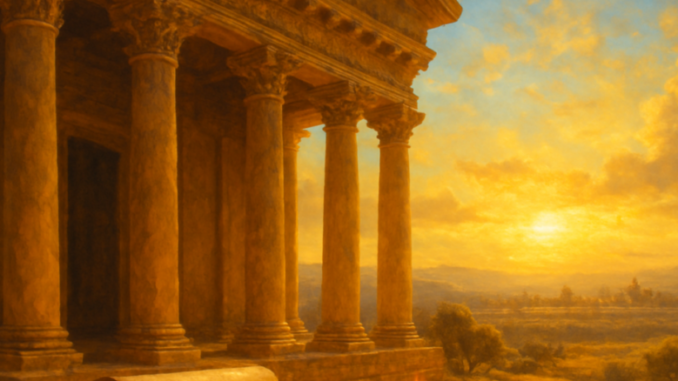
Peter does not speak only of individual salvation. His vision is architectural. The individual stones find their purpose only when they come together in a greater whole. This spiritual house — oikos pneumatikos — is not a temple of stone and timber, but a community of souls that support one another. The cornerstone of this structure is not human; it points to a transcendent reference point around which everything is ordered.
For the Freemason, this is a deeply familiar principle. The Lodge is not a building but a symbolic workshop where brethren labor together at the temple of humanity. Each brother brings his own stone, shaped by personal experience and self-reflection. It is only through mutual connection that the edifice takes form. Peter would have recognized this language, even though he wrote from a different framework.
A Royal Priesthood and the Dignity of Humanity
One of the most striking passages in the First Epistle of Peter is his description of believers as a royal priesthood, a holy nation. These are not titles reserved for a chosen elite but an invitation to everyone to recognize their own inherent dignity. The human being is not merely matter or accident — each person carries a spark that connects them to something greater.
The person who recognizes himself as a living stone understands that he is simultaneously builder and building material of his own spiritual destiny.
In the symbolic language of Freemasonry, this resonates with the concept of the inner temple. The outer world may be chaotic, but within the inner world, order can prevail. It is the task of every person to work on that inner temple — stone by stone, day by day. Peter emphasizes that this labor does not happen in isolation. The priestly calling implies service to others, the passing on of light.
Strangers and Pilgrims: The Journey Through the World
Peter calls his readers paroikoi and parepidemoi — strangers and sojourners. These are not terms of exclusion but of perspective. Those who see themselves as travelers attach less importance to the temporary and fix their gaze on what endures. The Stoic emperor Marcus Aurelius wrote centuries earlier about the transience of fame and possessions. Peter places this awareness in a context of hope: the journey has a destination.
For the Freemason, life is likewise a journey. From the Apprentice who first enters the temple to the Master who guides his brethren, each degree marks a stage of growth. The world is an antechamber, not the final destination. This thought does not free us from responsibility — it deepens it. Those who know they are passing through treat their surroundings with care and their fellow human beings with respect.
Suffering, Purification, and Light
The First Epistle of Peter does not shy away from the theme of suffering. On the contrary, it stands at the center of the letter. But this is not purposeless suffering. Peter compares the trial to fire that tests gold. What is impure burns away. What is real remains and shines all the brighter. This image of purification through fire has ancient roots, stretching from the alchemists to the mystical traditions of both East and West.
In Freemasonry, we speak of bringing the stone from rough to smooth. The mallet and chisel are not instruments of destruction but of liberation. Every blow removes what is superfluous and reveals what was always already present beneath the surface. The light that the Freemason seeks is not something that arrives from outside — it is something that breaks through from within once the obstructions have been cleared away.
A Timeless Invitation
The First Epistle of Peter was written in a specific time to specific people. Yet its message transcends that context entirely. The question Peter poses is the question every searching soul asks: Who am I, and what am I building with my life? The answer lies not in dogmas or prescriptions but in the willingness to see oneself as a living stone — shaped by life, fitted into a greater whole, oriented toward light.
The stone that lay on the ground turns out, on closer inspection, to be anything but a dead object. It carries within it the promise of the cathedral, of the temple not made with hands. Peter’s first epistle invites us to adopt this perspective: see yourself as both building material and builder, as both traveler and homecoming soul. It is an invitation that Freemasons, Christians, and seekers of every age recognize. The work upon the stone is the work upon the self — and it is never finished.
Peter’s ancient letter and the timeless craft of Freemasonry converge on a single, powerful truth: we are all living stones. Rough at first, shaped through experience, trial, and reflection, we find our highest purpose not in isolation but in community — fitted together into something far greater than any one of us could build alone. Whether you approach this truth through scripture, through the Lodge, or through the quiet work of your own conscience, the invitation remains the same. Pick up the mallet. Begin the work. Let the light break through.
Copyright text & image: devrijmetselaar.nl
Texts are based on the ideas and content of the author of devrijmetselaar.nl, reviewed, corrected, and supplemented with the assistance of OpenAI. Images are created based on the ideas of the author of devrijmetselaar.nl using OpenAI/DALL-E.
Frequently Asked Questions
What does the 'rough stone' symbolize in Freemasonry according to this article?
In Freemasonry, the rough stone represents the Entered Apprentice himself — unpolished, full of imperfections, yet carrying the promise of form and beauty. It serves as a starting point for the journey of self-improvement and transformation, similar to how Peter uses the image of living stones that must be refined and shaped.
How does Peter's concept of 'living stones' relate to Freemasonry's understanding of brotherhood?
Peter's vision of living stones being built into a spiritual house parallels Freemasonry's principle that individual brothers find their purpose only when connected within a greater whole. Just as the Lodge is a symbolic workshop where brethren labor together at the temple of humanity, each brother brings his own stone shaped by personal experience to create a unified structure.
What role does suffering and trial play in the transformation described in Peter's epistle?
Peter presents suffering and trial not as punishment but as a tool for transformation and character refinement. He compares this to fire purifying gold, suggesting that adversity serves as a trainer of the soul. This perspective aligns with Stoic philosophy and the Masonic understanding that challenges lead to personal and spiritual development.


Be the first to comment