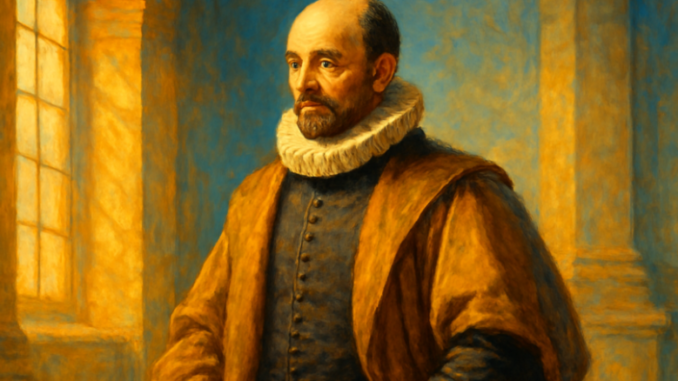
In 1580, a book appeared in Bordeaux that would permanently reshape European letters. Michel de Montaigne published his Essays — a collection of deeply personal reflections that shied away from no subject. In the fifty-first essay of the first book, “On the Vanity of Words,” he turned his sharp pen against a phenomenon that philosophers had criticized for centuries: the human tendency to use impressive language as a smokescreen for a lack of substance. Montaigne drew on a rich philosophical tradition stretching back to ancient Greece, and his thoughts continue to resonate wherever a brotherhood values authenticity over display.
Rhetoric Under Fire: An Ancient Philosophical Debate
To understand why Montaigne wielded such a sharp pen against hollow eloquence, we need to travel back to fifth-century Athens. There, an intellectual battle raged that would permanently shape Western philosophy. On one side stood the Sophists — itinerant teachers who taught the art of persuasion regardless of the truth of the argument. On the other stood Plato, who argued in dialogues such as the Gorgias and the Phaedrus that rhetoric without wisdom was nothing more than flattery. Plato’s teacher Socrates went even further: he regarded the true philosopher as someone who acknowledges his own ignorance rather than concealing it behind elegant sentences.
Montaigne knew these dialogues well. His library in the tower of his château contained extensive editions of Plato’s works, and the echo of Socratic suspicion toward verbal appearance rings loudly in “On the Vanity of Words.” Yet Montaigne was no slavish follower of Plato. Where Plato ultimately believed in absolute, knowable truths behind appearances, Montaigne stayed closer to a different tradition: skepticism.
Skepticism as a Foundational Attitude
The motto Montaigne had engraved on a medal — the phrase that summed up his entire way of thinking — was “Que sais-je?” What do I know? He borrowed this question from Pyrrhonist skepticism, a philosophical school tracing back to Pyrrho of Elis that experienced a remarkable revival during the sixteenth century. Through the work of Sextus Empiricus, which became available in Latin around 1562, Montaigne came to appreciate that the human mind is fundamentally limited in its capacity to achieve definitive knowledge. If even our senses deceive us and our reasoning rests on shifting sand, how great is the vanity of someone who, with carefully chosen words, pretends to hold a monopoly on truth?
This skeptical starting point made Montaigne acutely sensitive to the gap between word and reality. In “On the Vanity of Words,” he observes how politicians, scholars, and clergy mask their lack of decisive action with rhetorical virtuosity. It is an insight that flows directly from his skeptical philosophy: anyone who acknowledges that absolute certainty is unattainable will be suspicious of anyone who claims such certainty — especially when that claim is wrapped in ornamental language. For Freemasons, who are taught to seek Light through honest self-examination, Montaigne’s skeptical humility is a powerful reminder that true knowledge begins with acknowledging how little we know.
Stoic Roots: Seneca and the Virtue of Simplicity
Alongside skepticism, Stoicism served as a second great source of power for Montaigne’s thinking. Lucius Annaeus Seneca, the Roman statesman and philosopher of the first century, was one of Montaigne’s most frequently read authors. Seneca wrote extensively about the importance of inner virtue over outward display. In his Letters to Lucilius, he repeatedly warned that a philosopher who pays more attention to the style of his argument than to its truthfulness abandons the path of wisdom. The truly wise person, Seneca maintained, speaks simply and directly because his words are rooted in lived experience, not in the desire to impress.
Montaigne admired this Stoic sobriety, yet he was too honest to present himself as the perfect Stoic. His essays are shot through with self-deprecation and doubt. It is precisely this combination of Stoic ideals and skeptical modesty that makes his writing so remarkable. He did not preach complete mastery of the emotions; instead, he advocated sincerity — say what you mean, and mean what you say. This principle lies at the heart of Masonic tradition as well, where a Brother’s word is expected to be his bond, and where ritual language is meant to embody living truths rather than serve as empty ceremony.
Plutarch and Moral Biography as a Mirror
A third important influence on this essay was Plutarch, the Greek writer whose Moralia and Lives of the Noble Greeks and Romans ranked among Montaigne’s absolute favorite reading. Plutarch possessed a remarkable talent for portraying great historical figures in their full humanity — with all their weaknesses and contradictions. He paid close attention to the difference between what people said and what they actually did. Generals who delivered fiery speeches but failed in battle, politicians who preached virtue but were secretly corrupt: Plutarch documented it all with sober precision.
Montaigne followed this example. In “On the Vanity of Words,” he uses concrete examples from antiquity to drive his point home. By holding up the lives of historical figures as a mirror, he showed his readers that the gap between rhetoric and reality was no modern phenomenon but a universal human pattern. This same principle of self-examination through historical and allegorical reflection is deeply embedded in Masonic ritual, where candidates are continually invited to measure their conduct against timeless moral exemplars.
Renaissance Humanism: Rediscovering the Human Being
Montaigne did not write in a vacuum. He was a child of Renaissance humanism, an intellectual movement that placed the human being at the center of inquiry and rediscovered classical antiquity as a wellspring of wisdom. Thinkers such as Erasmus of Rotterdam had already ridiculed hollow scholarship and verbal display before Montaigne’s time. Erasmus’s In Praise of Folly of 1511 was a biting satire on theologians, jurists, and philosophers who compensated for their lack of insight with jargon and rhetorical tricks.
Yet Montaigne went a step further than Erasmus. Where Erasmus satirized from a Christian-humanist perspective — still anchored in the certainty of religious truth — Montaigne brought his skeptical lens to bear on all claims of certainty, including his own. This radical intellectual honesty is what makes Montaigne so modern, and so relevant to any tradition that values the pursuit of truth over the mere appearance of it. In the Masonic context, where every degree invites the initiate to strip away pretension and confront his authentic self, Montaigne’s insistence on intellectual humility feels remarkably at home.
Words Versus Deeds: A Lesson for the Lodge
At its core, Montaigne’s essay raises a question that every Freemason encounters on the path of self-improvement: do my words match my actions? The vanity of words is not merely an academic problem — it is a moral one. When ritual language becomes routine, when the grand phrases of the Craft are repeated without reflection, there is a danger that form replaces substance. Montaigne would have recognized this risk instantly. His entire philosophical project was an effort to close the gap between saying and being.
The philosophical traditions that fed Montaigne’s thinking — Socratic inquiry, Pyrrhonist skepticism, Stoic simplicity, Plutarchian self-examination, and Renaissance humanism — are all, in their own way, traditions of stripping away. They ask us to remove the decorative plaster and examine the stone beneath. In Masonic symbolism, the rough ashlar must be shaped through discipline and honesty before it can take its place in the temple wall. Montaigne’s essay reminds us that this shaping begins with our words: use them truthfully, use them sparingly, and never mistake eloquence for wisdom.
More than four centuries after its publication, Montaigne’s “On the Vanity of Words” remains a powerful meditation on authenticity. Its philosophical roots run deep — from Socrates and Seneca to Plutarch and the Renaissance humanists — and its central message is timeless: genuine understanding demands humility, and true conviction expresses itself in deeds rather than in decorated speech. For Freemasons walking the path of self-knowledge, Montaigne’s essay is not merely a literary curiosity but a living challenge. Let us ensure that the words we speak in and beyond the Lodge are always in harmony with the lives we lead.
Copyright text & image: devrijmetselaar.nl
Texts are based on the ideas and content of the author of devrijmetselaar.nl, reviewed, corrected, and supplemented with the assistance of OpenAI. Images are created based on the ideas of the author of devrijmetselaar.nl using OpenAI/DALL-E.
Frequently Asked Questions
What is the main argument of Montaigne's essay 'On the Vanity of Words'?
Montaigne criticizes the human tendency to use impressive language as a smokescreen for lack of substance. He argues against hollow eloquence and advocates for authenticity over impressive display, drawing on a philosophical tradition dating back to ancient Greece.
What is the significance of Montaigne's motto 'Que sais-je?' (What do I know)?
This motto encapsulates Montaigne's entire philosophical approach, borrowed from Pyrrhonist skepticism. It reflects his belief that the human mind is fundamentally limited in its capacity to achieve definitive knowledge, and therefore claiming certainty through eloquent words is inherently vain.
How did ancient Greek philosophy influence Montaigne's critique of rhetoric?
Montaigne drew inspiration from Plato's dialogues, particularly the Gorgias and Phaedrus, which argued that rhetoric without wisdom is merely flattery. He was also influenced by Socrates' principle of acknowledging one's own ignorance rather than concealing it behind elegant sentences, though Montaigne ultimately adopted a skeptical rather than Platonic approach.

Be the first to comment