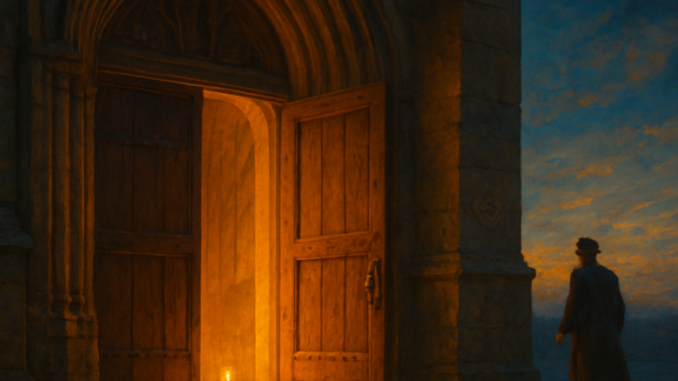
On November 8, 2026, harrowing testimonies emerged from Krakow: ordinary people fleeing a shooting, seeking refuge inside a church, and waiting in silence for the violence to end. The stories are breathtaking in their raw humanity. But beneath the headlines lies a deeper, older narrative — one about what happens to the human personality when everything is stripped away and only bare existence remains. That narrative touches the very heart of what Freemasons have been exploring for centuries.
A Church as Fortress: Historical Echoes
The image of people seeking shelter behind church walls is as old as Christianity itself. As early as the fourth century, the right of sanctuary was codified — a tradition holding that anyone who fled into a holy place could not be forcibly removed. Emperor Theodosius I ratified this right in 392 AD. Throughout the Middle Ages, cathedrals and chapels offered protection to the persecuted, to refugees, and even to criminals who needed a moment’s reprieve.
What stands out in the Krakow testimonies is that this ancient instinct appears to be fully intact. Without discussion, without a plan, people ran toward the nearest building that promised safety. The church was not merely a physical stronghold of thick stone walls — it also represented something else entirely: silence against chaos, calm against violence, community against isolation. In that instinctive gesture lies a truth that transcends the centuries.
The Moment Character Reveals Itself
The Greek philosopher Aristotle wrote that character is not formed by what a person thinks, but by what he does in the moment that matters. His student Theophrastus took this a step further, describing in his work on character types how people only become truly recognizable when circumstances force them to act. A crisis is like a furnace: what enters as raw material emerges as something whose true composition is finally revealed.
The witnesses in Krakow described exactly this process. Some froze. Others took charge — locking doors, comforting children, speaking calmly to strangers. Still others prayed. All of these responses are human; none of them is wrong. But together they form a window into what personality truly is: not the mask we wear on ordinary days, but the face that appears when that mask is torn away.
The Rough Ashlar and the Work of Self-Formation
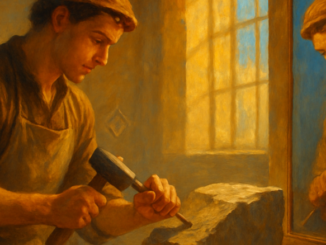
In Freemasonry, the working of the rough ashlar stands as one of the central metaphors for the formation of character. The rough stone represents the individual as he begins: unworked, angular, full of undiscovered potential. The Freemason’s task is to shape that stone gradually — not to imitate some external ideal, but to discover the form that was already hidden within.
This is no theoretical exercise. It takes place in the silence of the lodge, in encounters with brethren from vastly different backgrounds, in the honest conversation with oneself after a ritual meeting. The eighteenth-century clergyman and Freemason James Anderson set down in his Constitutions of 1723 that the Brotherhood should be a meeting place where people of all persuasions could come together on the basis of shared virtue. That idea was revolutionary in an age of religious wars and rigid class divisions. It remains profoundly relevant in a time when the violence in Krakow reminds us just how fragile the fabric of society can be.
Personality is not what you claim about yourself on quiet days — it is what remains when silence is shattered by chaos.
Courage, Fear, and the Stoic Tradition
The Roman emperor and Stoic philosopher Marcus Aurelius wrote in his Meditations that a person should not fear what happens to him, but should pay attention to how he responds. He saw every adversity as training material for the soul. Seneca, another Stoic whose ideas have long inspired Masonic thought, put it more sharply: “It is not because things are difficult that we do not dare; it is because we do not dare that they are difficult.”
The witnesses in Krakow dared. They dared to flee, dared to be still, dared to care for others while their own fear threatened to paralyze them. That paradox — acting despite paralysis — is precisely what the Stoics meant by virtue. It is also what Freemasons strive for in their work on character: not the absence of fear, but the willingness to do what is right in spite of it.
From Krakow to the Lodge: Lessons for Today
It would be inappropriate to reduce a tragedy like the one in Krakow to a lesson or a moral. The victims deserve our compassion, not our commentary. Yet it is worthwhile to reflect on what this event reveals about human nature. The people sheltering in that church formed a community in an instant. Strangers became allies. Language, origin, and belief ceased to matter. What counted was proximity, silence, and the shared will to survive.
That experience mirrors, in concentrated form, what happens inside a Masonic lodge — albeit under far less extreme circumstances. There, too, people come together who seem to have little in common outside the lodge walls. There, too, the mask of the daily role is set aside. There, too, connection arises through shared vulnerability. The difference is that the lodge offers a safe space in which to undergo this process consciously — as a practice in humanity, as preparation for the moments when it truly matters.
What Makes a Person Who They Truly Are?
The question that lingers after Krakow is not only about who bears responsibility for the violence. It is also the question that Aristotle, Marcus Aurelius, and generations of Freemasons have posed before us: what makes a person who they truly are? The answer lies not in words or intentions, but in deeds. In the choice to hold a church door open for a stranger. In the decision to stay calm when every nerve screams for flight. In the quiet resolve to be present for another human being when the world outside is falling apart.
Freemasonry does not claim to have all the answers. But it does offer a framework — a set of symbols, rituals, and shared reflections — within which these questions can be explored with honesty and depth. The rough ashlar reminds us that we are always works in progress. The events in Krakow remind us why that work matters.
In the end, the church in Krakow and the Masonic lodge share something essential: both are spaces where the veneer of everyday life falls away and the deeper architecture of human character becomes visible. The people who sheltered behind those ancient walls did not choose to be tested. But in their responses — in their courage, their fear, their compassion — they revealed what centuries of philosophical and Masonic tradition have always taught: that character is not built in comfort, but forged in the moments when comfort disappears. The work of the rough ashlar is never finished. And perhaps that is precisely the point.
Copyright text & image: devrijmetselaar.nl
Texts are based on the ideas and content of the author of devrijmetselaar.nl, reviewed, corrected, and supplemented with the assistance of OpenAI. Images are created based on the ideas of the author of devrijmetselaar.nl using OpenAI/DALL-E.
Frequently Asked Questions
What is the historical significance of sanctuary in churches?
The right of sanctuary was codified as early as the fourth century and ratified by Emperor Theodosius I in 392 AD. Throughout the Middle Ages, cathedrals and chapels offered protection to the persecuted, refugees, and even criminals seeking refuge. This ancient tradition remained intact during the Krakow incident, where people instinctively sought shelter in a church, demonstrating that the church represented not only physical safety but also silence against chaos, calm against violence, and community against isolation.
How does crisis reveal true character according to the article?
The article references Aristotle's philosophy that character is formed not by what a person thinks but by what they do in critical moments. During the Krakow shooting, witnesses displayed different responses—some froze, others took charge by locking doors and comforting children, and some prayed. These varied reactions revealed people's true personalities, as crisis acts like a furnace that strips away the masks people wear in ordinary life and exposes their authentic nature.
What is the Masonic significance of the rough ashlar in character formation?
The rough ashlar is a central metaphor in Freemasonry for the formation of character. Though the article's explanation is incomplete, it represents the idea that character, like stone, must be worked and refined through experience and deliberate effort to transform from its rough, unfinished state into something polished and complete.

Be the first to comment