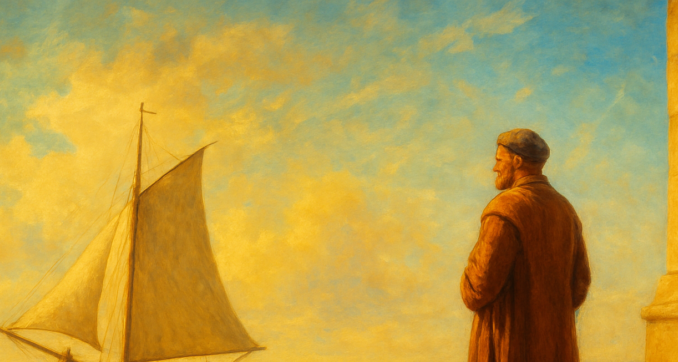
You may have experienced it yourself: you’re standing in a group of people, everyone reacting to the same event, and yet it seems as though each person is living in a different reality. One shrugs it off, another gets angry, and a third bursts out laughing. How is that possible? Michel de Montaigne asked himself precisely this question when he wrote about two ancient Greek philosophers who judged humanity in completely opposite ways. That essay touches, with surprising depth, on the very heart of what Freemasonry seeks to achieve: genuine connection beyond superficial judgment.
Two Philosophers, Two Ways of Seeing the World
In his essay on Democritus and Heraclitus, Montaigne describes how these two ancient thinkers had diametrically opposed reactions to human behavior. Democritus laughed at the follies of mankind; Heraclitus wept over them. It’s a contrast you may recognize from your own life: sometimes you can only shake your head and chuckle at the absurdity of a situation, while at other times you find yourself deeply moved by the very same human shortcomings.
But Montaigne does something remarkable. He doesn’t pick a side. Instead, he uses this contrast as a starting point for a deeper inquiry: how do we actually form our judgments? What does the way you look at the world reveal about you? Your judgment, he argues, is never simply a statement about what you observe — it is a mirror of your own inner life. That insight is not only philosophically powerful; it strikes directly at the core of the Masonic tradition.
Judgment as a Mirror of the Inner Self
Montaigne warns us against judging too quickly and too firmly. He advocates an attitude of humility: the recognition that your perspective is not the only truth, and that every judgment is inevitably colored by who you are. This idea stands remarkably close to one of the fundamental values within Freemasonry — self-reflection. The rough stone you work on is not the other person; it is yourself. The task is not to condemn the outside world but to honestly face your own inner workshop.
In the lodge, you learn that judging others is seldom productive. What is fruitful, however, is the willingness to examine your own prejudices and to question your own reactions. Why does something irritate you that leaves another person unmoved? Why do you laugh where someone else cries? Montaigne would say: study your own judgment, for that is where the key to self-knowledge lies. The Freemason would add: and through that self-knowledge, you find the path to genuine connection with others.
Beyond Either-Or: The Power of Multiple Perspectives
What makes Montaigne so relevant to the Masonic tradition is his refusal to reduce the world to simple oppositions. Democritus or Heraclitus, laughter or tears, right or wrong — Montaigne resists these sharp dichotomies. He invites you to consider multiple perspectives simultaneously, to embrace complexity rather than retreating into easy answers.
This is precisely what happens in a lodge. Brethren come together from diverse backgrounds, religions, professions, and philosophies of life. The power of that gathering lies not in unanimity but in the willingness to listen to one another without rushing to judgment. Aristotle once described the virtue of moderation as the middle ground between two extremes. Montaigne, who was deeply influenced by Aristotle as well as the Stoic and Skeptic traditions, applies that same wisdom to the act of judging itself. True wisdom lies not in choosing a side but in suspending your judgment until you have truly listened.
Those who learn to question their own judgments lay the foundation for real connection — because only when you stop condemning can you begin to understand.
Brotherhood Begins with Vulnerability
There is another layer in Montaigne’s essay that resonates deeply with the Masonic experience. By writing about the laughing Democritus and the weeping Heraclitus, Montaigne shows that both reactions spring from engagement. Both laughter and tears presuppose that you are touched by the human condition. Indifference is not an option for anyone who truly lives.
In Freemasonry, that engagement is a prerequisite for brotherhood. You can only be a true brother if you are willing to be moved, if you have the courage to be vulnerable. The search for light and knowledge is not a detached intellectual exercise. It is a personal journey that demands honesty, openness, and the courage to face your own imperfections. Montaigne understood this back in the sixteenth century. He wrote his essays not as abstract treatises but as personal confessions — as attempts to fathom himself. In doing so, he was engaged, without knowing it, in what Freemasons call the working of the rough stone.
Connection as Practice, Not Theory
The beauty of Montaigne’s approach is that he does not preach connection as an abstract ideal but demonstrates it as a daily practice. Every time you defer a judgment, every time you ask yourself why you react the way you do, you are practicing connection. You create space for the other — not by erasing yourself, but precisely by getting to know yourself better.
In Freemasonry, this practice is given structure through ritual. The ritual offers a safe space in which brethren can reflect together, where the everyday roles and masks are temporarily set aside. But the lesson extends far beyond the lodge. Montaigne reminds us that every conversation, every encounter, is an opportunity to practice that connection. Not by agreeing, but by genuinely wanting to understand.
Montaigne’s timeless wisdom offers Freemasons — and anyone on a path of self-improvement — a powerful reminder. Examine your own judgment before you judge another. Embrace complexity, because truth rarely has just one face. Allow yourself to be moved by the world around you, for engagement is the wellspring of both brotherhood and understanding. The rough stone is never finished, and every honest look inward brings you one step closer to the light you seek.
Copyright text & image: devrijmetselaar.nl
Texts are based on the ideas and content of the author of devrijmetselaar.nl, reviewed, corrected, and supplemented with the assistance of OpenAI. Images are created based on the ideas of the author of devrijmetselaar.nl using OpenAI/DALL-E.


Be the first to comment