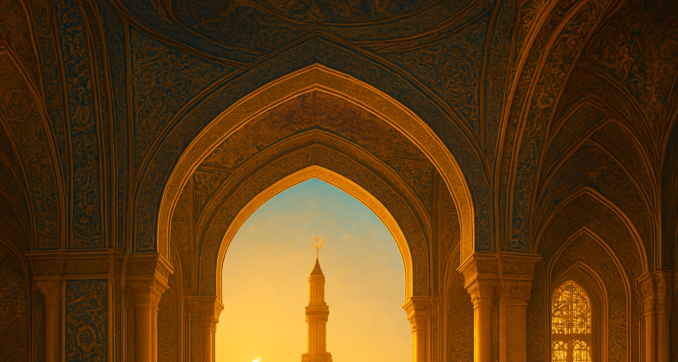
What if the most important message a person can ever receive doesn’t come from the outside — but from within? The twenty-eighth surah of the thirtieth part of the Quran, known as An-Naba or The Great Tidings, opens with a disquieting question: what are they asking one another about? The answer is as simple as it is overwhelming — about a great announcement, a reality that upends everything we take for granted. In this essay, we explore how this ancient call to awakening resonates deeply with the spiritual quest that lies at the heart of Freemasonry.
A Question That Breaks Everything Open
The opening verses of An-Naba are unusually direct. They don’t establish a doctrinal argument. Instead, they hurl a question that yanks the listener out of daily routine: “What are they asking one another about? About the great tidings, over which they disagree.” This rhetorical technique — shattering complacency through a piercing question — is far from unique to the Islamic tradition. Socrates employed the same method when he confronted passersby in the markets of Athens with their own ignorance. Freemasonry knows a remarkably similar moment: the instant when a candidate first enters the lodge and is confronted with darkness, silence, and the question of who he truly is. The “tidings,” across all these traditions, are not a news bulletin. They are an existential shock.
Creation as Evidence and as Mirror
After its opening question, the surah takes a surprising turn. Rather than immediately describing judgment, it points to creation itself. The earth as a place of rest, the mountains as anchors, the night as a covering, the day as a means of livelihood, the sky as a firm structure. Verse after verse, the natural order is invoked — not as decorative imagery, but as testimony. The reasoning is clear: anyone with eyes to see the harmony of the created world cannot deny the existence of an order that transcends the accidental.
This motif — creation as a mirror of a higher order — is deeply embedded in Masonic tradition. The Great Architect of the Universe is not a dogmatic deity but a principle, pointing to the conviction that the universe is not arbitrary. Just as the eighteenth-century natural philosopher Isaac Newton recognized a mathematical master plan in the cosmos, An-Naba invites its reader to perceive in nature the fingerprint of something far greater than the visible alone. The Masonic brother, gazing upon the symbolic tools of his Craft, is engaged in the same contemplation: seeking order behind apparent chaos, meaning behind mere matter.
The Day of Distinction: Accountability as a Spiritual Theme
At the heart of the surah lies what is called in Arabic “Yawm al-Fasl” — the Day of Distinction. It is the moment when truth and falsehood, justice and injustice, are definitively separated. For believers within the Islamic tradition, this refers to the resurrection and the final judgment. But the concept of a moment of ultimate accountability is far more universal than any single religious tradition.
In antiquity, the Egyptian Book of the Dead described the weighing of the heart against the feather of Ma’at, the goddess of truth and justice. The Greek philosopher Plato, in his dialogues on the soul, described how the individual must give an account of his lived life after death. And in Freemasonry, the candidate during initiation symbolically contemplates his own mortality — not to instill fear, but to create clarity. The person who truly grasps that his time is finite begins to treat his choices with far greater care and intention.
The great tidings, then, are not a prophecy about some distant future. They are a call to awaken now. Every moment of conscious living is itself a moment of distinction.
Counterpoint: Is Accountability Freedom or Compulsion?
Here a philosophical tension arises that deserves honest consideration. Is the idea of a day of reckoning liberating or suffocating? Critics of religious eschatology have often pointed out that fear of judgment can paralyze a person rather than elevate them. The French philosopher Voltaire — himself a Freemason and a sharp critic of ecclesiastical abuse of power — emphasized that virtue should not spring from fear of punishment but from an inner desire for goodness.
This position aligns closely with the Masonic approach. In the lodge, no one is compelled to adopt a particular faith or a specific vision of the afterlife. What is encouraged, however, is self-reflection — the willingness to measure your own actions against the principles of brotherly love, truth, and charity. The Day of Distinction need not be a cosmic courtroom. It can equally be the quiet moment when a person, alone with himself, honestly determines whether he has lived in accordance with his deepest values.
Synthesis: Where the Surah and the Lodge Meet
When we place An-Naba alongside the spiritual practice of Freemasonry, several striking parallels emerge that go well beyond surface-level resemblance:
The call to awaken: Both the surah and the initiation ritual confront the individual with his spiritual slumber and ask him to wake up. Creation as teacher: Nature is not mere scenery but a source of insight into order, harmony, and responsibility. Mortality as compass: The awareness of finitude is not a source of despair but a spur to live more consciously, more justly, and with greater love. Distinction as inner work: The separation of truth from falsehood begins not with an external verdict but with honesty toward oneself.
The German poet and Freemason Johann Wolfgang von Goethe wrote that a person is only truly free when he knows himself. That thought forms a bridge between the Quranic tidings and the Masonic endeavor. Both traditions, each in its own language and imagery, point toward the same truth: that real knowledge does not begin with the accumulation of facts, but with the courage to receive — to open oneself to a message that may change everything.
An-Naba’s great tidings are ultimately not about an external event imposed upon humanity from above. They are about the inner awakening that occurs when a person stops drifting through life on autopilot and dares to confront the fundamental questions of existence. Freemasonry, in its own symbolic language, extends the same invitation. Whether through the sacred text of a world religion or the ritual silence of a lodge, the message is the same: wake up, look honestly at yourself and the world around you, and begin the work of living with purpose, integrity, and compassion. The tidings have always been there. The only question is whether we are ready to hear them.
Copyright text & image: devrijmetselaar.nl
Texts are based on the ideas and content of the author of devrijmetselaar.nl, reviewed, corrected, and supplemented with the assistance of OpenAI. Images are created based on the ideas of the author of devrijmetselaar.nl using OpenAI/DALL-E.

Be the first to comment