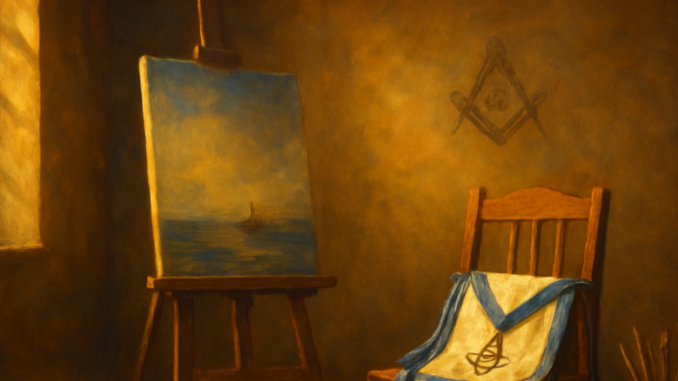
Candlelight flickers softly as a young man sets down his brush and stares at the canvas. As the eighth child in a large family, he learned early to observe, to listen, and above all, to wait his turn to be heard. Now, years later, he stands in a Masonic lodge where brethren have gathered around the art he has created. The story of the eighth child who becomes both philosopher and brother is a story about creativity born from necessity, wisdom cultivated in the shadows, and the art that emerges when a searching spirit finally finds a home.
The Philosopher Who Grew Up as the Eighth Child
Throughout the history of philosophy and the arts, we find a remarkable number of thinkers and artists who grew up among the youngest children in large families. The eighth child — whether literally or figuratively the youngest — learns early that the world does not revolve around him. This position creates a unique perspective on reality: observing, reflecting, and often developing a deep need to find meaning beyond the well-trodden path.
Jean-Jacques Rousseau, the eighteenth-century philosopher whose ideas helped shape the Enlightenment, knew this experience of being an outsider. His philosophy about the natural state of humanity and the corrupting influence of society reflects the perspective of someone who learned early to look inward. Rousseau did not view art as decoration but as an expression of the authentic human soul. This vision resonates deeply with the way Freemasons approach art: as a vehicle for spiritual and moral deepening.
Brotherhood and the Creative Spirit
When the eighth child becomes a philosopher and a brother in Freemasonry, a remarkable synthesis takes place. The lodge offers what the large family sometimes could not: a space where every voice counts equally, where the youngest brother enjoys the same dignity as the eldest. This is precisely what Freemasonry aims to achieve — a brotherhood in which social hierarchies are set aside in favor of shared values.
The true artist in Freemasonry creates not to be seen, but to make the invisible truth visible.
Wolfgang Amadeus Mozart, himself a Freemason, embodied this connection between art and brotherhood. His opera The Magic Flute is woven through with Masonic symbolism and ritual themes. Mozart understood that art can be more than entertainment — it can be a path toward enlightenment, a way to guide the listener toward higher insight. The composer as philosopher and brother uses his talent not for personal glory but in service to something greater.
The Eighth Child and the Art of Listening
A fundamental aspect of both the arts and Freemasonry is the capacity for listening. The eighth child in a large family develops this capacity out of sheer necessity. At the dinner table, you must wait, observe when there is room to speak. This skill proves invaluable later in life, both for the philosopher and for the brother.
Johann Wolfgang von Goethe, the German poet and thinker who was also a Freemason, wrote extensively about the relationship between art, nature, and human development. His concept of Bildung — the ongoing formation of the human personality — aligns seamlessly with the Masonic ideal of the rough ashlar being shaped and polished into a finished masterpiece. Goethe understood that art is not merely a product but a process: a continuous dialogue between the artist and the world.
The Lodge as a Workshop of the Soul
In the Masonic lodge, art is approached in a distinctive way. It is not primarily about aesthetic beauty, although that is certainly appreciated. It is about the transformative power of the creative process itself. When a brother writes a poem, paints a picture, or composes a piece of music for the lodge, he undertakes an inner journey that runs parallel to the symbolic journey from Entered Apprentice to Master Mason.
The philosopher who learned patience as the eighth child understands this slow ripening. Art in Freemasonry is not a quick production for the market but a meditative practice. It is the compass drawing its circles, the square measuring its right angles — tools that demand precision and dedication. The artist-brother knows that true masterpieces take time, just as the formation of character is a lifelong endeavor.
Art as a Universal Language
What connects Freemasonry and the arts is their ability to transcend boundaries. Just as the lodge brings together men of different religions, backgrounds, and convictions, art speaks a universal language that breaks through national and cultural barriers. The philosopher and brother who grew up as the eighth child often possesses a natural understanding of this universality. He learned early that multiple perspectives exist, that truth is not confined to a single voice.
Music speaks to the heart without words. Visual art reveals what language cannot capture. Poetry connects the everyday with the sublime. Architecture gives form to human aspiration. Each of these disciplines mirrors the Masonic endeavor — to build something lasting, meaningful, and greater than the individual who creates it.
The Brother as Creative Philosopher
The connection between the eighth child, the philosopher, and the brother finds its culmination in the creative act. When a Freemason creates art, he brings his entire life story with him: the lessons in patience from his youth, the wisdom gathered through study and reflection, and the brotherly love he has come to know within the lodge. These layers make his work rich and meaningful.
Freemasonry recognizes that every person is an artist in potential. Whether it is the craftsmanship of a carpenter, the eloquence of a speaker, or the creative vision of a painter — all forms of creation can contribute to the perfection of the individual and the betterment of the world. The eighth child who becomes philosopher and brother carries within him a unique gift: the ability to transform the quiet observation of his early years into works that illuminate, inspire, and unite.
Art in the Masonic lodge is more than mere adornment — it is a living expression of the Craft’s deepest ideals. The eighth child who grew into a philosopher and found brotherhood in Freemasonry reminds us that wisdom often grows in silence, that creativity flourishes when given the right space, and that the greatest art emerges not from the desire to be seen but from the longing to reveal something true. In the lodge, every brother is both artist and work of art — forever shaping and being shaped on the journey toward light.
Copyright text & image: devrijmetselaar.nl
Texts are based on the ideas and content of the author of devrijmetselaar.nl, reviewed, corrected, and supplemented with the assistance of OpenAI. Images are created based on the ideas of the author of devrijmetselaar.nl using OpenAI/DALL-E.
Frequently Asked Questions
What is the significance of being the 'eighth child' in relation to Freemasonry and philosophy?
The eighth child, whether literally or figuratively the youngest in a large family, develops a unique philosophical perspective through early observation, listening, and patience. This outsider position cultivates the ability to look inward and seek deeper meaning. When such individuals become Freemasons, they bring this reflective wisdom to the brotherhood, finding in the lodge a space where every voice is valued equally, regardless of social position or family hierarchy.
How does Freemasonry view art differently than the rest of society?
In Freemasonry, art is not viewed as mere decoration or entertainment, but as a vehicle for spiritual and moral deepening. The true artist in Freemasonry creates not to be seen or gain personal recognition, but to make invisible truth visible. This approach reflects the philosophy of thinkers like Jean-Jacques Rousseau, who saw art as an expression of the authentic human soul and a path toward enlightenment.
What is an example of how a famous Freemason integrated art and brotherhood?
Wolfgang Amadeus Mozart, himself a Freemason, exemplified the connection between art and brotherhood. His opera The Magic Flute is woven through with Masonic symbolism and ritual themes. Mozart understood that art could be more than entertainment—it could serve as a path toward enlightenment and a way to guide listeners toward higher insight, demonstrating how the composer as philosopher and brother uses his talent for spiritual purposes.

Be the first to comment