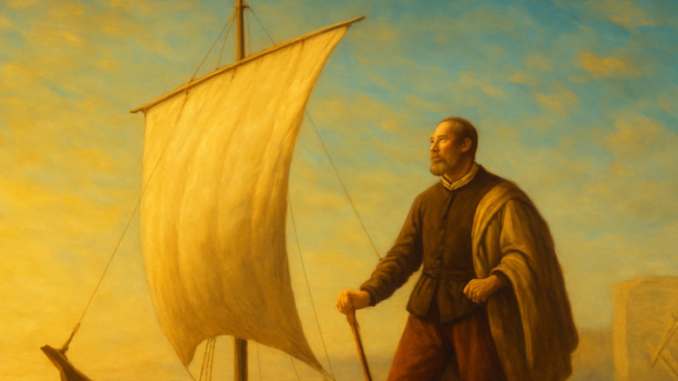
Imagine standing at a crossroads in life where the easy path beckons, but your conscience pulls you in the opposite direction. Michel de Montaigne explored this very tension in his fifteenth essay, which examines the punishment of cowardice. At first glance, it appears to be a military treatise, but look closer and it strikes at the heart of what it means to live a virtuous life. For Freemasons, this essay resonates with particular force — courage and personal accountability are pillars of the Craft.
What Montaigne Teaches Us About Cowardice
In his short but powerful essay, Michel de Montaigne wrestles with a provocative question: should cowardice on the battlefield be punished by death, or is the disgrace itself punishment enough? He points to the Roman practice of publicly humiliating cowards rather than executing them. Soldiers who fled from battle were forced to walk through the camp dressed in women’s clothing for days on end — a spectacle designed to shame rather than destroy.
Montaigne argues that executing someone for cowardice is fundamentally paradoxical. You cannot punish a lack of courage by killing the person, because death eliminates any possibility of redemption or improvement. This is classic Montaigne: he avoids absolute judgments and instead seeks to understand human weakness on its own terms.
Cowardice, he suggests, is not an unforgivable sin but a sign that someone has not yet developed the inner formation needed to overcome fear. This reframing is significant — it opens the door to growth and transformation rather than slamming it shut with condemnation.
Courage in the Masonic Tradition
Within Freemasonry, courage is not primarily understood as physical bravery. It is the inner strength to do the right thing, even when doing so is uncomfortable or risky. When an Entered Apprentice first steps into the lodge, he is symbolically confronted with his own fears and prejudices. The ritual demands surrender to a process of self-reflection that is not always pleasant. This is a form of courage Montaigne would have recognized immediately.
True courage is not the absence of fear, but the willingness to take responsibility for your own growth despite that fear.
The Freemason is invited to work his rough ashlar — a symbol of the continuous process of self-improvement. Cowardice in this context means avoiding that inner labor, looking away from your own shortcomings. And just as Montaigne argued, the punishment for such cowardice is not external condemnation but something far more consequential: remaining stuck in an unrefined state, an unworked stone.
Concrete Steps Toward Moral Courage
How do you translate these philosophical insights into daily life? Montaigne and the Masonic tradition together offer a practical framework. Here are four concrete actions you can apply starting today:
1. Name your fears out loud. Share them with yourself in honest reflection, or with a trusted Brother or Sister. Only what you acknowledge can be transformed.
2. Ask yourself a weekly question: Where did I choose the easy path this week when I knew better? This simple practice of self-examination mirrors the Masonic habit of regular introspection.
3. Seek out mild discomfort. Courage is a muscle that must be trained. Volunteer for the task you would normally avoid. Speak up when silence feels safer.
4. Ask for honest feedback. Montaigne warns that we deceive ourselves most easily of all. The people who care about you can hold up the mirror you might otherwise refuse to look into.
Brotherhood as a Safety Net for Failure
A crucial element that Montaigne implies — and that Freemasonry makes explicit — is the role of community. The Roman punishment Montaigne describes worked precisely because the community bore witness. Shame only has power within a group that genuinely cares about you. The Masonic lodge functions as exactly this kind of community: a space where Brothers hold each other accountable, offer support, and create room to fail without being destroyed by judgment.
This stands in stark contrast to modern anonymity, where people can hide from the consequences of their choices. In the lodge, you give an account of yourself — not as punishment, but as part of a process of mutual growth. Your Brothers see your struggles and offer the mirror you need to look at yourself honestly.
The Transformative Power of Self-Reflection
Montaigne wrote his essays as exercises in self-knowledge. He examined his own fears, doubts, and failings with a candor that was rare in his time. This attitude aligns seamlessly with the Masonic ideal of the search for truth — beginning with the truth about yourself. It takes genuine courage to look honestly at the places where cowardice has led you into patterns of avoidance.
The practical lesson is clear: do not punish yourself mercilessly for moments of weakness. Instead, use them as signposts pointing to where your inner work is most needed. Montaigne would have agreed with the Masonic understanding that moral perfection is not a destination but a direction. Every step toward greater courage, no matter how small, is a step toward the light.
Michel de Montaigne challenges us to see cowardice not as a final verdict but as an invitation to grow. The Masonic tradition provides precisely the framework in which that growth can take place: a brotherhood that values courage, encourages self-reflection, and offers the space to fail and begin again. The question is not whether you have ever been a coward — we all have. The real question is what you will do today to be braver tomorrow. That choice is in your hands.
Copyright text & image: devrijmetselaar.nl
Texts are based on the ideas and content of the author of devrijmetselaar.nl, reviewed, corrected, and supplemented with the assistance of OpenAI. Images are created based on the ideas of the author of devrijmetselaar.nl using OpenAI/DALL-E.
Frequently Asked Questions
What is Montaigne's view on punishing cowardice?
Montaigne argues that executing someone for cowardice is paradoxical because death eliminates any possibility of redemption or improvement. Instead, he points to the Roman practice of public humiliation, such as forcing soldiers to walk through camp in women's clothing. He reframes cowardice not as an unforgivable sin, but as a sign that someone has not yet developed the inner strength needed to overcome fear, opening the door to growth and transformation.
How does Freemasonry define courage differently from physical bravery?
Within Freemasonry, courage is understood as inner strength—the ability to do the right thing even when it is uncomfortable or risky. It is not the absence of fear, but the willingness to take responsibility for your own growth despite that fear. When an Entered Apprentice enters the lodge, he is symbolically confronted with his own fears and prejudices, requiring a form of moral courage that involves self-reflection and personal accountability.
What does 'working the rough ashlar' symbolize in relation to courage and cowardice?
The rough ashlar is a Masonic symbol of the continuous process of self-improvement and inner labor. Cowardice in this context means avoiding that inner work and looking away from your own shortcomings. True courage, by contrast, involves actively engaging in this process of self-examination and personal development, which aligns with Montaigne's philosophy that improvement requires confronting rather than avoiding one's weaknesses.


Be the first to comment