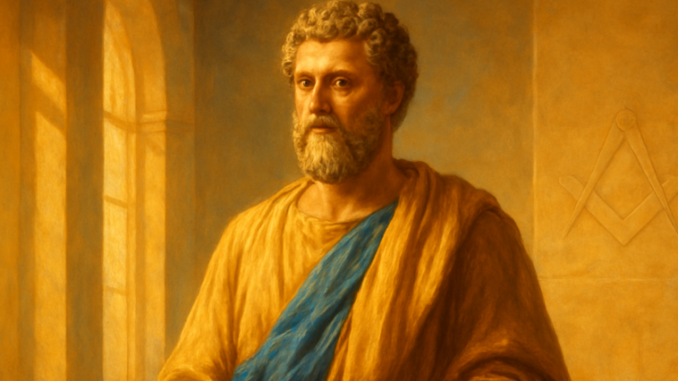
Imagine waking up in the morning and wondering why you should bother getting out of bed at all. The day stretches ahead — full of obligations, encounters, and perhaps worries. This is precisely the question Marcus Aurelius poses at the opening of Book II of his Meditations. But behind this seemingly simple opening lies a rich philosophical tradition reaching back to the early Stoa, one that found its way through thinkers like Epictetus and Seneca into the imperial chambers of Rome — and whose echoes can still be heard in Masonic lodges today.
The Stoic Heritage
Book II of the Meditations is steeped in Stoic wisdom. This philosophical school, founded around 300 BCE by Zeno of Citium in Athens, held that nature follows a rational order and that human happiness lies in living in accordance with that order. Marcus Aurelius never wrote for publication — his Meditations were a kind of philosophical diary, a private conversation with himself. Yet in every sentence you can hear the echo of centuries of philosophical contemplation.
The early Stoics distinguished three disciplines: the discipline of desire, the discipline of action, and the discipline of judgment. In Book II, Marcus Aurelius focuses primarily on the first two. He reminds himself that he will encounter people who are meddlesome, ungrateful, or untrustworthy. But rather than complain about this, he asks: what can I change in my own attitude? This inward turn — the insistence on mastering oneself rather than the world — is the beating heart of Stoic practice.
Epictetus as Master Teacher
Of all the philosophers who shaped Marcus Aurelius’ thinking, Epictetus was arguably the most important. This former slave, who rose to become one of the ancient world’s most influential thinkers, emphasized the distinction between what lies within our power and what does not. His Enchiridion (Handbook) and the Discourses, recorded by his student Arrian, were essential reading for the emperor. In Book II, this distinction resonates clearly when Marcus meditates on the impermanence of fame, possessions, and even the body itself.
Epictetus taught that external circumstances — including death — are morally neutral. It is our reaction to them that determines whether we become happy or miserable. This idea formed the backbone of Marcus Aurelius’ daily reflections and gave him a framework for confronting the harsh realities of his life as emperor and military commander.
Seneca and the Art of Dying
Alongside Epictetus, Seneca also played a role in shaping the intellectual landscape we find in Book II. Although Marcus Aurelius does not quote him directly, both thinkers share a deep preoccupation with death as a teacher. In his letters to Lucilius, Seneca wrote extensively about how the contemplation of death can free us from petty concerns. Marcus Aurelius echoes this insight throughout his second book: whoever truly grasps their own mortality will be far less inclined to waste precious time on anger, envy, or vanity.
This is not gloomy pessimism. On the contrary, the Stoics regarded meditation on death as a form of liberation. By becoming conscious of life’s finite nature, you can direct your energy toward what truly matters: virtue, wisdom, and the bonds you share with your fellow human beings.
The Stoic wisdom of Marcus Aurelius teaches us that awareness of impermanence is not a source of despair but a call to live each day with full attention and purpose.
Heraclitus and the River of Change
Another significant influence on Marcus Aurelius was the pre-Socratic philosopher Heraclitus. His famous observation that one cannot step into the same river twice reverberates throughout Book II. Marcus Aurelius describes life as a continuous flow in which nothing is permanent. Fame fades, wealth crumbles, and even the memory of great emperors dissolves into time.
For the Stoics, this cosmic vision of perpetual change was not a cause for despair but for acceptance. The logos — the divine reason pervading the universe — manifests precisely through this eternal transformation. By accepting this, a person places themselves in harmony with the greater whole, finding peace not in resistance but in alignment with nature’s deeper rhythm.
The Context of Empire
It is impossible to fully understand Book II without its historical context. Marcus Aurelius composed these meditations during his military campaigns along the northern frontier of the Roman Empire. Surrounded by death and danger, Stoic lessons ceased to be abstract theory and became living practice. The impermanence he writes about was no philosophical abstraction — it was daily reality.
It is precisely this context that gives his words their power. When Marcus Aurelius reminds himself of the brevity of life, he does so not from the comfort of a well-stocked library, but from a military encampment where tomorrow is uncertain. This lends his philosophical reflections an urgency that resonates to this day.
Connections to Freemasonry
The themes Marcus Aurelius explores in Book II find a powerful echo in Freemasonry. The death symbolism found in lodges — the skull and crossbones, the Chamber of Reflection, the memorial lodge — all serve to remind the Brother that life is finite. But just as with the Stoics, this is not a morbid fascination. It is an invitation to live today with awareness, to focus on what truly counts: personal growth, brotherhood, and leaving behind a life well lived.
Consider the parallels: the memento mori in the lodge mirrors ancient Stoic wisdom; the Masonic emphasis on inner virtue over outward appearance reflects the Stoic prioritization of character over circumstance; the fraternal bond serves as an anchor in a changing world; and the daily practice of self-reflection that both traditions encourage remains as relevant now as it was two thousand years ago.
The philosophical background of Marcus Aurelius’ second book thus forms a bridge between ancient wisdom and the modern search for meaning. The questions he posed to himself in his army tent are the same questions any thoughtful person — any Mason — can ask upon waking: how do I wish to live this day, knowing that it is finite?
The philosophical tradition that converges in Book II — from Zeno to Epictetus, from Heraclitus to Seneca — offers no ready-made answers, but something perhaps more valuable: a method for navigating the uncertainties of existence. Marcus Aurelius shows us that philosophy is not an ivory tower pursuit. It is a practical discipline, forged in the crucible of real life, and as applicable in a Masonic lodge as it was on the Roman frontier. The ancient call to reflect on impermanence is not about resignation — it is about awakening to the full weight and beauty of the present moment.
Copyright text & image: devrijmetselaar.nl
Texts are based on the ideas and content of the author of devrijmetselaar.nl, reviewed, corrected, and supplemented with the assistance of OpenAI. Images are created based on the ideas of the author of devrijmetselaar.nl using OpenAI/DALL-E.
Frequently Asked Questions
What is the connection between Stoicism and Freemasonry mentioned in the article?
The article suggests that the Stoic philosophical tradition, which shaped Marcus Aurelius' Meditations, has echoes that can still be heard in Masonic lodges today. The emphasis on self-mastery, rational order, and inward transformation in Stoicism aligns with core principles found in Freemasonry.
Who was Epictetus and why was he important to Marcus Aurelius?
Epictetus was a former slave who became one of the ancient world's most influential philosophers. He was arguably the most important philosophical influence on Marcus Aurelius. His key teaching distinguished between what lies within our power (our reactions and judgments) and what does not (external circumstances), providing the emperor with a framework for confronting life's challenges.
What are the three disciplines of Stoicism discussed in the article?
The early Stoics distinguished three disciplines: the discipline of desire, the discipline of action, and the discipline of judgment. In Book II of Meditations, Marcus Aurelius focuses primarily on the first two, emphasizing the importance of mastering one's own attitudes and reactions rather than attempting to control external circumstances.


Be the first to comment