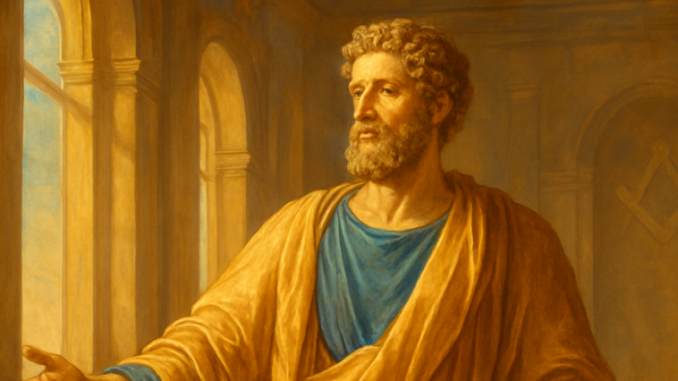
What does it mean to see yourself as a speck of dust in an infinite universe — and yet believe that this speck truly matters? This is the paradox Marcus Aurelius explores in Book X of his Meditations. The Roman emperor-philosopher invites us to adopt a cosmic perspective, not to make us feel insignificant, but to help us understand our true place in the grand scheme of things. The philosophical roots of this way of thinking reach deep into antiquity and continue to resonate in traditions that seek meaning through contemplation — including Freemasonry.
The Stoic Foundation: Logos and Natural Law
The cosmic perspective of Marcus Aurelius is inseparable from the Stoic philosophy that originated in Athens three centuries before his birth. Zeno of Citium, the founder of the Stoic school, introduced the concept of logos — the ordering force that permeates the entire universe. For the Stoics, the cosmos was not a chaotic tangle of random events but a living organism governed by a rational principle.
Marcus Aurelius inherited this worldview and refined it through his private reflections. Throughout Book X, he returns again and again to the idea that everything in existence is part of one coherent whole. The individual human being is like a single thread in an infinite tapestry — seemingly insignificant on its own, yet indispensable to the integrity of the entire pattern. This idea carries a powerful lesson: our significance lies not in our individual grandeur, but in our relationship to the whole.
Heraclitus and the River of Change
Behind Stoicism lies the even older wisdom of Heraclitus of Ephesus. This pre-Socratic thinker formulated the famous insight that everything flows — panta rhei. Marcus Aurelius refers to this principle repeatedly: nothing lasts, everything changes, and it is precisely our attachment to earthly things that becomes a source of suffering.
The cosmic perspective offers consolation here. When we realize that even the greatest empires crumble and the mightiest emperors are forgotten, we can place our own worries in proper proportion. Heraclitus taught that fire was the primordial element — a symbol for the eternal transformation that characterizes the universe. This motif of fire would reappear centuries later in mystical and ritual traditions that place the renewal of the individual through insight at their very center. For those familiar with Masonic symbolism, the theme of transformation through inner light needs no further explanation.
Epictetus: The Teacher at a Distance
Although Marcus Aurelius never studied under Epictetus in person, the influence of this former slave on his thinking was immense. Through lecture notes recorded by Epictetus’s students, the young Marcus learned the fundamental Stoic distinction between what is within our power and what is not.
This distinction is crucial to the cosmic perspective. The external world — including the movements of the stars and the fate of nations — lies beyond our control. What is within our power is our attitude toward these events. Epictetus articulated this with a clarity that Marcus Aurelius wove into his own daily meditations. In Book X, we see the emperor wrestling with the tension between his imperial responsibilities and his philosophical longing for inner peace.
The cosmic perspective does not teach us that we are insignificant. It teaches us that our smallness frees us from the illusion of omnipotence — a lesson that resonates deeply with anyone engaged in the lifelong work of self-improvement.
Seneca and the Practice of Philosophy
Alongside Epictetus, Seneca formed another vital link in the Stoic tradition that shaped Marcus Aurelius. Where Epictetus laid out the theory, Seneca demonstrated how philosophy could be practiced in daily life. His letters to Lucilius reflect a constant effort to make wisdom practical and applicable.
Seneca wrote about death, friendship, and adversity — always with the cosmic perspective as his backdrop. He described the human being as a citizen of two cities: the city in which he happens to have been born, and the cosmopolis — the universal city of all rational beings. Marcus Aurelius adopted this cosmopolitanism and made it a cornerstone of his own thought. This idea of dual citizenship — local and universal — has echoed through centuries of philosophical and fraternal traditions that seek to connect the individual with something far greater than himself.
The Universe as Temple
The Stoic conception of the cosmos as a unified whole permeated by logos bears remarkable parallels with traditions that view the universe as a sacred space. When Marcus Aurelius meditates on the starry sky and his own place within it, he approaches a form of contemplation that would later be formalized in ritual practice.
The temple as a symbol of the ordered universe, the celestial vault as a canopy above the seeking individual — these images connect ancient philosophy with later traditions of inner building and spiritual architecture. The idea that the human being is himself a temple that must be built and maintained finds its philosophical forerunner in precisely these Stoic reflections. Freemasons will recognize this motif immediately: the symbolic construction of the inner temple is central to the Craft, and its roots run far deeper than many realize.
A Legacy for Later Traditions
The cosmic perspective of Marcus Aurelius did not remain confined to antiquity. Renaissance humanists rediscovered the Meditations and saw in the Roman emperor a model of enlightened leadership combined with philosophical depth. Montaigne, who wrote extensively about self-knowledge and human limitation, found in the Stoics kindred spirits for his own essays on the human condition.
The core insight — that we must know our place in a greater whole without thereby losing our sense of personal worth — has continued to resonate in every tradition that links personal development with cosmic awareness. Freemasonry, with its emphasis on moral architecture and the place of the individual Brother within a chain of generations, can rightly be seen as an heir to this philosophical heritage. The working tools, the allegories of building, and the contemplation of one’s role within the Lodge and beyond all echo the Stoic call to see oneself as part of something larger.
The paradox we began with — the speck of dust that matters — turns out to be not a contradiction at all, but an invitation. The cosmic perspective diminishes our problems while simultaneously enlarging our sense of responsibility. Precisely because we are part of a greater whole, our choices and our character contribute to that whole in ways we may never fully see. Marcus Aurelius wrote his Meditations not for publication but as a personal exercise in exactly this kind of wisdom. That we can still read them nearly two thousand years later — and still find ourselves challenged by them — is perhaps the most powerful testament to the enduring truth of the cosmic perspective.
Copyright text & image: devrijmetselaar.nl
Texts are based on the ideas and content of the author of devrijmetselaar.nl, reviewed, corrected, and supplemented with the assistance of OpenAI. Images are created based on the ideas of the author of devrijmetselaar.nl using OpenAI/DALL-E.

Be the first to comment