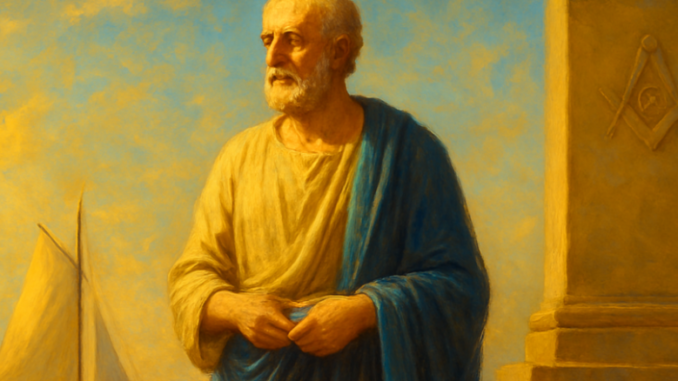
Perhaps you know the moment: you walk down a familiar street and suddenly notice how old the trees have become. Or you meet a friend you haven’t seen in years and realize just how much time has passed. Lucius Annaeus Seneca described exactly such a moment in his twelfth letter to Lucilius. He visited his country estate and found crumbling walls, neglected trees, and an old gardener he barely recognized. What followed was not a lament about the passage of time, but a profound meditation on what truly connects us — to others, to time, and to ourselves. For those familiar with Freemasonry, this ancient letter resonates in a remarkably powerful way.
The Mirror of Time
Seneca opens his letter with a confrontation. The gardener Felicio, whom he had known as a child, now stands before him as an old man. For a moment, Seneca wants to protest — surely this cannot be the same boy? But then he turns his gaze inward. The aging of another becomes a mirror reflecting his own mortality. Rather than avoiding this realization, Seneca embraces it. He writes to Lucilius that every phase of life carries its own gifts, provided you are willing to look.
This attitude of honest self-reflection sits at the heart of Freemasonry. From the very first degree, the Entered Apprentice is invited to examine himself — not to judge, but to understand. Just as Seneca sees aging not as an enemy but as a teacher, the Freemason regards every stage of life as an opportunity for inner growth. The rough ashlar is not perfected in a single day; it requires time, patience, and the willingness to look at yourself with unflinching honesty.
Connection Beyond the Surface
What stands out in Letter XII is how Seneca uses the physical signs of decay to reveal a deeper truth. The plane trees he once planted himself are now gnarled and bare. The walls are crumbling. But instead of giving in to nostalgia or regret, Seneca searches for what endures. The essence of his bond with the estate, with the people who worked there, with his own memories, does not depend on outward beauty.
True connection does not arise despite impermanence — it becomes meaningful precisely because we face impermanence together.
Within Freemasonry, this awareness plays a central role. Brethren meet one another not as masks or titles, but as fellow travelers on the same journey. The Brotherhood is not a superficial network; it is a community rooted in the shared understanding that we are all mortal, all seeking, all in the process of becoming. It is this collective awareness of finitude that makes Masonic bonds so deeply meaningful.
The Art of Letting Go
Seneca’s letter also contains a powerful lesson on letting go. He does not mourn what has been lost. Instead, he asks: what have I learned? What do I carry with me? The Stoic wisdom he articulates here aligns seamlessly with the Masonic ideal of the search for truth. Truth is not static; it unfolds as we grow older, as we dare to release what no longer serves us.
This letting go is not resignation — it is an active choice. You release old beliefs that stand in the way of your growth. You part with illusions of immortality or permanence. And in that very process, space opens up for something new: deeper insight, stronger bonds, and a clearer vision of what truly matters.
Every Day as a Complete Life
One of the most frequently quoted passages from Letter XII is Seneca’s assertion that we should live each day as though it were a complete life. This is not a call to haste or anxiety, but to fullness. Live this day with attention. Be present with the people around you. Leave nothing undone out of fear of tomorrow.
For the Freemason, this is a deeply familiar idea. The lodge is a space where the outside world falls silent. There is no rush, no distraction — only a shared focus on what truly matters. That concentration on the present moment, on the ritual act, on the words spoken, reflects exactly what Seneca means. It is a practice of presence, a discipline of attention that transforms the ordinary into something sacred.
Virtue as a Compass
Seneca closes his letter with a call to live virtuously. Not because virtue is rewarded, but because virtue is its own reward. A life well lived need not be long to be complete. This thought speaks directly to the Masonic ideal of moral perfection — not as an unattainable endpoint, but as a direction. The square and compasses are not symbols of perfection already achieved; they represent the ongoing effort to live uprightly and justly.
The parallels between Stoic philosophy and Masonic teaching become especially clear when we consider their shared values:
- Self-reflection: the willingness to examine yourself honestly
- Brotherhood: connection that goes deeper than appearances or status
- Virtue: not a destination, but a daily practice
- Letting go: making room for growth by surrendering old illusions
An Invitation to Connect
Perhaps you are reading these words at a moment when you find yourself reflecting on time — on what has passed and what still lies ahead. Seneca’s letter invites you not to avoid those thoughts, but to welcome them. Aging is not an enemy; it is a teacher that reminds us of what truly matters. And what matters, as both the Stoics and the Freemasons understood, is not what we possess or achieve, but how we relate to the people around us and to ourselves.
Seneca’s Letter XII is far more than a philosophical musing on growing old. It is an invitation to take seriously the bonds that connect us — precisely because they are temporary. Freemasonry extends a remarkably similar invitation: seek not what divides, but what unites. Do not look away from impermanence, but let it teach you what is truly of value. In this shared attitude — that of the Stoic philosopher and the seeking Brother alike — lies a timeless wisdom that speaks as clearly today as it did two thousand years ago.
Copyright text & image: devrijmetselaar.nl
Texts are based on the ideas and content of the author of devrijmetselaar.nl, reviewed, corrected, and supplemented with the assistance of OpenAI. Images are created based on the ideas of the author of devrijmetselaar.nl using OpenAI/DALL-E.
Frequently Asked Questions
How does Seneca's letter relate to Freemasonry?
Seneca's twelfth letter to Lucilius resonates with Freemasonry because both emphasize honest self-reflection and personal growth through life's stages. Just as Seneca uses the aging he observes as a mirror for his own mortality, Freemasonry invites members from the first degree to examine themselves without judgment. Both traditions regard each phase of life as an opportunity for inner development rather than decline.
What is the main theme of Seneca's Letter XII?
The main theme is a meditation on mortality, aging, and what truly connects us to others and ourselves. When Seneca visits his country estate and finds it decayed, along with the aging of his old gardener Felicio, he doesn't lament the passage of time. Instead, he reflects on how genuine connection transcends physical appearance and impermanence, and that every life stage carries its own gifts.
What does Freemasonry teach about impermanence and connection?
Freemasonry teaches that true connection becomes meaningful precisely because Brethren face impermanence together. Rather than being superficial, the Brotherhood is rooted in shared understanding that all members are mortal, all seeking, and all in a process of becoming. This awareness parallels Seneca's insight that lasting bonds depend not on outward beauty or permanence, but on deeper essence and mutual recognition.


Be the first to comment