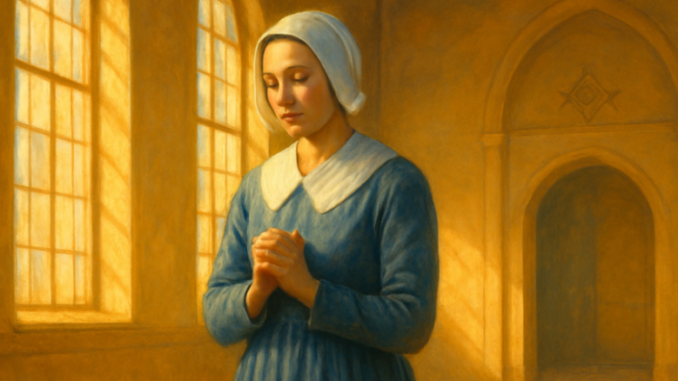
In the middle of the seventeenth century, as England was torn apart by religious disputes and political turmoil, a movement emerged that dared to think radically differently about spirituality. The Quakers — formally known as the Religious Society of Friends — developed a set of core principles that continue to guide their practice to this day. These five testimonies not only form the heart of the Quaker tradition but also reveal a surprising kinship with the spiritual quest that defines Freemasonry.
The Quaker World: The Inner Light as Compass
For the Quaker, all spirituality begins with what they call the Inner Light. George Fox, who founded the movement during the 1640s and 1650s, taught that every human being has direct access to the divine — without the mediation of priests or prescribed rituals. This was a revolutionary idea at a time when the Church of England and various Puritan factions were battling for the soul of the nation. Fox and his followers were frequently imprisoned for their convictions, yet they refused to be deterred.
From this emphasis on the Inner Light, five core testimonies gradually emerged: simplicity, peace, integrity, community, and equality. The word testimony is crucial here. These are not abstract dogmas but principles that must be embodied through one’s own life. A Quaker does not testify to simplicity by preaching about it but by living simply. This practical spirituality developed organically during the movement’s first decades and was only explicitly articulated later.
The Masonic World: Virtue as Building Stone
Place these Quaker testimonies alongside the core values of Freemasonry and striking parallels appear. The Freemason, too, strives for personal refinement through the concrete practice of virtue. The rough ashlar does not become smooth through philosophizing alone — it requires the actual work of the mallet and chisel. Both traditions share the conviction that spiritual growth must translate into daily action.
Yet there are fundamental differences in approach. Where the Quaker keeps ritual to a minimum and gathers in silence to let the Inner Light speak, Freemasonry embraces a rich ceremonial life. The lodge provides a structured framework for contemplation, while the Quaker meeting deliberately resists all imposed structure. This difference in form, however, conceals a shared core: both traditions recognize that true spirituality lies beyond words.
Historical Roots of the Five Testimonies
The five testimonies as we know them today were not codified by George Fox himself. They crystallized over the first century of the Quaker movement. The peace testimony, for example, gained particular urgency during the English Civil War and the subsequent Restoration period. Early Quakers refused to bear arms and articulated their conviction in the Peace Declaration of 1661, addressed to King Charles II.
Margaret Fell, often called the “Mother of Quakerism,” played a key role in formulating and spreading these principles. Her home, Swarthmoor Hall, became a center of the movement, and her writings contributed to the theological foundation of the testimonies. William Penn, later the founder of Pennsylvania, translated Quaker ideals into a political experiment in which freedom of conscience and equality stood at the center.
The five testimonies are not rules to follow but directions in which to live, where the inner compass matters more than any external prescription.
What Both Traditions Share: Life as Testimony
When we place the Quaker testimonies and Masonic principles side by side, it becomes clear that neither tradition treats spirituality as a Sunday affair. The Quaker testimony of integrity resonates with Freemasonry’s emphasis on honesty and trustworthiness. The testimony of community mirrors the Masonic ideal of brotherhood that transcends all social distinctions and backgrounds.
Simplicity: Both Quakers and Freemasons warn against the trap of outward show.
Peace: Both traditions emphasize harmony as a condition for inner and outer progress.
Integrity: One’s word must align with one’s deed.
Community: The individual quest unfolds within a supportive fellowship.
Equality: Every person carries the same potential for spiritual growth.
Lessons for the Modern Seeker
The historical context of the five testimonies teaches us that spiritual principles do not appear out of thin air. They grow from the concrete experiences of people wrestling with the questions of their age. George Fox sought answers in a world of religious conflict and found them in the stillness of the Inner Light. The early Freemasons of the eighteenth century — contemporaries of later Quaker generations — likewise searched for a spirituality that rose above sectarian strife.
Both traditions offer today’s seeker an alternative to rigid dogmatism on one hand and uncommitted relativism on the other. The five testimonies are not without obligation, yet neither are they oppressive. They invite continuous self-reflection, an ongoing accountability to one’s own inner compass. This is a spirituality that does not ask what you believe but how you live.
The five Quaker testimonies and Freemasonry’s teaching of virtue may differ in form, but in essence they touch the same human need: the search for a coherent life in which conviction and action are one. Anyone who studies the background of the Quaker testimonies discovers a tradition that, much like Freemasonry, invites us to become architects of our own inner life — not through grand declarations, but through quiet deeds.
Copyright text & image: devrijmetselaar.nl
Texts are based on the ideas and content of the author of devrijmetselaar.nl, reviewed, corrected, and supplemented with the assistance of OpenAI. Images are created based on the ideas of the author of devrijmetselaar.nl using OpenAI/DALL-E.

Be the first to comment