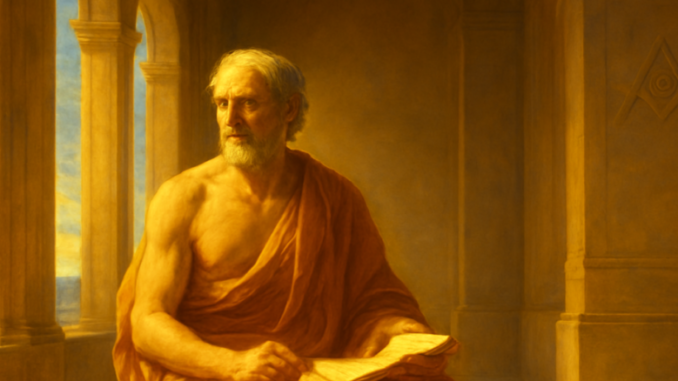
There is a chair in the corner of a room. Sometimes that chair is a sanctuary — a place where thoughts settle and the soul finds restoration. At other times, the very same chair becomes a prison, a symbol of isolation that suffocates the spirit. In his fifty-fifth letter to Lucilius, the Stoic philosopher Lucius Annaeus Seneca explored precisely this tension: the delicate balance between solitude and companionship. For Freemasons — who know both the silence of personal contemplation and the warmth of brotherly connection — this ancient letter opens a window onto timeless wisdom.
The Chair as a Mirror of the Soul
In Letter LV, Seneca describes his visit to the villa of Vatia, a man who had completely withdrawn from public life. The Roman philosopher observes how Vatia’s seclusion did not lead to wisdom but to a kind of living death. The villa, beautifully situated on the Bay of Naples though it was, became a tomb for a man who was running away rather than seeking something higher. Here lies the first lesson: solitude in itself is neither good nor bad. It is the intention behind it that determines whether it bears fruit.
The chair in the corner can take on two forms. When someone retreats to reflect — to work the rough stone of their character — that chair becomes a workshop. But when someone flees from responsibility, from human connection, from the challenges that life demands, the same chair becomes a hiding place for cowardice. Seneca makes this distinction crystal clear: it is not the absence of people that makes a person wise, but the presence of purpose.
The Temple of Silence and the Lodge of Connection
Freemasonry understands the importance of both worlds. The Chamber of Reflection, where a candidate is left alone with his thoughts before initiation, symbolizes the necessity of turning inward. There, in that darkness and silence, the candidate is invited to confront himself — to consider who he was, who he is, and who he wishes to become. This ritual moment of solitude is not a punishment. It is a gift.
At the same time, Freemasonry is above all a brotherhood built on connection. The lodge is a space where men come together not despite their differences but precisely because of a shared desire for growth and truth. The chain that brothers form when they stand hand in hand powerfully illustrates this principle: no one stands alone, yet each carries his own responsibility. Seneca would recognize this as the golden mean he so often championed.
True wisdom does not arise in complete isolation, nor in constant company, but in the ability to consciously choose when to withdraw and when to connect.
The Anchor and the Sail
Seneca frequently used metaphors of the sea in his letters. Let us extend this imagery with two symbols that illuminate the tension between solitude and fellowship: the anchor and the sail. The anchor represents those moments when we come to a standstill, grounding ourselves in reflection and rest. Without this anchor, we would drift endlessly, tossed about by every wind that blows and every impulse that strikes us.
But a ship that remains permanently at anchor loses its destination. The sail is needed to move forward, to reach new harbors, to engage with the world. In Masonic terms, one might say that the anchor symbolizes the inner work done in the Chamber of Reflection, while the sail represents the brotherly labor in the lodge and our actions in the wider world. Both are indispensable for the journey toward light and knowledge.
The Quality of Company
Seneca does not only warn Lucilius about the pitfalls of solitude — he also cautions against the dangers of poor company. What matters is not how many people surround us, but who those people are and what they awaken within us. Company can elevate or diminish, drawing us closer to our better nature or dragging us toward indifference and superficiality.
Freemasonry has embedded this principle deeply in its very fabric. The careful selection of new members, the emphasis on character over status, the ongoing pursuit of moral refinement within the brotherhood — all of this speaks to the understanding that community is only valuable when it is founded on shared values. The Craft seeks brothers who, as Seneca would put it, are not merely present but who actively contribute to each other’s growth.
Back to the Chair
The chair in the corner waits patiently. It does not judge; it merely invites. The question that Seneca poses — and that Freemasonry echoes in its own way — is this: with what intention do we take our seat? Are we fleeing from the world, or are we turning inward temporarily so that we may return stronger and wiser? Do we seek company to numb ourselves, or to see ourselves more clearly reflected in the mirror of another?
The symbols speak their own language. The chair, the anchor, the sail, the chain of hands, the dark chamber and the illuminated lodge — together they form a map of human existence. Seneca and Freemasonry offer us the same compass. Neither solitude itself nor fellowship itself, but the conscious alternation between the two leads to a fulfilled life.
As the day draws to a close and the quiet of evening settles in, we may ask ourselves where we stand in this eternal interplay. Seneca’s letter to Lucilius is not an instruction manual — it is an invitation. Freemasonry is not an answer — it is a path. Both point toward the same truth: the art of living lies not in choosing between solitude and company, but in knowing when each one serves us best. In that wisdom — found in silence and shared among brothers — lies the truest connection of all.
Copyright text & image: devrijmetselaar.nl
Texts are based on the ideas and content of the author of devrijmetselaar.nl, reviewed, corrected, and supplemented with the assistance of OpenAI. Images are created based on the ideas of the author of devrijmetselaar.nl using OpenAI/DALL-E.


Be the first to comment