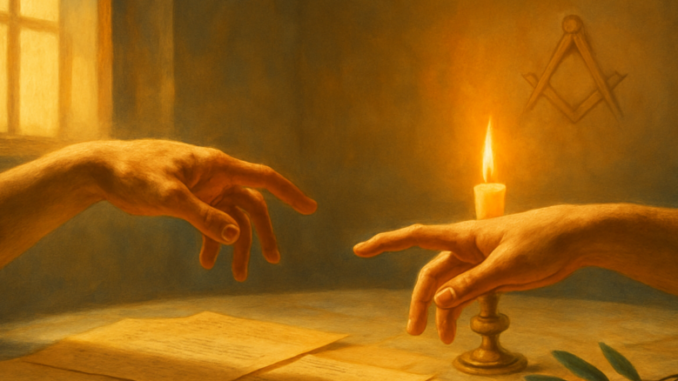
When a politician calls for dialogue instead of confrontation, something fundamental is at stake. A recent appeal by a Dutch official to pursue conversation rather than retaliation over sanctions against the International Criminal Court raises questions that reach far beyond diplomacy. What kind of character does it take to extend a hand when tensions are running high? And what can Freemasonry teach us about shaping that character in times of conflict?
Why Do Some Choose Dialogue Where Others Choose Confrontation?
This may be the central question when we look at international tensions. It seems easy enough to answer sanctions with counter-sanctions, to build walls where bridges are needed. Yet there are always those who seek a different path — not out of weakness, but from a deep understanding that lasting solutions only emerge when opposing parties truly meet.
In Freemasonry, we call this working on the rough stone. Every person enters the lodge as unworked material, full of sharp edges and unpolished corners. The art lies in shaping yourself into someone who doesn’t react from impulse but from considered virtue. That requires a personality trained in patience, a willingness to listen, and the ability to look beyond first impressions and snap judgments.
What Do Freemasons Mean by Character Formation?
Character formation stands at the heart of Masonic work. Unlike a personal development course, this isn’t about quick results or measurable targets. It is a lifelong process in which the Mason continually looks in the mirror and asks: Am I acting according to my highest principles? Am I the person I aspire to be?
Aristotle wrote that virtue is not a state but an activity. You are not courageous simply because you call yourself so, but because you make courageous choices in concrete situations. The same applies to the willingness to engage in dialogue — it is not an abstract ideal but a daily practice. The philosopher Immanuel Kant added that we must never treat others merely as a means, but always also as an end in themselves. This principle permeates Freemasonry: every Brother, every human being, deserves to be heard.
True strength of character reveals itself not in winning conflicts, but in the ability to build bridges where others see only walls.
Is Dialogue a Sign of Weakness?
This is a common misconception. In our age of social media and rapid judgments, steadfastness often seems synonymous with intransigence. Those who extend a hand are sometimes viewed as people who capitulate. Nothing could be further from the truth.
Marcus Aurelius, the Stoic emperor who also serves as a source of Masonic inspiration, wrote in his Meditations that we should not expect others to behave as we wish, but that we can govern our own actions. Seeking dialogue from a position of inner strength is fundamentally different from yielding out of fear. It demands a personality that is sturdy enough to endure criticism, flexible enough to change position when arguments warrant it, and wise enough to know when speaking is more productive than silence.
How Does the Lodge Shape Such Personalities?
The Masonic lodge is a training ground par excellence for difficult conversations. During ritual work, Brethren come together who might find themselves on opposite sides in daily life. Here they learn that differences of opinion need not lead to enmity — that you can respect someone without agreeing with them.
This doesn’t happen through rules or directives, but through experience. By working together year after year on the building of the temple, by listening to the stories of others, by testing your own convictions against the light of new insights. The French philosopher Montaigne called conversation the most fruitful exercise of the mind. In the lodge, that exercise is given ritual form.
What Can We Learn from This for Our Current Times?
The call for dialogue in international affairs is more than a diplomatic instrument. It is an invitation to reflect on what kind of character we want to cultivate — as individuals and as a society. Do we choose the easy path of hardening our positions, or do we invest in the slow, painstaking work of mutual understanding?
Freemasonry does not offer ready-made answers to geopolitical problems. What it does offer is a methodology for personal development that is directly relevant to how we relate to conflict and difference. A few core principles stand out:
- Listen before you judge.
- Seek common ground before emphasizing differences.
- Work on yourself before trying to change others.
- See strength in vulnerability, not in rigidity.
Johann Wolfgang von Goethe, himself a Freemason, wrote that character is formed in the stream of the world. Not in isolation, but in daily encounters with those who think differently, we learn who we truly are. The current debate over international sanctions and the call for conversation reminds us that personality is not a fixed quality but something we continually shape through our choices.
The question of whether dialogue is worthwhile in times of tension is ultimately a question about who we want to be. Freemasonry teaches that character formation is a lifelong craft, in which every encounter offers an opportunity to further polish our rough stone. In a world that clamors for quick judgments and hardline positions, the invitation to conversation remains an act of courage — not the courage of the warrior, but the courage of the builder who knows that temples are not raised in a single day.
Copyright text & image: devrijmetselaar.nl
Texts are based on the ideas and content of the author of devrijmetselaar.nl, reviewed, corrected, and supplemented with the assistance of OpenAI. Images are created based on the ideas of the author of devrijmetselaar.nl using OpenAI/DALL-E.



Be the first to comment