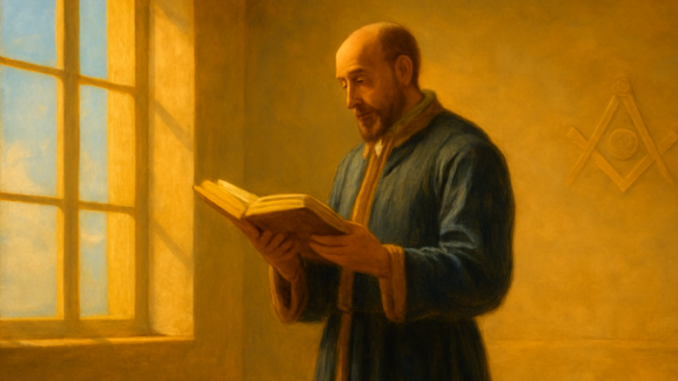
Can someone who claims to know nothing for certain still serve as a reliable guide through the world of reading? It is precisely this paradox that makes Michel de Montaigne, in his essay ‘On Books,’ one of the most fascinating thinkers ever to reflect on the written word. His confession of uncertainty is not a weakness — it is a method, rooted in ancient philosophical traditions that still resonate today in the way Freemasons approach knowledge: not as a destination, but as a perpetual quest.
Ignorance as a Philosophical Starting Point
Michel de Montaigne opens his essay ‘On Books’ with disarming honesty. He warns the reader that his judgments are personal, fallible, and that he reserves the right to change his mind at any time. This is not false modesty. It is the practical application of a philosophical attitude stretching back to Greek antiquity: Pyrrhonian skepticism, named after Pyrrho of Elis. This school of thought held that true knowledge is unattainable and that the wise person is better served by suspending judgment than by making dogmatic claims. Through the writings of Sextus Empiricus, Montaigne gained access to this tradition and made it the foundation of his entire method of thinking.
But where Pyrrho leaned toward a complete suspension of judgment, Montaigne goes a step further. He does judge — and with relish — but always attaches the caveat that he might be wrong. This nuance makes him not a skeptic in the modern, cynical sense, but rather an intellectual adventurer exploring the boundaries of his own knowledge. Within Freemasonry, we recognize a kindred attitude: the Craft does not demand dogmatic answers but asks for the willingness to continually question and improve oneself.
Seneca and Plutarch: Two Ancient Masters
In ‘On Books,’ Montaigne explicitly names the two authors who shaped his thinking more than any others: Seneca and Plutarch. These are not random preferences. Seneca, the great Roman Stoic, offered Montaigne a philosophy of inner resilience. The Stoic teaching that a person should focus on what lies within their own power, and bear the blows of fortune with equanimity, reverberates throughout Montaigne’s entire approach to reading. For him, books are not decoration or status symbols — they are tools for the soul, instruments for making life more bearable and comprehensible.
Plutarch represents a different kind of influence. Where Seneca is the moral teacher, Plutarch is the storyteller, the painter of human character. His ‘Lives’ and ‘Moralia’ gave Montaigne an inexhaustible supply of concrete examples of human conduct. Montaigne loves the anecdotal, the specific, the tangible. Abstract philosophical systems he gladly leaves to others. This preference for lived experience over theoretical constructs is characteristic of the Renaissance humanism in which Montaigne was rooted.
Renaissance Humanism as Fertile Ground
Montaigne wrote during an era when the rediscovery of classical texts was fundamentally transforming European thought. Renaissance humanism, with forerunners such as Francesco Petrarch and Desiderius Erasmus, placed the individual and their intellectual formation back at the center of philosophical inquiry. The studia humanitatis — the program of grammar, rhetoric, poetry, history, and moral philosophy — formed the intellectual framework in which Montaigne was raised. His father, Pierre Eyquem de Montaigne, had him speaking Latin before French, a pedagogical experiment born directly out of humanist ideals.
Yet Montaigne went further than many of his humanist contemporaries. Where they often approached the classics with reverence and imitation, Montaigne read them as an equal. He dared to call Cicero dull and openly confessed that he couldn’t get through some celebrated works. That candor was revolutionary. It implied that the reader is just as important as the writer — that the value of a book lies not in its reputation but in what it does to the person who reads it.
Montaigne did not read to obey the ancients; he read to know himself more sharply. In this, he anticipates the Masonic ideal: know thyself — not through blind imitation, but through honest inquiry.
The Limits of Skepticism: A Necessary Counterpoint
There is a tension in Montaigne’s position that should not be overlooked. If he truly knows nothing for certain, why should the reader pay attention to his judgments? And if all judgments are provisional, doesn’t that undermine every form of intellectual authority? Later thinkers, notably René Descartes, saw this problem clearly. Descartes’ methodical doubt was partly a response to the kind of skepticism Montaigne practiced: where Montaigne embraced doubt as a permanent state, Descartes sought a way out — an indubitable foundation upon which certain knowledge could be built.
Montaigne would likely have considered that ambition presumptuous. For him, doubt is not a problem to be solved but an attitude that keeps thinking alive. In Freemasonry, we find a similar balance. The Lodge offers no dogma, no catechism of absolute truths, but a space in which Brethren can pose questions together — a space in which the process of seeking is at least as valuable as the finding.
Three Philosophical Pillars Beneath the Essay
Montaigne’s essay ‘On Books’ rests on three interconnected philosophical pillars, each of which contributes something essential to his approach to reading and self-knowledge.
Pyrrhonian Skepticism: The suspension of judgment as a method to come closer to truth — or at least closer to honesty. By refusing to claim certainty, Montaigne opens a space for genuine exploration rather than mere confirmation of what he already believes.
Stoicism (via Seneca): Books as moral exercise, as tools for a well-lived life. Reading, in the Stoic sense Montaigne embraces, is not idle entertainment but a form of spiritual discipline, a way to strengthen the soul against the unpredictability of fortune.
Renaissance Humanism (via Erasmus and Petrarch): The classical texts as living conversation partners, not untouchable authorities. Montaigne’s willingness to argue with the ancients, to find them wanting, and to admit his own limitations transforms reading from passive reception into active dialogue.
Reading as Inner Work
What unites these three philosophical currents in Montaigne’s essay is a vision of reading as a form of inner labor. Books are not consumed; they are worked with. Each page is an opportunity not merely to absorb information, but to test oneself — one’s assumptions, one’s patience, one’s capacity for honesty. This is remarkably close to the Masonic understanding of self-improvement: the rough ashlar is not shaped by passive observation but by deliberate, sustained effort.
Montaigne’s library, housed in a tower room of his château, was his temple of reflection. There, surrounded by inscriptions of classical quotations on the ceiling beams, he conducted the work that every Freemason would recognize: the careful, often uncomfortable labor of turning inward, of questioning what one thinks one knows, and of striving — always striving — toward a better version of the self.
His essay ‘On Books’ is not simply a list of literary preferences. It is a philosophical manifesto disguised as casual conversation — a demonstration that honest reading, honest doubt, and honest self-examination are inseparable. For anyone walking the Masonic path, Montaigne remains an indispensable companion: not because he provides answers, but because he teaches us to ask better questions.
Montaigne’s enduring relevance lies in his refusal to pretend he has all the answers. In ‘On Books,’ he shows us that true intellectual courage is not found in certainty but in the willingness to remain uncertain — to keep reading, keep questioning, keep refining. This is the same spirit that animates the Masonic journey: a commitment to inner work that never claims to be complete. In a world that too often rewards dogmatic conviction, Montaigne’s gentle skepticism and his love of honest inquiry offer both Freemasons and thoughtful readers a timeless model for the life of the mind.
Copyright text & image: devrijmetselaar.nl
Texts are based on the ideas and content of the author of devrijmetselaar.nl, reviewed, corrected, and supplemented with the assistance of OpenAI. Images are created based on the ideas of the author of devrijmetselaar.nl using OpenAI/DALL-E.

Be the first to comment