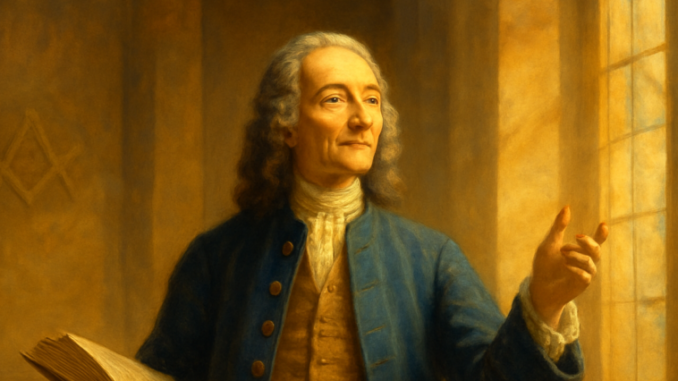
A candle in the darkness. So simple, so ordinary, and yet so laden with meaning. For Voltaire, the idea of God was exactly like that — a light that human reason needed in order to perceive, but which itself remained elusive. In his celebrated Philosophical Dictionary of 1764, he penned one of his most thoughtful essays on the concept of God. The philosophical roots of that essay, however, reach far deeper than the eighteenth century alone.
The Legacy of English Empiricism
Voltaire’s thinking about God is unimaginable without the influence of John Locke. During his exile in England from 1726 to 1728, Voltaire encountered Locke’s Essay Concerning Human Understanding. Locke argued that all knowledge arises from sensory experience and reflection. This had far-reaching consequences for any theology: if we cannot perceive God directly, how can we claim to know anything about Him?
Voltaire took this question seriously, yet he also departed from Locke in important ways. While Locke still allowed room for a rational proof of God’s existence, Voltaire grew more skeptical about the reach of human reason. Yet unlike the radical atheists of his day, he held firm to the existence of an ordering force in the universe. A clock presupposes a clockmaker, he reasoned. This argument from design — tracing back to the ancient Greek Stoics — runs like a thread throughout his essay On God.
Spinoza: The Uncomfortable Interlocutor
Baruch de Spinoza died nearly a century before Voltaire’s essay appeared, but his shadow falls unmistakably across it. Spinoza’s pantheism — the view that God and Nature are one and the same — was often equated with atheism in Voltaire’s time. Voltaire rejected that equation, but he could not ignore the rigor of Spinoza’s reasoning. In his own words: if everything is God, the word becomes meaningless.
Yet Voltaire shared with Spinoza a deep aversion to anthropomorphic images of God. Voltaire’s God is no bearded patriarch on a throne, but an abstract principle of order and intelligence. Here we also hear the echo of Leibniz, whose theodicy Voltaire would later so savagely parody in Candide. The question of God’s justice in the face of human suffering never let him go.
The Stoic Foundation
Deeper than the influence of his philosophical contemporaries, the roots of Voltaire’s thinking about God lie in ancient Stoicism. Philosophers such as Marcus Aurelius and Seneca regarded the universe as permeated by a divine logos — a cosmic reason that orders all things. This providence was not supernatural but immanent within reality itself.
Voltaire’s God is not a listening father, but an architectural principle: the Grand Architect of a rationally ordered universe.
Voltaire read the Stoics with eagerness and admiration. Their ethics of self-mastery and their trust in cosmic order resonated deeply with him. In On God, he channels this heritage by presenting God as the guarantor of natural law — not as an intervening power who performs miracles.
The Masonic Dimension: Symbol of the Grand Architect
Voltaire’s vision of God resonates remarkably with the Masonic thought of his era. While Voltaire’s own membership in Freemasonry is historically documented — he was initiated into the Lodge of the Nine Sisters in Paris in 1778 — what matters here is something more fundamental: the conceptual kinship. Freemasonry speaks of the Grand Architect of the Universe, a symbol deliberately kept open so as to unite brethren of different religious backgrounds.
This symbol functions like a candle in the lodge: it illuminates without scorching. It leaves room for personal interpretation, from deistic abstraction to theistic devotion. Voltaire’s God fits seamlessly into this framework. He is not an object of dogmatic dispute, but a principle that makes the human search for truth possible.
The Skepticism of Pierre Bayle
Another crucial influence on Voltaire was Pierre Bayle, whose Dictionnaire historique et critique of 1697 served as a model for Voltaire’s own Philosophical Dictionary. Bayle demonstrated how critical thinking could unmask religious prejudices without necessarily leading to atheism. Voltaire eagerly adopted his method of incisive analysis and historical comparison.
Bayle showed that many images of God were cultural constructions rather than eternal truths. This freed Voltaire to formulate his own purified conception of God. God as a working hypothesis, as we might put it in modern terms: necessary for moral order, but impossible to capture in confessional formulas.
Symbolic Depth: The Invisible Behind the Visible
Voltaire’s essay On God is ultimately an exercise in symbolic thinking. For him, the question of God’s existence is not a matter of logical proof but of existential orientation. Just as the Freemason sees in the square and compasses not merely tools but principles of measure and harmony, Voltaire saw in the concept of God a symbol for the human need for meaning and coherence.
Locke brought him the question of what can be known. Spinoza confronted him with the limits of language. The Stoics gave him a cosmic framework. Bayle taught him the art of critical discernment. Together, these influences formed the soil from which Voltaire’s deism blossomed — not as a rigid system, but as an attitude. An attitude of wonder at the existing world, combined with a refusal to let that wonder harden into dogma.
Voltaire’s essay On God is not a final destination but an invitation. It asks us to look beyond the word “God” to what is meant by it, and beyond that meaning to what we ourselves are seeking. Just as a candle flame both illuminates and obscures what lies behind it, Voltaire’s concept of God functions as a symbol of our own limits and possibilities. For Freemasons, this may feel deeply familiar: the Grand Architect of the Universe is, after all, also a mirror in which every brother sees his own search reflected.
Copyright text & image: devrijmetselaar.nl
Texts are based on the ideas and content of the author of devrijmetselaar.nl, reviewed, corrected, and supplemented with the assistance of OpenAI. Images are created based on the ideas of the author of devrijmetselaar.nl using OpenAI/DALL-E.

Be the first to comment