When the eighteenth-century thinker François-Marie Arouet — better known as Voltaire — picked up his pen to write about God, he did so with the precision of a surgeon and the wonder of a child. His entry “On God” in the 1764 Philosophical Dictionary remains one of the most influential texts ever written on the relationship between reason and faith. For Freemasons, who place the Great Architect of the Universe at the center of their philosophy without prescribing any specific religion, Voltaire’s approach offers remarkably familiar ground.
The Core Idea: God as Watchmaker
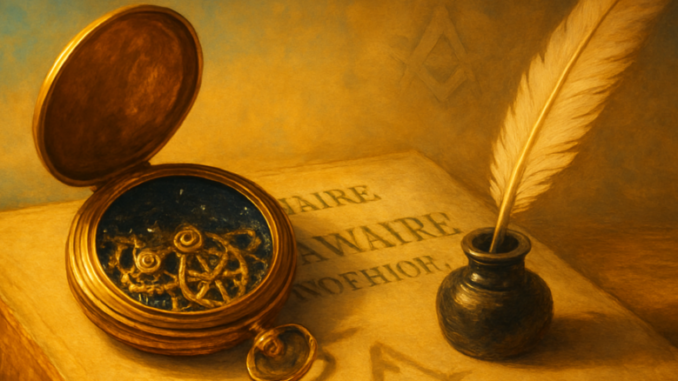
Voltaire opens his reflection with a question that has echoed through the centuries: can we know anything about God with certainty? His answer is characteristically nuanced. He rejects the personal, punishing God of orthodox religion, yet at the same time embraces the idea of a creative intelligence behind the universe. Nature itself, he argues, bears witness to an ordering principle. A watch implies a watchmaker, and the universe — with its laws and harmony — equally implies a designer.
This position, known as deism, was a radical alternative in Voltaire’s time. Where the Church proclaimed a God who actively intervened in the world, Voltaire envisioned an architect who stepped back after creation. The world runs on its own laws, like a perfect mechanism. For Voltaire, God’s existence is a logical necessity, but God’s true nature remains fundamentally unknowable to the human mind.
Two Perspectives: The Believer and the Philosopher
To fully grasp Voltaire’s position, it helps to place two worldviews side by side. On one hand stands the traditional believer of the eighteenth century. For this person, God is a father who listens, intervenes, punishes, and rewards. Biblical stories are literal truth. Miracles happen. Prayer changes reality.
On the other hand stands the philosopher as Voltaire embodied him. This thinker gazes at the same starry sky and feels the same sense of wonder. But where the believer kneels before a personal deity, the philosopher bows before reason. God exists, yes — but not as a being who answers prayers or punishes sinners. God is the principle behind the order, the first cause that requires no further cause.
Voltaire saw in God not a person to fear, but a principle to explore: the source of all order, unknowable in essence yet recognizable in effect.
The Examples Voltaire Drew Upon
Voltaire was a master of using concrete examples to sharpen his arguments. In his entry on God, he refers extensively to the ancient Greeks, particularly to the philosophies of Plato and Aristotle. Plato’s concept of a demiurge — a divine craftsman who shapes the world according to eternal models — resonates strongly with Voltaire’s own vision. Aristotle’s concept of the unmoved mover — the first cause that is itself uncaused — provides another intellectual anchor.
Voltaire also turns his critical eye toward what he considered superstition. He challenges naive images of God as an old man sitting on a cloud, a vengeful judge, or a being who takes sides in human wars. Such depictions, he argues, are merely projections of human weakness onto the divine. The true God — if such a being exists — stands far above these anthropomorphic fantasies.
Where Both Perspectives Meet
Despite the apparent opposition between the traditional believer and the deistic philosopher, Voltaire identifies important common ground. Both acknowledge that the universe could not have created itself from nothing. Both sense a moral dimension to existence that demands accountability. And both search for meaning in a world that often seems devoid of it.
This shared foundation is precisely the territory where Freemasonry has planted its flag. The Lodge does not ask which God you worship, but whether you recognize the existence of an ordering principle that transcends humanity. The Great Architect of the Universe is not a dogmatic definition — it is an open symbol. It is the compass that draws circles without asking about the color of the hand that holds it.
A Lesson for Our Time
Voltaire’s entry on God is not a final answer — it is an invitation. It invites a conversation that reaches beyond the certainty of atheism or the intolerance of fundamentalism. In an age when religious polarization is flaring up once again, his deism offers a middle path: acknowledgment of mystery without abandoning reason.
For Freemasons, the lesson is particularly resonant. The Lodge has always been a space where people of different faiths can meet without faith itself being put on trial. What matters is the willingness to build — to build yourself, to build community, to build a better world. Voltaire’s God is not the God of a single book or a single tradition. It is the God that shines through every sincere search for truth.
The Compass and the Mystery
The symbol of the compass, so familiar in Freemasonry, gains an additional layer of meaning in the light of Voltaire’s philosophy. The compass draws circles — perfect forms that impose order on chaos. But the compass does not determine what falls inside or outside the circle. The same is true of our knowledge of God: we can discern the contours, observe the order, experience the beauty. But the core remains forever beyond our reach — a mystery that invites humility rather than certainty.
Voltaire’s reflection on God in the Philosophical Dictionary remains strikingly relevant more than 250 years after it was written. His deism offers a bridge between faith and reason, between tradition and renewal. For Freemasons, who honor the Great Architect without seeking to define Him, this is deeply familiar territory. Voltaire taught us that the point is not to possess all the answers, but to ask the right questions. And it is in that questioning spirit that both the philosopher and the Freemason find their common ground.
Copyright text & image: devrijmetselaar.nl
Texts are based on the ideas and content of the author of devrijmetselaar.nl, reviewed, corrected, and supplemented with the assistance of OpenAI. Images are created based on the ideas of the author of devrijmetselaar.nl using OpenAI/DALL-E.
Frequently Asked Questions
What is Voltaire's concept of God as the 'Watchmaker'?
Voltaire uses the watchmaker analogy to argue that just as a watch implies the existence of a watchmaker, the universe's laws and harmony imply the existence of a designer or creative intelligence. He believed God is a creating principle who established the world's natural laws but does not actively intervene in its affairs, similar to how a watchmaker creates a mechanism that functions independently. This deistic view rejected both the personal, interventionist God of traditional religion and atheism.
How does Voltaire's view of God relate to Freemasonry?
Voltaire's deistic approach to God shares common ground with Freemasonry's philosophy. Both place an ultimate creative intelligence—called the Great Architect of the Universe in Masonry—at the center of their worldview without prescribing any specific religious doctrine. Both emphasize reason and natural order over dogmatic religious authority, making Voltaire's ideas remarkably compatible with Masonic principles.
What is the main difference between the traditional believer and the philosopher in Voltaire's view?
According to Voltaire, the traditional believer sees God as a personal father figure who listens to prayers, performs miracles, and punishes or rewards based on biblical teachings. The philosopher, by contrast, recognizes God as an impersonal principle of order and the first cause of the universe. While both sense wonder at creation, the believer approaches God through faith and fear, while the philosopher approaches through reason and contemplation of natural law.

Be the first to comment