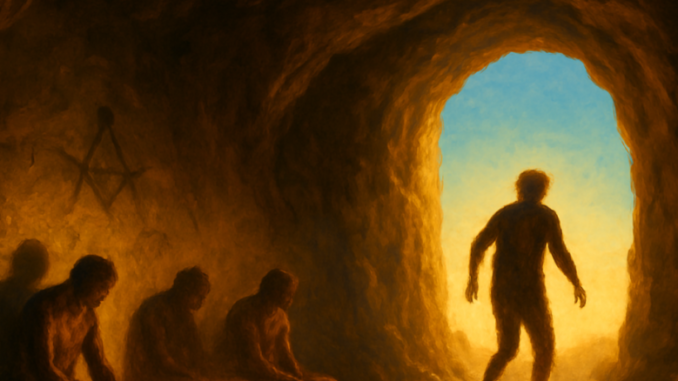
In Book VII of The Republic, Plato presents one of the most enduring images in Western philosophy: the Allegory of the Cave. Far more than an abstract thought experiment, it is a powerful metaphor for the human condition — our confinement within limited perception, the painful pursuit of truth, and the arduous path toward enlightenment. For those who walk the Masonic path, the allegory resonates with particular force: it mirrors the symbolic journey from darkness to light that lies at the very heart of the Craft.
The Setting of the Cave
Plato has his teacher Socrates describe the scene to Glaucon, one of the dialogue’s participants. Imagine, Socrates says, an underground cavern where people have been chained since birth. Their heads are fixed so they can only see the back wall of the cave. Behind them burns a fire, and between the fire and the prisoners runs a raised walkway where figures carry objects back and forth. The shadows of these objects are cast upon the wall before the prisoners’ eyes.
For these prisoners, the shadows are the only reality they have ever known. They name the shadows, they compete over who can best predict their movements and interpret their shapes. Their entire world consists of this shadow play. Plato uses this vivid image to illustrate how profoundly limited human perception can be when we have never been exposed to anything beyond our immediate experience.
The Liberation of a Single Prisoner
The story takes its dramatic turn when one prisoner is unchained. At first, this is no liberation at all — it is agony. The glare of the fire sears eyes that have only ever known shadow. The freed prisoner resists, yearning to return to the familiar darkness. But suppose, Socrates asks, that someone compels him gently upward, dragging him along the steep and rugged passage toward the cave’s mouth, out into the daylight.
Once above ground, the pain is even greater. The sunlight is utterly blinding. Only gradually do the eyes adjust. First the freed prisoner can perceive only shadows, then reflections in water, then objects themselves in moonlight, and finally — at last — the sun itself. This is the moment of true insight: the sun is revealed as the source of all light and life. In Plato’s philosophical framework, the sun represents the Form of the Good — the highest principle upon which all knowledge and existence depend.
The allegory teaches us that genuine knowledge is never simply handed over. It must be won through discomfort, through patient adjustment, and through the courage to release old certainties. Anyone who has experienced a meaningful initiation — Masonic or otherwise — will recognise this pattern intimately.
Two Perspectives: The Cave and the Daylight
Plato’s allegory invites us to compare two fundamentally different ways of being in the world. From the perspective of those still inside the cave, the shadow world is entirely coherent. They have their own experts, their own hierarchies, their own truth. Whoever reads the shadows best is considered wise. There is no reason to question this order, because no alternative is known.
From the perspective of the one who has seen daylight, everything has changed. The shadows have been unmasked as mere derivatives of something real. The sun does not only cast light — it gives warmth, sustains growth, makes life itself possible. Knowledge is no longer the naming of fleeting shapes but an understanding of the source from which all things arise. Yet this hard-won wisdom proves almost impossible to convey to those who have never left the cave.
This tension between inner knowing and the difficulty of communicating it is a theme that resonates deeply in Freemasonry. The experience of ritual, of symbolic death and rebirth, of moving from darkness into light — these are things that must be lived to be understood. No amount of explanation can substitute for the experience itself.
The Return to the Cave
Plato has Socrates pose a haunting question: what would happen if the freed prisoner returned to the cave? His eyes, now accustomed to sunlight, would struggle in the darkness. He would fumble when naming the shadows, make errors, and be mocked by his former companions. The other prisoners would declare that the journey above had ruined him. And if he tried to free them, they might very well kill him.
This passage is widely understood as a reference to the fate of Socrates himself, who was condemned to death by the citizens of Athens in 399 BCE for the crime of challenging their certainties. But it is also a universal warning: those who bring truth to people who are unwilling to hear it place themselves in danger. The allegory asks not only about the nature of knowledge, but about the responsibility that comes with possessing it — a theme that runs like a thread through Masonic teaching.
What Both Worlds Share
Despite the stark contrast Plato draws, he also reveals what the world inside and outside the cave have in common. Both the prisoners and the liberated seeker are driven by the same impulse: they look for patterns, coherence, and meaning. The difference lies not in the desire for knowledge, but in access to deeper layers of reality. The shadows are not worthless — they are a starting point, a first step on a long road.
Plato suggests that philosophy — and, we might add, the Masonic journey — consists of the gradual relinquishing of lower forms of understanding in favour of higher ones. Not by rejecting the senses outright, but by recognising that they show us only shadows of shadows. The goal is not to despise the cave, but to understand what it truly is: a preliminary stage, never a final destination.
The Enduring Relevance of the Cave
Plato’s Allegory of the Cave has inspired philosophers, theologians, and artists for over two millennia. From Augustine to modern thinkers, the image of the cave remains a potent metaphor for every situation in which human beings find themselves trapped within limited perception — whether through political propaganda, media echo chambers, or personal blind spots. Plato’s cave reminds us that reality may be far richer than what we perceive at first glance.
Consider the allegory’s key symbols and what they represent:
The shadows represent opinions, assumptions, and unexamined beliefs. The fire stands for the artificial sources that shape our worldview. The ascent symbolises the difficult journey toward genuine insight. And the sun embodies the Good — the highest principle of knowledge and truth.
For Freemasons, these symbols carry additional resonance. The journey from darkness to light is not merely metaphorical — it is ritually enacted. The working tools remind us that self-improvement is labour, not leisure. And the obligation to share what we have learned with our Brethren echoes Plato’s insistence that the philosopher who has seen the sun must return to the cave.
Plato’s Allegory of the Cave, written some two and a half thousand years ago, remains a timeless invitation to examine the boundaries of our own knowledge. It confronts us with an uncomfortable question: are we content with shadows, or are we willing to undertake the painful journey toward the light? The allegory teaches that liberation is not simply a matter of seeing — it demands the courage to accept what that seeing reveals, and all that it requires of us. And whoever has once beheld the sun carries a solemn responsibility: to guide others along the way, however thankless that task may prove. It is a responsibility that every Freemason, in their own way, has chosen to embrace.
Copyright text & image: devrijmetselaar.nl
Texts are based on the ideas and content of the author of devrijmetselaar.nl, reviewed, corrected, and supplemented with the assistance of OpenAI. Images are created based on the ideas of the author of devrijmetselaar.nl using OpenAI/DALL-E.
Frequently Asked Questions
What is Plato's Cave Allegory and why is it significant?
Plato's Cave Allegory, found in Book VII of The Republic, is a philosophical thought experiment that uses the image of chained prisoners in an underground cave watching shadows on a wall as a metaphor for the human condition. It illustrates how limited human perception can be when confined to a single perspective, and represents the journey toward truth and enlightenment. The allegory is significant because it remains one of the most enduring and powerful images in Western philosophy, addressing fundamental questions about reality, knowledge, and enlightenment.
How does the liberation of the prisoner reflect the journey toward enlightenment?
The liberation of the prisoner is a gradual and painful process that mirrors the path to enlightenment. When first unchained, the prisoner experiences agony as his eyes adjust to the fire's glare. As he is dragged toward the cave's mouth and into daylight, the pain intensifies before his vision adjusts through stages: seeing shadows, reflections, objects in moonlight, and finally the sun itself. This demonstrates that genuine knowledge cannot be simply given—it must be won through discomfort, resistance, and gradual adjustment to new realities.
What is the connection between Plato's Cave Allegory and Freemasonry?
The allegory resonates with particular force for those on the Masonic path because it mirrors the symbolic journey from darkness to light that lies at the very heart of the Craft. Both Plato's allegory and Masonic teachings use the metaphor of moving from darkness to illumination as a representation of spiritual and intellectual awakening, making the ancient philosophical text especially relevant to Masonic philosophy and practice.

Be the first to comment