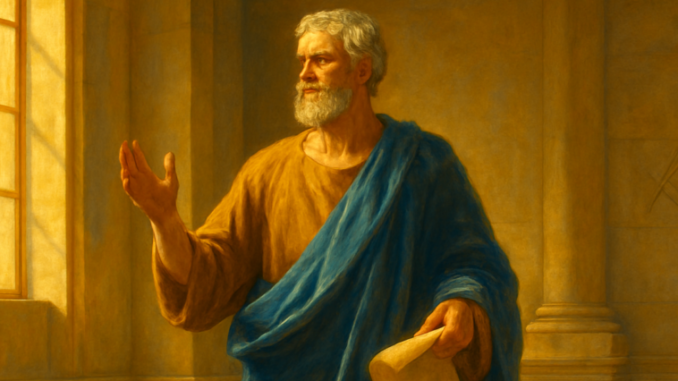
Can a person truly come to know themselves without withdrawing from the world? And is the company of others a distraction — or an enrichment? In his fifty-fifth letter to Lucilius, Lucius Annaeus Seneca explores a paradox that every Freemason will recognize: the tension between the silence of the inner chamber and the warmth of brotherhood. This essay places Seneca’s reflections in their philosophical context and reveals how Stoic insights on solitude and community still resonate powerfully within the ritual space of the lodge.
The Stoic Tradition as Foundation
Seneca wrote his letters from within a rich intellectual heritage. The Stoic school, founded by Zeno of Citium around 300 BCE, had already spent generations contemplating the relationship between the individual and the community. For the Stoics, every person was a cosmopolitan — a citizen of the world — inseparably connected to all of humanity and yet called to cultivate inner freedom. This tension between communal responsibility and self-sufficiency forms the backbone of Letter LV.
Seneca built on the work of Chrysippus and Cleanthes, but also on Roman predecessors such as Musonius Rufus. What distinguished him was his remarkable ability to translate abstract philosophy into the art of living. Where earlier Stoics sometimes leaned toward strict withdrawal from society, Seneca sought balance. He acknowledged that solitude is essential for self-reflection, but warned that complete isolation can lead to a withering of the soul.
Epicurus as an Unexpected Dialogue Partner
One of the most striking aspects of Seneca’s letters is his willingness to look beyond the boundaries of his own philosophical school. Throughout his correspondence, he frequently quotes Epicurus — a philosopher who was traditionally considered a rival of the Stoics. Epicurus taught that friendship is among the highest goods, yet also maintained that the wise person is sufficient unto themselves. This apparent contradiction fascinated Seneca. In Letter LV, we hear echoes of the Epicurean idea that one should not seek the company of many, but rather the company of the few who genuinely contribute to the growth of the soul.
True solitude is not an escape from the world, but a return to the core of who you are — so that you may become company of real value to others.
Seneca transcends sectarian thinking here. He demonstrates that wisdom is not the exclusive property of any single school, but that the search for the good life is a shared human endeavor. This ecumenical spirit is something we also recognize in Freemasonry, where brethren from widely different religious and philosophical backgrounds come together around shared principles.
The Villa of Vatia: A Philosophical Metaphor
In Letter LV, Seneca describes a visit to the villa of Vatia, a former consul who had withdrawn entirely from public life. The ruinous state of the estate serves as a powerful philosophical metaphor. Seneca poses the essential question: did Vatia truly live, or did he merely hide? The distinction between active retreat and passive flight stands at the heart of Seneca’s argument.
This reflection touches on a theme that preoccupied Plato and Aristotle as well. Plato described in his Allegory of the Cave how the philosopher must withdraw in order to behold the light, but must then return to the community. Aristotle emphasized that the human being is a zōon politikon — a social creature who can only reach full flourishing within a community. Seneca balances between these positions: solitude is not an end in itself, but a means of returning to others better equipped and more fully formed.
The Lodge as a Training Ground for the Soul
For the Freemason, Seneca’s meditation takes on a particular and deeply personal resonance. The Chamber of Reflection, where the candidate sits in silence before initiation, symbolizes precisely that necessary solitude. It is a moment of confrontation with oneself, stripped of external roles and expectations. Only after this inner work does the candidate enter the lodge, where the brotherhood awaits.
The Masonic ritual thus mirrors the very movement Seneca describes: from isolation to community, from introspection to connection. The square and compasses — central symbols of the Craft — may be understood in this context as tools that work upon both the inner person and the relationship to others. The square reminds us of rectitude toward our fellow human beings; the compasses remind us to keep our passions within due bounds.
Plutarch and the Art of Listening
Another thinker whose ideas color Seneca’s reflections is Plutarch, although he lived slightly later. Plutarch wrote extensively on friendship and the art of listening. His emphasis on being receptive to others aligns closely with Seneca’s view that company is only truly valuable when it contributes to mutual improvement. In the lodge, this principle finds expression in the silence of the Entered Apprentice, who learns to listen before he speaks — a discipline that echoes across centuries of philosophical and Masonic tradition.
Key Themes in Philosophical Perspective
Several major philosophical concepts converge in Letter LV, each carrying significance for the thoughtful Freemason:
Autarkeia — the Stoic ideal of self-sufficiency. The ability to stand alone with one’s own thoughts and conscience, not out of pride, but out of inner strength.
Cosmopolitanism — the understanding that every human being is a citizen of the world, carrying obligations toward all of humanity, not merely toward one’s immediate circle.
Philia — friendship as a virtue and a training ground for the soul. Not mere social pleasantry, but a genuine commitment to each other’s moral and spiritual growth.
Otium — fruitful rest as opposed to empty busyness. The Stoics distinguished sharply between leisure that cultivates wisdom and idleness that merely wastes time.
These themes come together in Letter LV to form a nuanced argument: the wise person seeks solitude not to flee, but to return to the community enriched and better prepared to serve. It is precisely this movement that the Freemason recognizes in his own path of self-improvement within the circle of his brethren.
Seneca’s fifty-fifth letter does not offer a simple choice between solitude and companionship. Instead, it presents a philosophical exploration of how each presupposes and strengthens the other. The Stoic tradition, enriched by Epicurean and Platonic insights, provides a reliable compass for navigating this territory. For the Freemason, there is a familiar echo in this ancient wisdom: the Chamber of Reflection and the illuminated lodge are not opposites, but successive steps on the path toward true humanity. The darkness prepares us for the light, and the silence prepares us for the word — just as the solitary labor on the rough ashlar prepares us for meaningful fellowship within the Craft.
Copyright text & image: devrijmetselaar.nl
Texts are based on the ideas and content of the author of devrijmetselaar.nl, reviewed, corrected, and supplemented with the assistance of OpenAI. Images are created based on the ideas of the author of devrijmetselaar.nl using OpenAI/DALL-E.


Be the first to comment