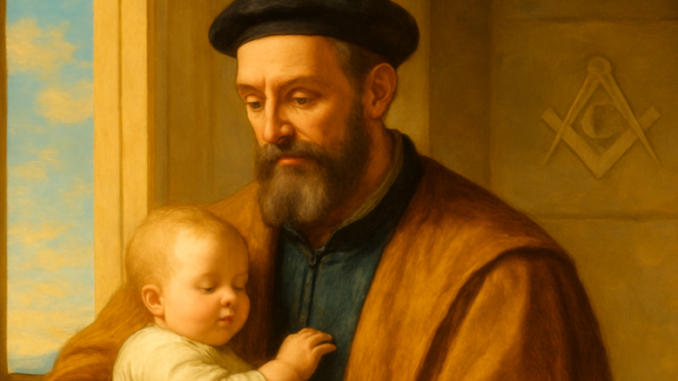
What does it truly mean to be a father — not merely in the biological sense, but as a spiritual creator? In the eighth essay of the second book of his famous Essays, Michel de Montaigne tackles a question that is both deeply personal and universally human: why do fathers love their children, and is that love always returned? Going far beyond sentimentality, Montaigne explores the hidden forces behind parental attachment and draws a striking comparison between two forms of fatherhood — the physical and the intellectual. It is a comparison that resonates powerfully within Freemasonry, where the question of what a person truly leaves behind lies at the heart of the Craft.
Love as a Natural Impulse
Montaigne opens his essay with the proposition that parental affection is one of the most natural feelings a human being can experience. He regards it as a universal given, woven into human nature and observable even in the animal kingdom. Yet Montaigne is no romantic. He asks whether this affection is always reasonable, whether it sometimes degenerates into blind adoration, and whether fathers truly know their children or merely see a projection of themselves.
The essay is dedicated to Madame d’Estissac, a widow who raised her son with exemplary devotion. Montaigne praises her balanced approach to parental love while warning against fathers who treat their children as possessions, withhold resources out of fear of losing control, or show affection only when it serves them. He draws on classical thinkers to support his arguments. Aristotle, for instance, observed that the giver always loves more than the receiver — just as an artist is more attached to his work than the work could ever be to the artist.
Two Forms of Fatherhood: Body and Spirit
The most remarkable distinction Montaigne draws is between biological fatherhood and intellectual fatherhood. A man can beget children, but he can also bring forth works: books, ideas, art. Montaigne openly asks which form of creation is more valuable. He confesses that he is at least as attached to his own essays as he is to his children. The intellectual offspring, he argues, springs entirely from the father’s own mind and soul, while the biological child is the product of two parents and will inevitably develop a will of its own.
Here we hear echoes of Seneca, who stressed the primacy of the inner life over outward possessions, and of Plato, who in the Symposium elevated the creation of spiritual progeny above the production of physical heirs. Montaigne’s aim is not to diminish parenthood but to broaden it: whoever creates something that outlasts their own lifespan practices a form of immortality.
What the Outsider Sees and What the Initiate Recognizes
For a reader unfamiliar with Freemasonry, Montaigne’s essay reads as a wise meditation on parenthood and creativity. But those acquainted with the Masonic tradition will recognize a deeper pattern. In Freemasonry, building is central — not as a physical act, but as a metaphor for personal and spiritual development. The Freemason works on himself as a stonecutter shapes a rough ashlar, with the ultimate goal of leaving behind something greater than his own existence.
Montaigne’s distinction between physical and spiritual fatherhood aligns closely with the ritual path a Freemason walks. The Entered Apprentice receives knowledge, the Fellow Craft processes and refines it, and the Master Mason transmits it to others. This cycle of receiving, shaping, and passing on is essentially the same process Montaigne describes: the creator gives something of himself in the hope that it will live on and bear fruit. The legend of Hiram Abiff, the master builder of King Solomon’s Temple, embodies precisely this ideal — the masterwork survives the master.
According to Montaigne, the noblest form of fatherhood is not the begetting of children but the creation of something that transcends one’s own lifespan: a thought, a work, an attitude toward life that inspires others long after the creator is gone.
The Pitfalls Montaigne Exposes
Montaigne is far from purely lyrical about fatherly love. He explicitly warns against three pitfalls that parental affection can fall into:
Possessiveness: Fathers who regard their children as property and deny them the space to become independent individuals. This clinging grip stifles growth rather than nurturing it.
Avarice: Aging fathers who cling to their wealth out of fear of dependency, leaving their children in poverty while abundance sits locked away. Montaigne saw this as a betrayal of the parental bond.
Vanity: Parents who seek only a mirror of themselves in their children and feel disappointed when the child chooses its own path. True love, Montaigne insists, must allow for difference.
With these warnings, Montaigne reveals himself as a sharp observer of human weakness. He advocates a love that lets go, that trusts, and that acknowledges the child as an autonomous being. This ideal of generosity without expectation will be instantly recognizable to anyone who has encountered the Masonic principle of brotherly benevolence: give without demanding, build without claiming ownership.
What Both Worlds Share
Whether one reads Montaigne’s essay as a philosophical treatise or as a mirror for Masonic values, the same fundamental note sounds throughout. Both the philosopher and the Freemason recognize that true creation is an act of surrender. The child, the book, the idea, the ritual — they only truly come alive when the creator is willing to release them and entrust them to the world.
Montaigne found comfort in the thought that his essays would outlive him. The Freemason finds a similar consolation in the knowledge that the temple he builds is not made of stone but of shared values and transmitted insights. The work endures not because it is held tightly, but because it is given freely.
Essay II,8 is far more than a meditation on fatherhood. It is an invitation to reflect on what we create, how we love, and what we ultimately leave behind. Montaigne reminds us that the greatest legacy is not what we possess but what we set free — a truth that lies at the very heart of the Masonic journey. Whether you are a student of philosophy or a Brother on the path, the message is the same: build something worthy, love it enough to let it go, and trust that it will continue to shape the world long after you have laid down your tools.
Copyright text & image: devrijmetselaar.nl
Texts are based on the ideas and content of the author of devrijmetselaar.nl, reviewed, corrected, and supplemented with the assistance of OpenAI. Images are created based on the ideas of the author of devrijmetselaar.nl using OpenAI/DALL-E.

Be the first to comment